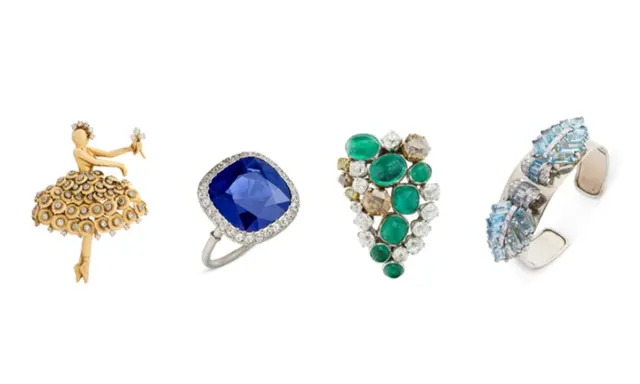
Phillips has previewed its New York Jewels Auction for 10 December 2026, bringing together signed jewellery, gems and pieces associated with figures from the performing and visual arts. The auction house's announcement of 12 November highlights works from Bulgari, Cartier, Buccellati and Verdura, with a notable group of jewels formerly belonging to opera singer Virginia Zeani. The sale offers an interesting contrast between the characteristics of important gemstones and the artistic or historical qualities that can distinguish a signed object. For a collector assembling jewellery to enjoy across a private residence, yacht and international travel programme, these are separate but complementary considerations.
The cultural history of a jewel
A gemstone can be assessed in relation to its physical qualities, but the history of a particular piece of jewellery may offer another reason to acquire it. The identity of its designer, the period in which it was made and evidence of its previous ownership can help distinguish it from another object containing comparable materials.
The sale includes jewellery associated with Zeani and her husband Nicola Rossi-Lemeni, both prominent opera singers of the twentieth century. This provides a particularly direct link between the decorative and performing arts. A prospective buyer with an interest in opera might therefore consider the pieces within a wider collection of material connected with the theatre. The auction house's attribution is an important starting point, but the original provenance documents and any supporting evidence should be examined as part of the acquisition process.
Bulgari and Virginia Zeani
Phillips identifies a Bulgari brooch and earring set among the principal highlights from Zeani's collection. Her international career included appearances at La Scala, Covent Garden and the Metropolitan Opera, giving the association a significance beyond a local history of ownership. The jewellery is a tangible connection with a period in which the public image of a performer could be closely associated with personal style.
For a collector, a brooch and earrings can also be understood as a group of related objects. Their relationship may be part of the interest of the acquisition rather than merely a convenient way of presenting them together. It is useful to examine whether the pieces retain their original components and whether their condition and fittings make them suitable for the owner's intended use. Historical associations do not remove the need for a practical assessment of an individual jewel.
Aldo Cipullo's Flowing Forms
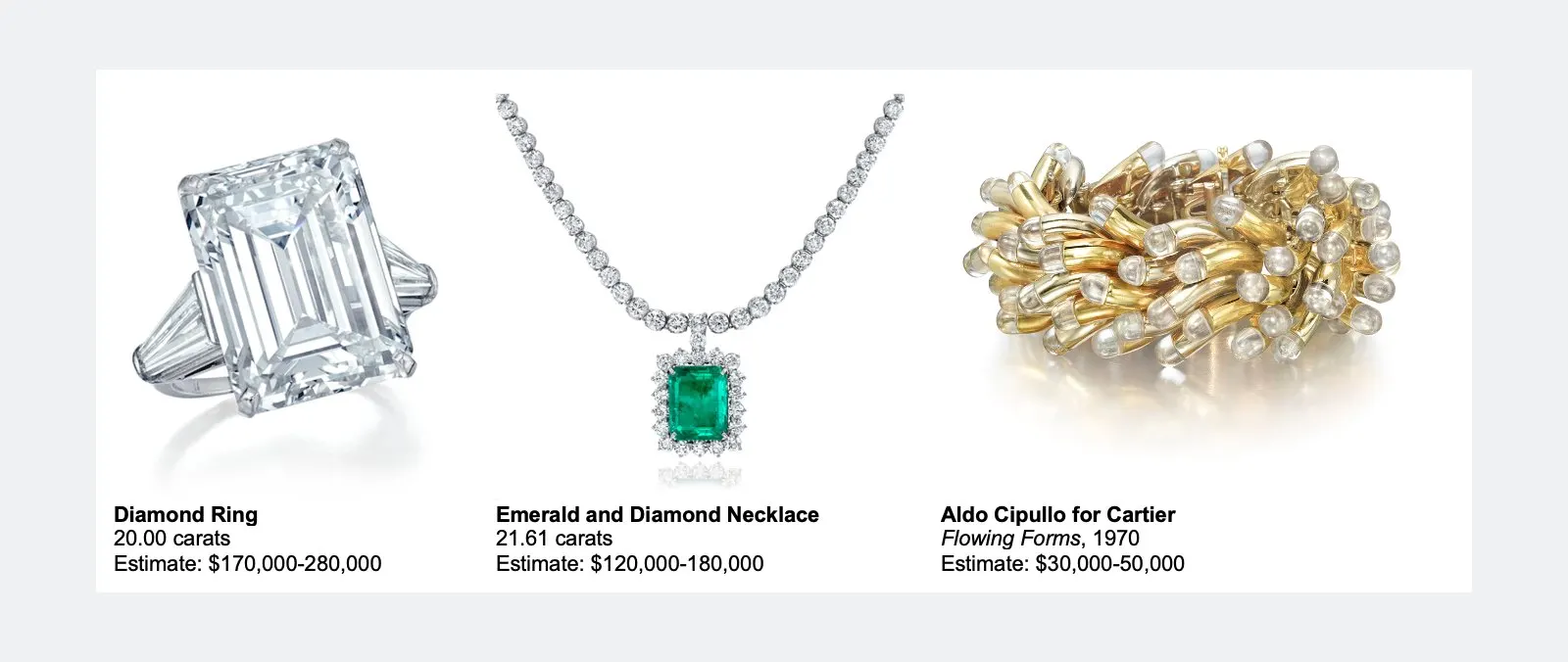
Lot 26 in the auction catalogue is a rock crystal and gold bracelet made by Aldo Cipullo for Cartier in the 1970s, identified as Flowing Forms. Its estimate is $30,000 to $50,000. Phillips relates the piece to Cipullo's first collection for the house, which gives the object a particular place in the development of his work.
Rock crystal permits a designer to explore transparency and the relationship between a relatively understated material and a gold structure. The light passing through it can create an effect very different from that of a jewel whose visual emphasis is derived from an opaque coloured stone. In a sunny coastal setting, the appearance of a crystal jewel may also change markedly as it moves between shaded and brightly illuminated spaces. The fit, condition and vulnerability of the actual bracelet should be established before assuming that it will be comfortable for frequent wear.
Verdura and the Dede Moss collection
A number of works from the collection of philanthropist Diane Dede Moss are included in the auction. The catalogue identifies a limited-edition Verdura Maltese Cross cuff numbered 54 from a production of 70. It is made in 18-carat yellow gold with off-white enamel and a group of coloured stones, including a cabochon amethyst, emeralds and several other gems. The auction house describes an inner circumference of approximately six inches.
The contrast between the pale enamel, the gold structure and the concentrated colour of the stones is central to the design. The cross provides an organising motif around which several different materials can be combined. A collector should consider the condition of the enamel and the security of the settings as well as the integrity of the signature and edition number. The circumference is also meaningful because a substantial rigid cuff may have a more restricted fit than a flexible bracelet.
Smaller signed objects in the same collection
Lot 62 is a pair of Verdura Wrapped Pearl ear clips from the Moss collection, estimated at $7,000 to $9,000. The combination of cultured pearls and diamonds creates a different relationship between softness of appearance and reflected light from that of the enamel cuff.
The inclusion of several works associated with the same collector provides an opportunity to consider how one person's tastes developed across different designs and occasions. It can also help a new collector identify individual pieces that suit an existing collection without necessarily pursuing its most valuable lot. The purchase should nevertheless be assessed independently. A shared previous owner does not mean that each jewel has the same degree of rarity, condition or suitability for the person who will wear it.
The Buccellati approach to surface
Phillips also identifies a group of Buccellati works as an important element of the sale. Jewellery associated with the house is of interest to collectors who appreciate the relationship between goldsmithing and the fine textures created on the surface of metal. The workmanship can be as important to the character of a piece as the size of any individual stone.
When examining a jewel with a highly worked surface, a collector should pay attention to the preservation of the original finish. Repairs, later polishing and wear can alter the appearance of a design in ways that may not be immediately apparent in an overall photograph. A close examination under suitable lighting, together with the auction house's current condition information, will provide a more useful basis for a decision than an assumption derived from the manufacturer's reputation.
Intaglios and the visual arts
The auction house's announcement refers to neoclassical intaglios associated with Prince Stanislas Poniatowski of Poland and a Henryk Kaston brooch created for Salvador Dalí. These subjects broaden the auction beyond contemporary perceptions of jewellery as a collection of gemstones. An intaglio involves an image cut into a surface, while an artist-associated brooch can carry its own significance within the broader history of visual art.
Pieces with strong historical or artistic associations can appeal to collectors who might not otherwise concentrate on jewellery. Their value may depend on the authenticity of an inscription or attribution, the survival of earlier records, and the relationship between the object and the work of a particular artist. It is especially important not to treat a catalogue association as proof of every possible claim about the item's creation or history.
The twenty-carat diamond ring
The sale also includes a 20.00-carat emerald-cut diamond ring. The stepped geometry associated with an emerald cut produces broad areas through which the interior of the stone can be examined. Its appearance differs from that of cuts designed to create a more concentrated pattern of sparkling reflections. Phillips highlights the ring alongside an emerald and diamond necklace and a natural fancy yellow diamond tennis bracelet.
A buyer considering an important diamond should review the actual laboratory documentation and confirm that its identifying details correspond with the stone offered. Carat weight alone does not establish quality or value. Colour, clarity, proportions and any relevant treatments or disclosures must be considered in the context of the individual gemstone. No independent grading of the ring has been performed for this article.
Collecting for life afloat and ashore
The practical circumstances of wearing valuable jewellery differ between formal occasions, coastal travel and time spent on a yacht. Salt water, sun protection products, movement and contact with equipment can affect different materials and settings. Pearls, enamel, rock crystal and precious metal surfaces have their own care requirements. An owner should obtain specific professional advice rather than assume that every piece can be worn during all activities.
Storage and insurance are equally significant. A collection intended to travel internationally should be documented and covered for the actual circumstances of its use. The terms of an insurance policy may distinguish between storage at a permanent residence, transport and periods spent aboard. It can be sensible to choose particular pieces for particular occasions rather than carry the entire collection on every journey. These considerations are part of ownership and should be addressed before acquiring a valuable item.
The December viewing and sale
Phillips plans public viewing at 432 Park Avenue from 5 to 9 December, with the live auction on 10 December and an additional online sale from 4 to 15 December. The official live catalogue provides the individual descriptions and estimates. Estimates are not sale results and buyers should allow for premiums, taxes and other relevant costs.
Luxury Yacht Guide has not inspected or independently valued any of the jewels. The information is drawn from Phillips' announcement and its published catalogue, and the accompanying press image is attributed to the auction house. The sale demonstrates the breadth of a jewellery collection that can combine exceptional materials, identifiable designers and the personal histories of people whose lives were associated with the arts.
Explore related Luxury Yacht Guide lifestyle reporting
- Sotheby’s Geneva Fine Jewelry Auction Opens 30 October with Cartier and Bulgari
- Christie’s Hong Kong Jewels Sale Pairs an 8.41-Carat Pink Diamond With a Cartier Ruby
- Doloni Brings Ukrainian Jewellery and Craft to Design Miami 2026
- CADAR Brings Circle of Light and Spark to Design Miami 2026
Primary reporting and image credit
Primary manufacturer and organiser source(s): https://www.phillips.com/press/release/rare-signed-pieces-from-cartier-buccellati-verdura-and-bulgari-to-lead-phillips-december-jewels-auction. Phillips; official press-release jewellery artwork. Image is used only for correctly attributed factual editorial coverage and never represented as open-licence stock photography.