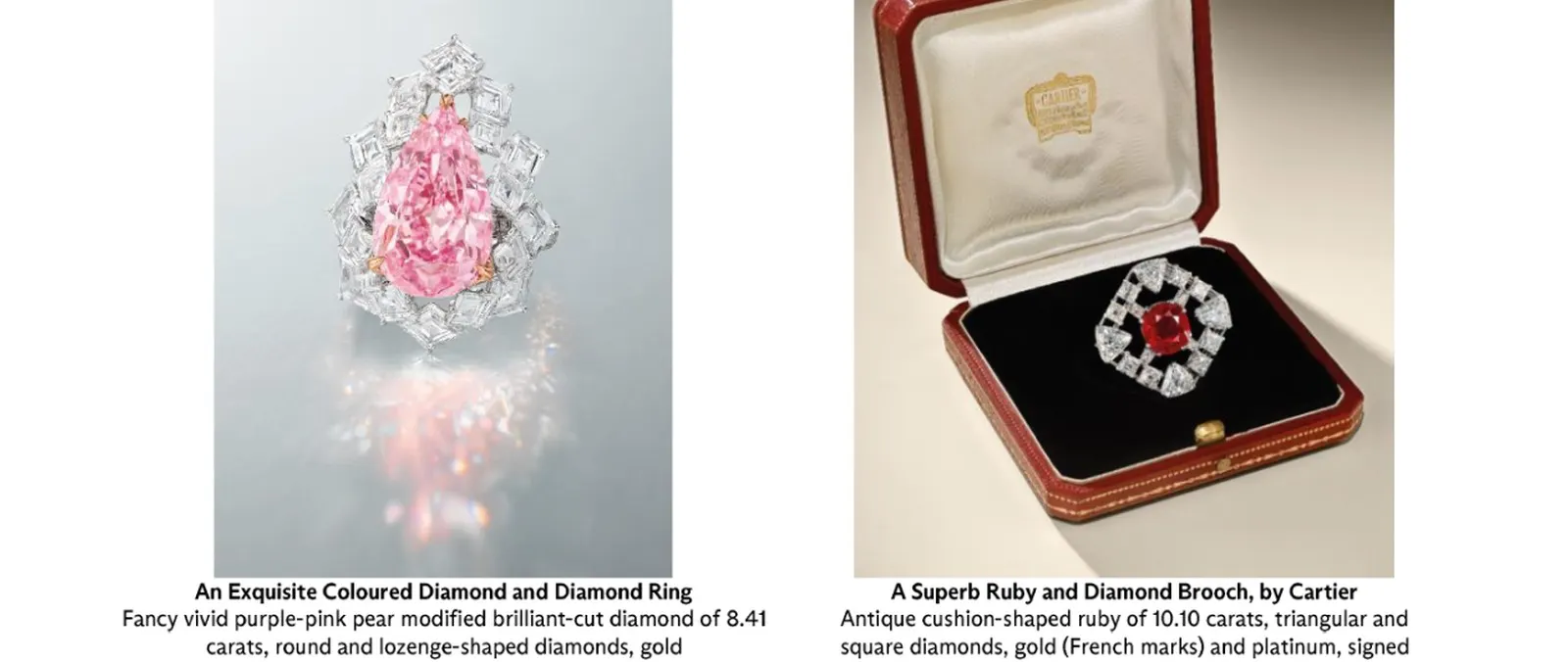
Christie’s Hong Kong has revealed two leading jewels for its November 24 Magnificent Jewels auction, placing an 8.41-carat fancy vivid purple-pink diamond ring beside a 10.10-carat ruby and diamond brooch by Cartier. The sale forms part of Hong Kong Luxury Week and will also include coloured gemstones, jadeite, natural pearls and signed jewellery.
The pairing illustrates two different reasons collectors compete for exceptional jewels. The pink diamond is driven by extreme natural rarity, while the Cartier brooch combines an important ruby with identifiable design and workshop provenance.
The purple-pink diamond belongs to a rare Type IIa category
The 8.41-carat stone is classified as Type IIa, a category associated with very low nitrogen content and often exceptional transparency. Fancy vivid is the highest commonly encountered saturation grade in coloured-diamond auctions, and the addition of a purple modifier makes the colour profile especially unusual.
Large rough pink diamonds are rare before cutting even begins, so producing a finished stone above eight carats with strong saturation requires both extraordinary material and careful planning. Collectors therefore evaluate size, hue, saturation, clarity and cut together rather than using one characteristic alone.
Pink diamonds occupy a distinct place in the market
The closure of major sources such as Australia’s Argyle mine has intensified awareness of supply constraints, even though important pink stones also come from elsewhere. Auction records have shown that collectors are prepared to compete strongly when a stone combines size with vivid colour and credible certification.
For jewellery buyers, these diamonds can function both as wearable objects and as portable stores of rarity. That dual identity helps explain why coloured stones attract interest from collectors who may also participate in art, watches and other high-value categories.
Cartier adds design history through a 10.10-carat ruby
The second headline lot is a ruby and diamond brooch by Cartier centred on a 10.10-carat stone. Important rubies are evaluated through colour, origin, treatment and transparency, while signed mounting can add a separate layer of desirability.
A Cartier brooch brings the object into the history of twentieth-century jewellery design. For collectors, the combination of a major gem and a recognised maison can create stronger appeal than an unsigned stone of similar quality because authorship and craftsmanship remain visible.
Hong Kong Luxury Week attracts cross-category collectors
The November sale is positioned inside a wider programme of luxury auctions, allowing jewellery buyers to move between watches, handbags, wine and other categories. Many high-end collectors already operate this way, building collections around design and rarity rather than one specialist field.
Hong Kong’s concentration of regional wealth and international clients continues to make it a natural location for major jewellery. Physical previews are especially valuable because subtle colour differences in diamonds and rubies are difficult to understand fully through screens.
The strongest jewels combine material and narrative
A great gemstone can stand on rarity alone, but auctions become more compelling when the object also carries a design story. Christie’s two headline lots demonstrate that contrast clearly: one is dominated by geological scarcity, while the other adds the history of Cartier to an exceptional ruby.
For buyers, the decision will depend on whether they prioritise the pure rarity of a coloured diamond or the combined qualities of gemstone, design and signed manufacture. Both routes lead to objects intended to remain significant well beyond one season’s auction calendar.