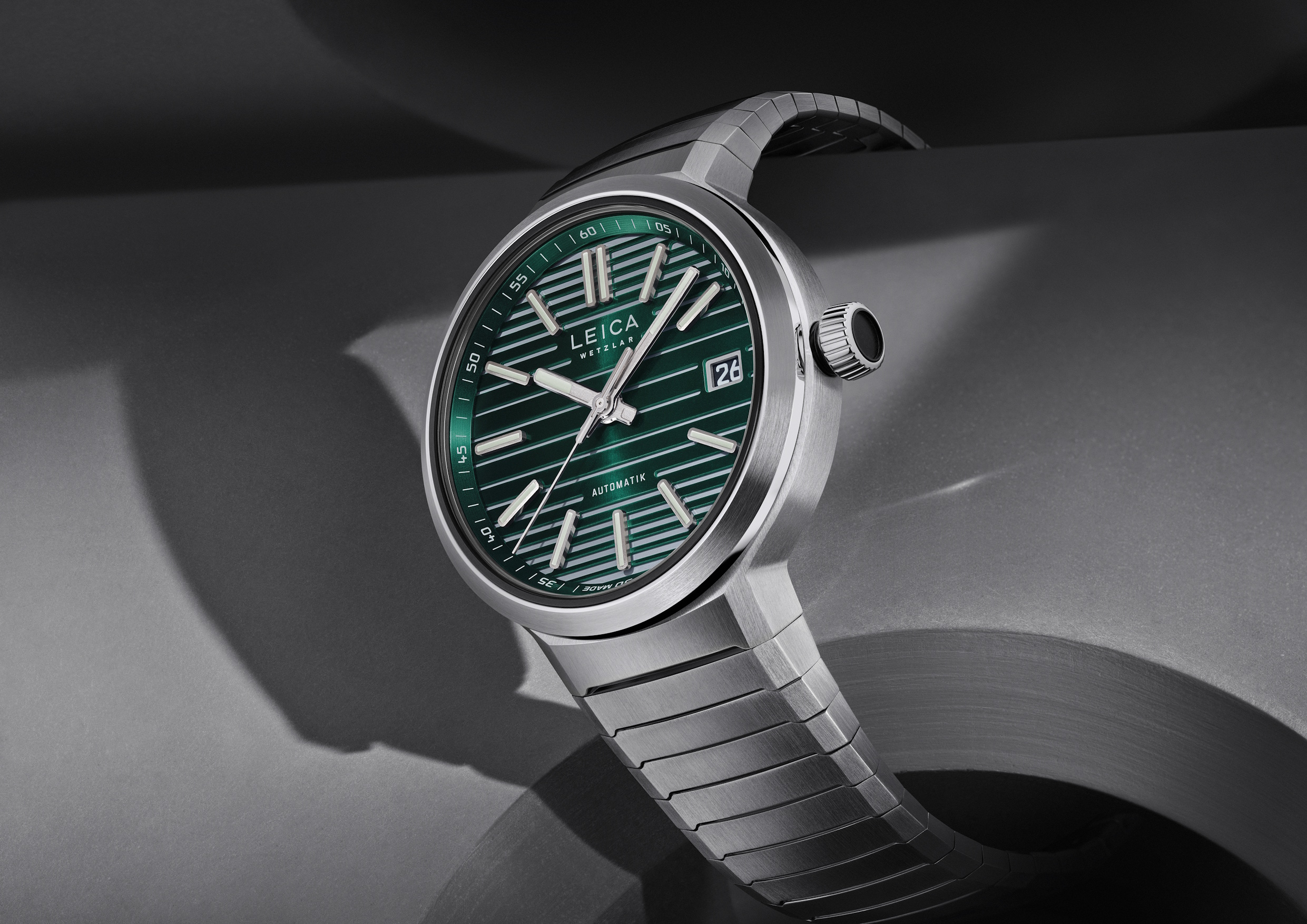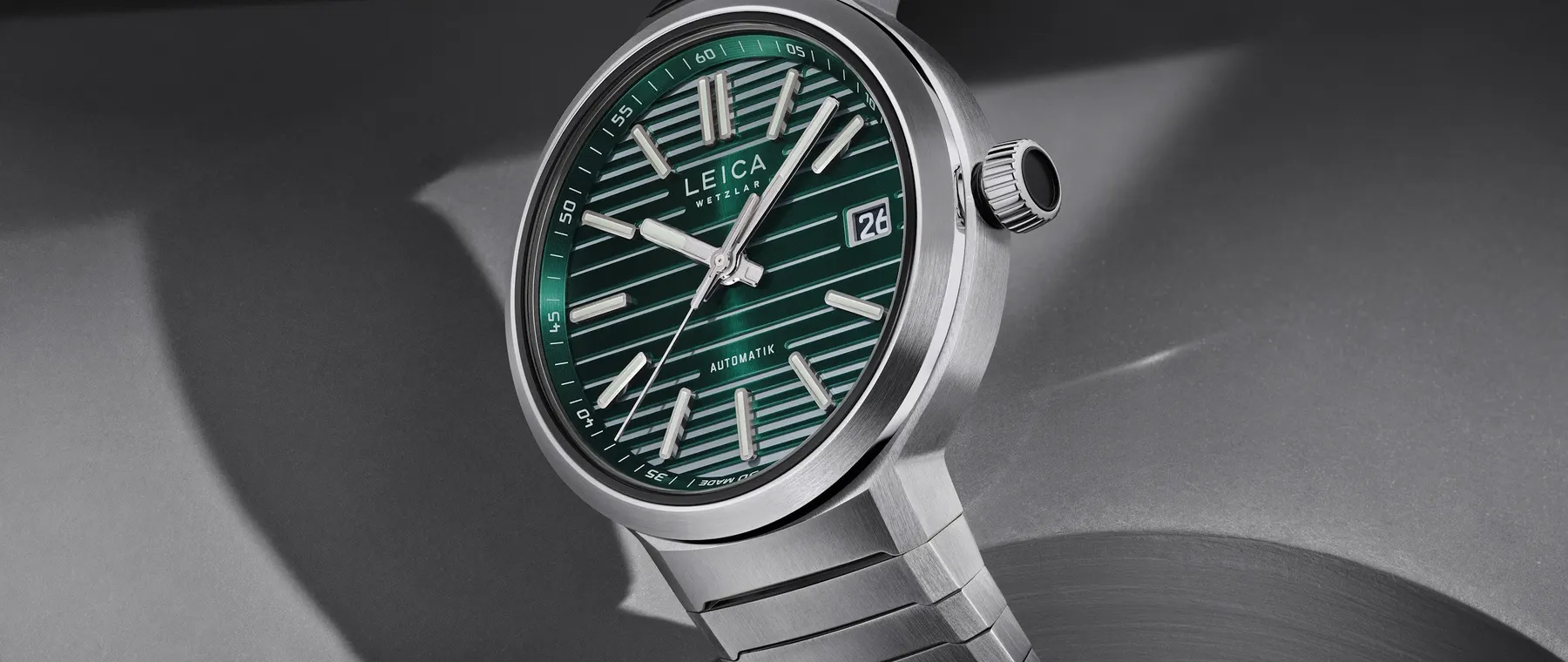
Leica Camera has added a distinctive colour-changing dial to its ZM 11 watch collection. Introduced in Wetzlar on 17 November 2026, the Leica ZM 11 Green Spirit combines a layered green dial that appears to shift towards grey as the viewing angle changes with a self-winding Swiss movement developed in cooperation with Chronode. The watch is housed in a 41-millimetre stainless-steel case and carries a recommended retail price of approximately €6,800 including VAT, depending on configuration. For enthusiasts who collect fine cameras as well as mechanical watches, it is an intriguing example of a company using the language of photography—light, perspective and precise engineering—to establish a recognisable approach to horology.
A design rooted in the behaviour of light
The first thing Leica wants observers to notice is the changing appearance of the ZM 11 Green Spirit dial. The company describes a dual-layer construction that gives an impression of depth, with the visible colour shifting from green towards stark grey depending on perspective. This is not described as an electronic display, nor is it a mechanism that physically rotates a colour filter. The impression comes from the interaction between the dial surfaces and ambient light. Its appeal is therefore best judged in person, where movement of the wrist and changing illumination reveal effects that a still photograph may not reproduce. The concept resonates with anyone who has spent time looking at how a photographic subject changes as the light moves.
Photography and watchmaking share a visual vocabulary
Both camera and watch design involve more than technical specifications. Carefully formed surfaces, tolerances, tactile controls and the legibility of small details shape how an object is used. Leica has a long association with photographic equipment built around a deliberately restrained industrial aesthetic. Its watch collection extends that approach into a product that is constantly in view on the wrist. The connection should not be overstated: a mechanical watch is not a camera, and the quality of one does not automatically prove the quality of the other. Yet the company's emphasis on clarity, material finishes and a change in perspective gives the ZM 11 a coherent design story. Collectors can assess whether the actual object supports that narrative.
The proportions of a 41-millimetre case
The ZM 11 Green Spirit uses a stainless-steel case measuring 41 millimetres, a size that many collectors will recognise as contemporary rather than unusually small. Case diameter is only one factor in how a watch wears. Lug shape, case thickness, strap flexibility and the distribution of weight can make two similarly sized watches feel very different. The original Leica release does not provide every measurement needed to predict a universal fit. Someone choosing the watch should therefore consider a personal fitting, especially if they intend to wear it regularly rather than keep it as a collectible. The green-grey dial may appear more dramatic on a wrist than in a display case, reinforcing the value of seeing it in changing light.
A self-winding movement with Swiss connections
At the centre of the watch is Leica Boutique calibre LA-3001, which the company developed together with Swiss watchmaker Chronode. Leica quotes a power reserve of 60 hours and a target timekeeping accuracy of minus four to plus six seconds per day. It says accuracy testing was conducted in five positions, reflecting the importance of orientation to mechanical watch performance. These are manufacturer specifications, not independent test results for a particular customer's example. Actual timekeeping can vary with condition, use and maintenance. The technical interest lies in a movement designed to meet a defined standard while fitting the watch's particular identity. Collectors should ask about the service network and support arrangements as carefully as they study the published specifications.
Why a power reserve matters
A 60-hour power reserve means that, when fully wound under appropriate conditions, the mechanism is designed to run for roughly two and a half days without additional winding. For someone rotating between several watches, that can be a useful convenience. A self-winding watch normally receives energy from the wearer's movement, but it will stop if left unused beyond its stored reserve. The quoted figure is not a guarantee that an unworn watch will maintain exactly the same rate throughout the entire interval. Mechanical movements also need periodic servicing, and conditions such as strong magnetic fields or impacts may affect performance. A conscientious owner can enjoy the convenience while recognising the continuing responsibilities of mechanical ownership.
Small components and surface finishing
Leica's announcement refers to approximately thirty-five jewels within the movement and to finishing methods including sandblasting, brushing and polishing. In a mechanical watch, jewels serve as functional bearings at locations where friction and wear matter, rather than as conventional decorative gemstones. Their number should not be treated as a simple measure of superiority. The finishing of components can add aesthetic interest, though some details are primarily visible during servicing or through appropriate observation. The more meaningful question is how the movement was designed and made to perform over time. A premium watch combines visible craft with hidden engineering, and the manufacturer's documentation should allow a collector to understand both.
Legibility is a practical design decision
A beautiful dial that is difficult to read would be a poor outcome for a watch intended for regular use. Leica has addressed legibility with brushed indices whose edges are polished and filled with Grade A Super-LumiNova, while the hands use diamond-cut and facetted surfaces with different finishes. These details allow light to catch the display in changing conditions and provide luminescent assistance in darker surroundings. They also create a relationship between the watch's visual drama and its ordinary purpose. The effectiveness of luminous material depends on prior exposure to light and other conditions. Buyers should not mistake promotional imagery for a guarantee that the watch will remain equally bright throughout a long night.
The Red Dot becomes a practical control
One of the more distinctive details is Leica's Easy Change System for the strap. Inspired by the lens-release mechanism of the company's cameras, it allows the wearer to change the watch's appearance by pressing the Red Dot. The design is intended to make strap changes convenient without turning them into a complicated workshop operation. It may also appeal to collectors who regularly coordinate a watch with different occasions. However, buyers should confirm which straps are compatible and whether specific accessories are included with the version being purchased. A quick-change mechanism should be used according to the manufacturer's instructions, especially when a watch will be exposed to water, movement or other demanding conditions.
A green dial with more than one personality
Green has become a familiar choice in contemporary watch design, but Leica's execution is intended to avoid dependence on a single uniform colour. The changing appearance gives the ZM 11 Green Spirit a more dynamic visual character. Depending on light and viewing angle, the same watch may appear expressive or restrained. This can be appealing to someone who wants one timepiece to work with a range of clothing rather than owning several purely decorative variants. Yet perception remains subjective. Different people may notice different tonal changes, and photographs taken under controlled studio lighting can emphasise particular effects. An in-store viewing is the best way to decide whether the design feels satisfying in normal use.
Materials and the question of durability
A stainless-steel case is a practical choice for a watch intended to be worn regularly, but it is not impervious to scratching or damage. Leica describes the case as waterproof without specifying every detail of its practical rating in the announcement reproduced here. A buyer should review the manufacturer's documentation before swimming, diving or wearing the watch during demanding activities. The same caution applies to straps and seals. An elegant case finish can be altered by repeated hard contact, and mechanical movements require protection from severe shocks. A luxury object benefits from careful use, not from assuming that the presence of premium materials makes it indestructible.
The price positions it among serious mechanical watches
Leica lists a recommended retail price of approximately €6,800 including VAT, depending on the version. That places the Green Spirit firmly within the market for premium mechanical watches, where buyers can compare many established Swiss, German and independent makers. Price alone does not settle the question of value. A prospective owner may care most about the movement, dial design, rarity, manufacturer heritage or quality of support. Leica's camera identity is a distinctive reason to consider the watch, but it should not displace normal due diligence. Buyers should examine warranty coverage, authorised sales channels, return conditions and servicing arrangements before committing. Future resale value should never be assumed from a launch announcement.
A watch for people interested in visual craft
The Green Spirit is likely to attract someone who appreciates how precision objects are designed rather than someone buying solely for a prominent brand mark. Leica owners may recognise the Red Dot and the relationship with camera controls. Watch enthusiasts may instead focus on the LA-3001 movement, the layered dial and the finishing. Both perspectives are legitimate. Collecting can be more rewarding when a person understands what makes an object distinctive and can explain why it appeals to them. The watch should be considered within its own category rather than treated as a free accessory to the company's cameras. Its performance and comfort must stand on their own.
A luxury traveller's everyday companion
For people who divide their year between major cities, coastal destinations and life aboard yachts, a mechanical watch can become a constant personal object. It may accompany formal dinners, airport transfers and days spent exploring unfamiliar places. The Green Spirit's visual adaptability could suit that range, though the wearer should select appropriate straps and respect the manufacturer's limitations on exposure to water and impact. A yacht owner's interest in precision engineering may also extend naturally to photography and horology. The connection is one of curiosity, not a technical claim that watch accuracy and marine navigation require the same equipment. Modern navigation depends on appropriately certified systems rather than a fashion-oriented wristwatch.
A new perspective on the ZM 11
The ZM 11 Green Spirit is notable for placing the changing behaviour of light at the centre of its design. Leica has combined a layered green-grey dial, a 41-millimetre steel case, a movement developed with Chronode and a strap-release detail recalling its photographic heritage. The watch is available through selected official channels from 17 November 2026, subject to local stock and pricing. Its success will depend on whether collectors find its real-world finish, comfort and engineering as compelling as the concept. For those who appreciate watches as functional objects and expressions of industrial design, it offers an interesting new reason to examine the relationship between photography and fine watchmaking.
Sources and image credits
Reporting based on Official primary press announcement — https://leica-camera.com/en-US/press/leica-zm-11-green-spirit.
Lead photograph: Leica ZM 11 Green Spirit with silver bracelet, original Leica Camera AG 17 November 2026 press photograph. Leica Camera AG official November 2026 editorial press photograph; original image rights retained by Leica Camera AG and its photographer. Original official image source.