A new gathering on Hong Kong’s Southside
The invitation to spend a day looking at interesting motor cars becomes particularly attractive when the event takes place somewhere worth visiting in its own right. On 7 November 2026, the inaugural Repulse Bay Motoring Classics brought collectors, enthusiasts and automotive businesses together at The Repulse Bay on the southern side of Hong Kong Island. The property's operator has now published its account of the gathering on 18 November, placing the new event within the wider Peninsula Motoring programme.
The organisers arranged their selection around three broad periods, described as the Roaring Twenties, Timeless Classics and Living Legends. That approach allowed vehicles associated with very different stages of the development of motoring to be shown in proximity to one another. The announced selection included a 1997 McLaren F1, a 1961 Ferrari 250 GT California Spyder and a 1963 Aston Martin DB5, as well as a demonstration of a Benz Patent-Motorwagen associated with the origins of the automobile.
For Luxury Yacht Guide readers, the attraction of such a gathering lies partly in the relationship between its subject and location. Enthusiasts can appreciate the character of a well-preserved car without being a collector of exceptionally rare vehicles themselves. The event has already taken place, and the organisers have not yet announced a date or access arrangements for a subsequent edition. The significance of the November report is the establishment of a new occasion for automotive culture in Hong Kong.
The contrast between three generations of sporting cars
The presence of the Ferrari, Aston Martin and McLaren offers an interesting comparison across approximately three and a half decades of automotive design. The two early 1960s cars belong to a period in which an elegant grand touring car could convey considerable visual character through its proportions, curved surfaces and relatively restrained exterior detailing. The McLaren, designed in a very different technological and commercial environment, represents another approach to the pursuit of performance.
The 1961 Ferrari 250 GT California Spyder draws particular attention to the relationship between an open car and its surroundings. An open body gives the driver and passengers a different experience of a road, but it also introduces practical constraints and a set of structural considerations that differ from those of a closed coupé. The event announcement does not specify the chassis number or detailed configuration of the Ferrari exhibited, matters that would be important in establishing the history and value of the individual example.
The Aston Martin DB5, from 1963, is connected in popular culture with the James Bond films. Its interest as an automotive object is nevertheless not dependent upon that association. Its profile and interior can be appreciated within the tradition of British grand touring cars. Nor should the model's cinematic connection be interpreted as evidence that the particular car at Repulse Bay was used in a film. The official report makes no such claim.
Looking at these two vehicles alongside a later generation of sports car can be rewarding because the similarities and differences in their objectives become especially apparent. They address related aspirations in design and performance, but they do so through different technologies and conventions.
McLaren’s F1 and the value of a distinctive idea
The McLaren F1 was produced in the 1990s and occupies an unusual position in the history of the road-going supercar. Its central driving position is among the most immediately recognisable aspects of its conception. The arrangement changes the relationship between the occupants and the space available inside the car, making the interior an important part of its design identity.
The F1's appearance at a classic motoring event is itself a reminder that the passage of time changes the way people view automotive technology. A car presented as a contemporary achievement during one decade may subsequently be considered for its historical significance. Features once discussed chiefly in relation to their performance can become interesting as examples of the design decisions and manufacturing ambitions of a particular era.
For a visitor who is not planning to acquire a car of comparable value, the opportunity to examine the underlying idea can be just as worthwhile. The experience of seeing how an unusual seating arrangement fits within a particular body, or how the surrounding components contribute to the overall proportions, is difficult to reproduce through a collection of specifications alone.
The Repulse Bay statement identifies the year of the McLaren exhibited but does not provide its individual ownership history, mileage or technical condition. Those details would be essential to any specialist valuation. The event was an exhibition of significant motor cars, not an announcement that the examples concerned were being offered for sale. There is no basis for assigning a particular current market value to them from the organiser's report.
Beginning with the invention rather than the supercar
The demonstration of a Benz Patent-Motorwagen introduced a much earlier stage of automotive history. The design associated with Karl Benz dates from 1886 and is widely recognised as an early landmark in the development of the petrol-powered automobile. Its three-wheeled form is distinctly different from the arrangements that became familiar during the twentieth century.
That contrast can prompt a visitor to reconsider which features of a modern car appear inevitable simply because they have become conventional. The ways in which steering, propulsion and seating were brought together during early motoring involved a series of decisions that were not yet standardised. Looking at such a machine alongside a much later sporting vehicle provides a particularly clear view of how far those decisions have evolved.
The organisers identify the demonstration with the 1886 vehicle design but do not provide an account of the provenance, construction date or originality of the particular machine used. It would therefore be inappropriate to describe it as an authenticated surviving original on the basis of the announcement. A visitor can appreciate the historical significance of the design independently of that question.
For people interested in traditional engineering, this kind of demonstration may be the most memorable part of an automotive gathering. Visible mechanical arrangements can invite questions about how the vehicle was operated and maintained. They also illuminate the distinction between an object understood primarily through its historical context and one chosen principally for its ability to perform in the present day.
A coastal setting with its own history
The Repulse Bay property occupies the site of the former Repulse Bay Hotel, with a combination of residences, shops, restaurants and club facilities. The operator, The Hongkong and Shanghai Hotels, also owns The Peninsula brand. Its November announcement places the event within the company's wider approach to developing occasions that connect its properties with their local communities. The Peninsula Motoring programme already encompasses established international events and recognition of historic automobile design.
Repulse Bay offers a different setting from the concentrated commercial districts usually associated with a visit to Hong Kong. The beach, surrounding hills and views towards the water give the area a character that may appeal to visitors who have spent a substantial part of their holiday elsewhere in the city. For yacht owners and charter guests accustomed to looking at a destination from the sea, the opportunity to approach its coastal neighbourhoods from ashore can offer a complementary perspective.
The redevelopment of the former hotel site has created a destination that serves several purposes. The restaurants and retail spaces can be experienced independently of an automotive occasion, while its residential and members' facilities have different access arrangements. It is worth distinguishing those ordinary amenities from temporary event spaces when planning a visit. Neither attendance at the motoring gathering nor access to a particular club facility is implied by simply visiting the area.
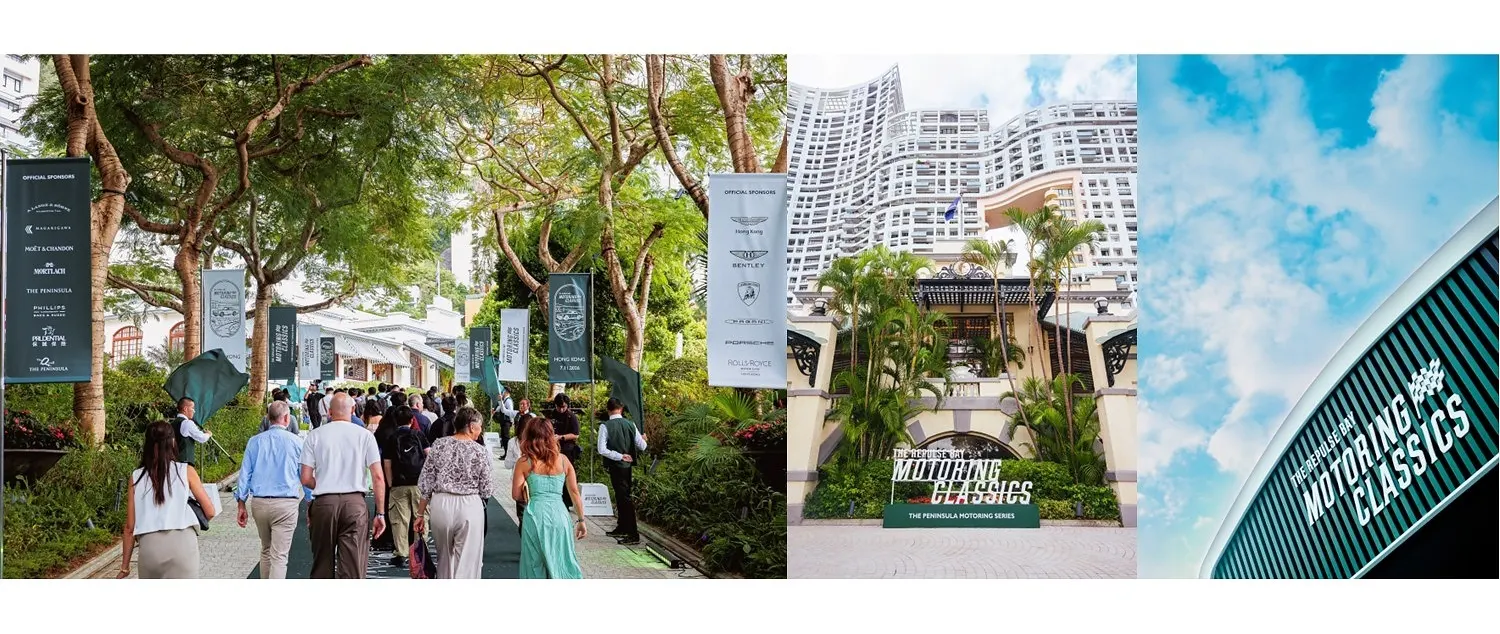
The official image accompanying this report is a collage of the inaugural event's setting and signage. It records the atmosphere of the occasion rather than providing photographs of the specific individual vehicles described above. Readers interested in detailed images and provenance should consult the appropriate specialist documentation.
Collecting as a shared interest
An appealing aspect of a well-curated automotive event is the opportunity to discover which elements of the subject hold the greatest interest for the individual visitor. Someone who appreciates mechanical ingenuity may respond to a very early car. Another person may be particularly taken with the proportions of a grand tourer or the ambition behind a later supercar. These preferences need not depend on the price attached to the models.
For a person considering ownership of a classic car, there are many routes into the hobby at expenditure levels well below those associated with the exceptional examples exhibited at Repulse Bay. The appropriate vehicle depends on the owner's purposes, practical storage arrangements and enthusiasm for its continuing maintenance. A collection can be built around a particular make, design period or type of engineering without concentrating on the highest-priced vehicles within that category.
An exhibition also offers an opportunity to enjoy automotive culture without making any purchase. An understanding of why a particular car was designed as it was can enhance the experience of seeing other examples in museums, at gatherings or on the road. Conversations with knowledgeable owners and specialists may contribute as much to the occasion as the vehicles themselves.
The first Repulse Bay Motoring Classics is therefore an interesting development both for Hong Kong's automotive community and for visitors who enjoy the combination of cultural interests and coastal hospitality. Its organiser has confirmed that the inaugural gathering took place on 7 November, but has not yet set out the programme for another edition. Enthusiasts who wish to attend a future event should follow the organiser's announcements rather than treating the 2026 date as a recurring fixture. The appeal of the occasion lies in the opportunity to appreciate the history of motoring together, in a setting that adds its own character to that experience.
Sources and lead image
Source documentation: https://www.prnewswire.com/apac/news-releases/the-inaugural-repulse-bay-motoring-classics-establishes-a-new-benchmark-for-automotive-excellence-in-asia-302943495.html. Lead image: Scenes from the first Repulse Bay Motoring Classics event in Hong Kong — The Repulse Bay, official photographic event collage distributed with its 18 November 2026 announcement.. Official issuer-supplied press photograph, reproduced for editorial coverage of the specific announcement and resized for web display.