Three days of collecting in Pennsylvania
An auction can provide a fascinating view of several different kinds of collecting within the space of a morning. An object designed for an ordinary household may now be valued for the way it was made, while an item associated with commerce may have become a record of a particular period. On 18 November 2026, Pennsylvania auctioneer Morphy Auctions announced highlights of its forthcoming Fine and Decorative Arts sale on 1 and 2 December, followed by a dedicated sale of coins and currency on 3 December.
More than 1,200 lots are scheduled for the first two days, with another 400 or more in the subsequent numismatic session. The published highlights range from early twentieth-century Tiffany Studios lighting and a vintage Cartier bracelet to experimental packaging and a particularly high-denomination American banknote. The objects have very different origins and purposes, offering several possible starting points for people developing their own interests in decorative or historical material.
For Luxury Yacht Guide readers, the announcement is not simply an invitation to purchase some of the most valuable objects in the sale. It is an opportunity to examine how craftsmanship, condition, design and documented history are understood in a specialist marketplace. The prices discussed below are the auctioneer's advance estimates, expressed in US dollars. None represents an achieved sale price. The December auctions have not yet taken place.
Two approaches to Tiffany Studios lighting
The decorative arts selection includes two Tiffany Studios floor lamps. The first is approximately 69 inches high and carries a leaded-glass shade with a diameter of 22.5 inches. Its design uses a Greek key band in contrast with a mottled green background. The auctioneer describes cobalt-blue tones becoming apparent in reflected light and identifies a signature carrying the model reference 1507. The published estimate is $50,000 to $80,000.
The second lamp has a wider, 24-inch shade with a curtain border, diamond-shaped elements and glass in several blue, green and golden tones. Its shade carries the reference 1515, according to the announcement, and the auctioneer estimates the lot at $40,000 to $60,000.
The pairing is interesting because the objects demonstrate the effect of different approaches to the organisation of coloured glass. In one, the repeated geometric band establishes a particularly strong horizontal relationship around the shade. In the other, the treatment of the lower edge contributes a different visual rhythm. A prospective collector can appreciate those differences without assuming that the higher estimate necessarily identifies the more rewarding design for a particular room.
Condition and attribution are significant considerations in this collecting field. A shade may have undergone repairs or contain replacement pieces, and the relationship between a shade and its supporting base needs to be understood when examining a particular lamp. The appearance of a lamp in a photograph does not establish its electrical safety for continued operation. Anyone intending to use antique lighting should obtain an appropriate technical assessment without assuming that its original components meet present installation requirements.
A residential interior may benefit from the presence of a single distinctive object rather than a large collection of similar pieces. The lamp's position, the scale of nearby furniture and the quality of the surrounding light can all influence the experience of living with it.
Jewellery that rewards a closer examination
The jewellery highlights include a platinum necklace set with 110 emerald-cut diamonds. Morphy's catalogue announcement gives a total diamond weight of 46.75 carats and describes the clarity range as VS1 to VS2, with colour grades between F and H. Its estimated price is $60,000 to $90,000. The repeated forms of emerald-cut stones create a visual language rather different from that of a necklace dominated by a single conspicuous stone.
A vintage Cartier bracelet in eighteen-carat yellow gold is also featured, with an estimate of $20,000 to $30,000. The auctioneer gives its length as seven and three-quarter inches and a gross weight of 72.7 grams, along with details of the markings.
These are examples of specialist jewellery rather than a representative indication of the price of every article in the sale. Someone interested in vintage jewellery at a lower price level may find it worthwhile to examine the wider catalogue rather than concentrate only on the objects chosen to illustrate the press announcement.
For a purchaser, understanding the construction of a piece is particularly important. The quoted total weight of stones in a necklace is not the same as the size or grade of any individual stone. Equally, the gross weight of a bracelet does not on its own establish the quantity of recoverable gold or the value of the piece. Design, originality, hallmarks, condition and the quality of any previous repairs may influence the assessment. An interested bidder should examine the documentation available for the specific lot and seek independent advice where the financial commitment warrants it.
Jewellery intended to be worn regularly also has practical requirements. Length, the way a fastening works and the condition of settings may matter more to its eventual owner than whether a piece was highlighted in an auction announcement.
An experimental bottle and the history of everyday design
One of the more unusual objects in the decorative arts sale is an experimental Coca-Cola bottle from 1915 associated with the Root Glass Company. The auctioneer describes a green-glass prototype approximately 7.5 inches high and assigns an estimate of $50,000 to $150,000.
The interest of an early prototype can extend far beyond the community of collectors concerned with drinks advertising. Packaging occupies an important place in the history of industrial design. Its shape can influence handling, storage and recognition, and the decisions involved in creating a familiar product can be difficult to trace once manufacture has become established. Surviving experimental objects may reveal differences between a developmental design and a form that later became widely distributed.
The wide estimate attached to this lot is itself a reminder that a rare object can be difficult to compare with others. A prospective buyer should establish the evidence connecting the bottle to the stated period, its material condition and whatever documentation accompanies it. An auctioneer's use of the term prototype is a description that should be evaluated alongside the available provenance.
The general category offers a useful contrast to jewellery and fine lighting. An individual may be attracted to the design history of a relatively modest everyday object without wanting to acquire an exceptionally rare example. Other packaging, advertising material and objects associated with manufacturing can provide accessible ways of developing that interest. The historical significance of an object and its financial value are distinct questions. Neither is necessarily a reliable measure of how much pleasure a collector will obtain from owning it.
A banknote with a Las Vegas association
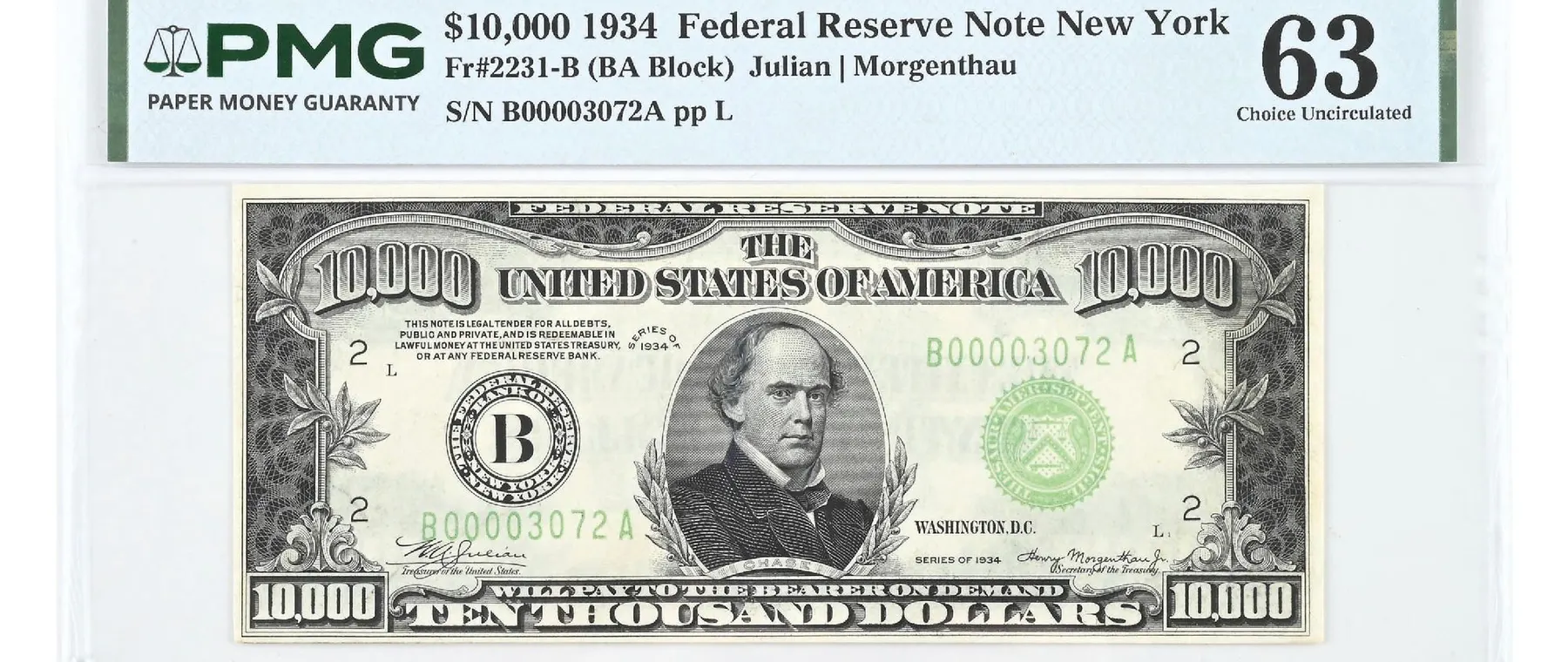
The separate currency auction on 3 December includes a 1934 United States Federal Reserve Note with a face value of $10,000. The note is identified as Fr. 2231-B and has been graded Choice Uncirculated 63 by Paper Money Guaranty. Morphy's estimate of $250,000 to $290,000 reflects the collectible proposition rather than the denomination alone.
The auctioneer associates the note with the display at Binion's Casino Horseshoe in Las Vegas. That reported provenance adds a separate dimension to the interest of the object. The official photograph accompanying this article shows both the note and its grading holder, with the denomination, date and classification visible.
A first-time currency collector should distinguish the condition grade from an appraisal of price. Numerical grading provides a means of describing particular aspects of a note's condition within a grading service's system. It is not a guarantee of a future market price. Series, issuing district, rarity, identifying numbers and documentation may all be relevant when comparing currency of superficially similar appearance.
Someone who enjoys maritime history might already be familiar with the attraction of historical documents whose significance is not immediately apparent from their appearance. Currency offers another route into the history of institutions and commerce. It can be collected at many different price levels, and the presence of an exceptional banknote at the top of a sale does not mean that a newcomer must begin there. The November release also identifies Morgan silver dollars, historic gold coins and other early American issues in the December session.
Approaching an auction as an informed visitor
Morphy's three sessions are scheduled at its Denver, Pennsylvania gallery at 2000 North Reading Road. The first two days are due to begin at nine in the morning Eastern Time, with the currency session starting at ten on 3 December. Preview appointments are available on weekdays beginning one week before the auction, and the company also provides morning previews on sale days. Remote bidding options include absentee bids, telephone participation by arrangement and its live online service.
A prospective bidder should consult the current catalogue for the condition reports and full terms. The amount paid can exceed the winning bid because of buyer's premiums, taxes, shipping or other charges. A budget should include those costs rather than treating the estimate as the total cost of acquiring an object. A sensible upper limit also reduces the possibility of making a purchase for reasons unrelated to the object's original appeal.
For an international purchaser, arrangements for export, import and insurance deserve attention before bidding, particularly when an object is fragile or valuable. None of those costs is determined by the advance estimates in the November announcement.
The pleasure of following a good auction can begin well before a decision to buy. The catalogue brings together examples of different collecting disciplines and offers an opportunity to learn how specialists describe, authenticate and assess them. A reader may discover a new interest through an exceptional piece while choosing eventually to collect more modest examples. The forthcoming Morphy sales provide a particularly varied setting for doing so.
Sources and lead image
Source documentation: https://www.prnewswire.com/news-releases/morphys-dec-1-2-fine--decorative-arts-auction-offering-1-200-top-quality-lots-will-be-followed-by-a-400-lot-premier-coins--currency-auction-dec-3--302943271.html. Lead image: The 1934 $10,000 Federal Reserve Note featured in Morphy's December 2026 currency auction — Morphy Auctions, official lot photograph distributed with the auctioneer's 18 November 2026 announcement.. Official issuer-supplied press photograph, reproduced for editorial coverage of the specific announcement and resized for web display.