An exhibition rooted in the waterways of Louisiana
Newcomb Art Museum at Tulane University announced on 4 November 2026 that it will present Lynda Benglis: Elemental from 21 January to 20 May 2027. The planned exhibition is expected to assemble nearly forty works dating from 1961 to 2024, bringing together several aspects of an artist whose approach to material has challenged conventional distinctions between painting and sculpture. Its particular emphasis is on the influence of Louisiana, including the waterways, wetlands and industrial landscapes associated with Benglis' childhood in Lake Charles. This is a significant theme for visitors whose relationship with the Gulf Coast is often experienced through its coastal communities, rivers and changing landscapes. The exhibition is not presented here as a boat show or a marine design event. It matters to an audience interested in luxury yachting because it offers a considered cultural excursion and a different way of looking at material, space and movement. Those subjects also have practical resonance for collectors and people commissioning work for a residence or yacht.
An early work returning to its geographical context
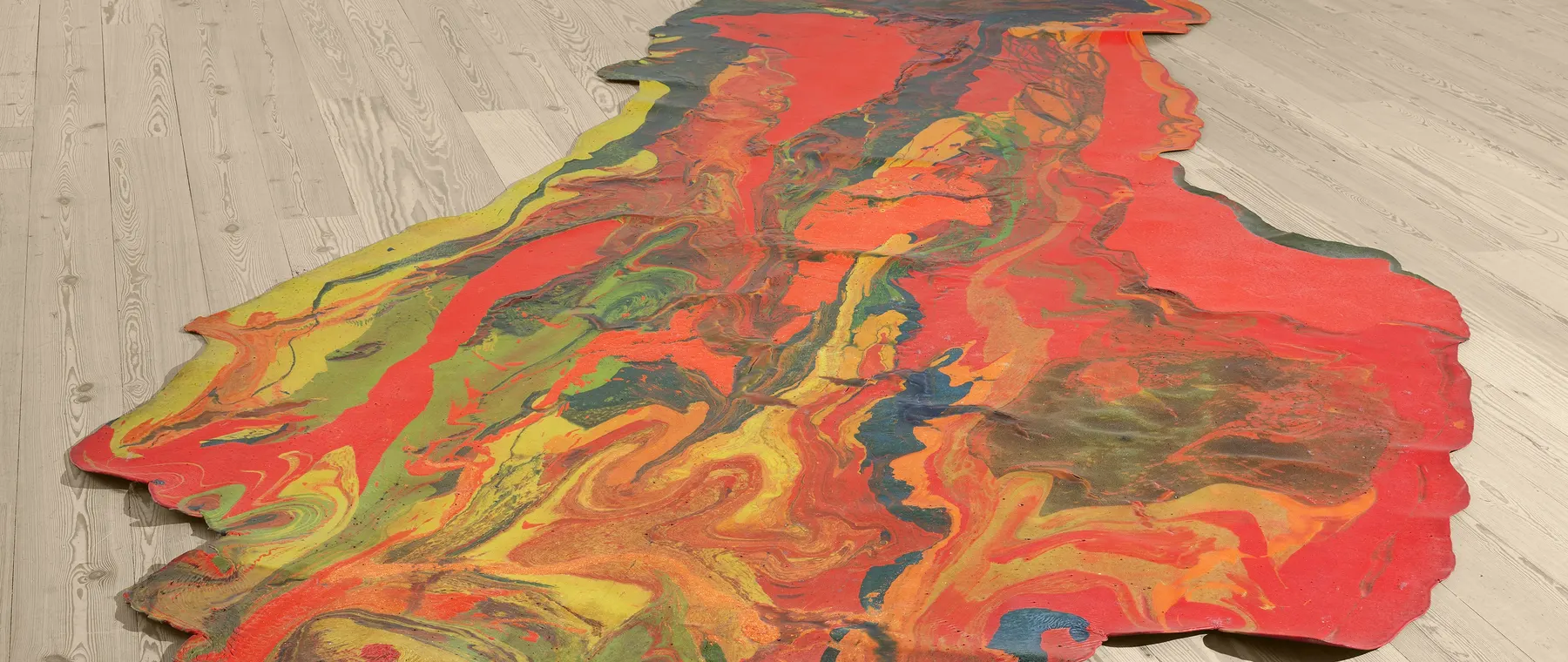
One of the most important loans identified by the museum is Contraband, created in 1969 and held by the Whitney Museum of American Art. According to the announcement, it has not previously been exhibited in Louisiana. The work's title refers to Contraband Bayou near Benglis' childhood home, providing a specific link between an abstract work and a place that formed part of the artist's early environment. Made using fluorescent-pigmented latex, the work is often understood as an example of the artist's departure from the conventional upright painted surface. Instead of confining colour within a rectangular canvas, Benglis allowed material to occupy space at ground level. This change in orientation affects the way a viewer moves around and perceives the work. It also makes the support, physical environment and behaviour of the material part of the work's identity. Photographs can communicate the outline and colours of such a piece, but a museum presentation provides an opportunity to appreciate its scale and physical relation to the viewer.
From the picture plane to a spatial experience
The distinction between a painting on a wall and a work extending across a floor is especially interesting in the context of interior architecture. A painting is often encountered from a recognisable position, with a relatively clear division between the work and the space in front of it. An object occupying the floor makes movement and placement particularly important. Benglis' early experiments invite attention to the way colour can become a physical presence rather than simply an image of something else. For an art collector planning an interior, the implications extend beyond the visual appearance of a particular object. The experience of seeing a work changes according to the surrounding surfaces, available sightlines, lighting and the distance at which it can be approached. In a constrained environment such as a midsize yacht, a work may be unsuitable despite being admired by the owner. A museum encounter can encourage the development of a stronger understanding of individual preferences without requiring the immediate acquisition or display of a comparable piece aboard.
Pleated metal, movement and material transformation
The museum also identifies Goliath, a sculpture created in 1989 by manipulating pleated wire mesh through folding and tying. Unlike pigment applied to a conventional surface, the material itself establishes much of the form. Folds and repeated elements make the sculpture responsive to the viewer's angle of observation and to changing light. The announcement connects this area of Benglis' work with Jonathan Anderson's autumn and winter 2026–2027 haute couture collection for Christian Dior, demonstrating how ideas concerning texture, volume and movement can attract attention in another design discipline. The connection should not be understood as evidence that an artist's work and a manufacturer's collection are interchangeable. The purposes, materials and production conditions are different. What can travel between disciplines is a way of examining a familiar material and identifying possibilities that have not ordinarily been associated with it. For people who commission interiors, the example encourages a dialogue about structure and craft rather than simply choosing decoration according to an established catalogue of styles.
Six decades rather than one recognised style
The exhibition is intended to include drawing, painting, ceramics, glass and metal work, as well as the experiments for which Benglis is widely known. Another work illustrated in the announcement is Lucky Strike, a bronze from 2024. The difference in material and date between that object and Contraband is a useful indication of the range the museum plans to consider. It would be reductive to interpret a long artistic career exclusively through one medium or one frequently reproduced piece. A retrospective or thematic museum exhibition allows an audience to notice relationships between works created at substantially different times. Some recurring concerns may be visible, while other changes reveal responses to new materials, opportunities or ways of working. A collector interested in a particular artist can gain a great deal from experiencing a group of works together before considering acquisitions. Familiarity with a famous image does not necessarily translate into a developed understanding of the artist's practice or the practical requirements of preserving an individual work.
The importance of exhibition context and research
The museum identifies Laura Blereau as curator of exhibitions and describes the project as organised in collaboration with Pace Gallery and the artist's studios in New York and Santa Fe. An illustrated catalogue from Dancing Foxes Press is planned for 2027. These relationships provide the institutional context for the exhibition and its examination of the artist's formative years. Benglis studied at Newcomb College, which gives the university setting a particular significance. An exhibition rooted in institutional history may offer visitors a way to connect a recognised artist with a place and community rather than presenting works as isolated objects of market interest. The forthcoming catalogue may provide further scholarship once published, but its final contents are not established by the announcement. Readers wishing to plan a visit should check the museum's current dates, opening arrangements and any requirements for viewing individual works. Schedules for loans and public programming can change before an exhibition opens, particularly when the presentation involves several institutions and different types of material.
Collecting considerations for life afloat
An interest in contemporary sculpture does not mean that every kind of work can successfully be accommodated aboard a yacht. Large or irregular objects may require a level of stability, environmental control and physical clearance that is difficult to achieve at sea. A work displayed horizontally raises a particularly clear question about circulation, securing objects and preventing unintentional contact. Materials may react differently to humidity, temperature, sunlight and vibration. Any collector contemplating the display of a valuable work aboard should discuss the individual object's care requirements with an appropriate conservator, installer, insurer and suitably qualified marine designer. It may be more appropriate to display certain works in a shore residence and choose other pieces for the yacht. The objective is not to subordinate artistic interest to a decorative scheme but to create conditions compatible with the care of the object and the safe operation of the vessel. A museum exhibition offers a valuable opportunity to appreciate work without making compromises determined by a private interior.
A cultural visit planned around the Gulf Coast
Elemental is scheduled to open in January 2027 and run until May at Newcomb Art Museum in New Orleans. Visitors to the broader Gulf Coast can consider it as part of a separately arranged cultural journey, allowing sufficient time to appreciate the exhibition and the area's other artistic institutions. The museum's location on Tulane's campus should be understood independently of any yacht berthing or waterway arrangements; the announcement does not provide a dedicated service for maritime visitors. For Luxury Yacht Guide readers, the interest extends from collecting and the appearance of art in private interiors to a broader appreciation of the physical landscapes that have informed an artistic practice. An examination of the influence of wetlands, waterways and industry offers a way to encounter the region through the work of an individual who spent her formative years there. The exhibition has not yet opened, and Luxury Yacht Guide has not reviewed the final installation. Its announced loans and curatorial approach nevertheless provide a substantive reason to follow the project and consider a visit.
Sources and lead image
Source documentation: https://www.prnewswire.com/news-releases/newcomb-art-museum-presents-lynda-benglis-elemental-302928720.html. Lead image: Lynda Benglis, Contraband (1969), pigmented latex — © 2026 Lynda Benglis / Licensed by VAGA at Artists Rights Society (ARS), New York; photo Christopher Burke Studios; Whitney Museum of American Art / Newcomb Art Museum press release. Official issuer-supplied press photograph, reproduced for editorial coverage of the specific announcement and resized for web display.