The theatre comes to a private Manhattan residence
A seasonal accommodation concept at Manhattan's Beekman Tower brings the visual traditions of the Radio City Rockettes' Christmas Spectacular into a residential setting. Announced by Wyndham Hotels and Resorts in a release dated 12 November 2026, the Christmas Spectacular Suite is scheduled to welcome guests from 20 November until 3 January 2027. It combines an overnight stay with access to the production and displays of genuine theatrical material.
The suite occupies approximately 525 square feet within the landmark Art Deco tower on Manhattan's East Side, a property operating within Wyndham's Trademark Collection. Unlike a conventional hotel room carrying a loosely applied holiday theme, the accommodation is designed around objects associated with the performance itself. Authentic costumes, original tap shoes and archival sketches form part of the narrative, giving guests the chance to examine aspects of theatrical design away from the auditorium.
The arrangement is an unusual intersection of tourism, performing arts and interior decoration. For yacht guests spending a period in New York during the festive season, it represents a shore-based cultural experience rather than a traditional five-star hotel package. In this instance, the appeal lies in access to a recognisable piece of the city's entertainment history and in the opportunity to explore the material culture behind a major live production.
Costume design viewed at close quarters
On a theatre stage, costumes are perceived from a considerable distance. Colour, fabric, embellishment and silhouette have to communicate immediately, often under rapidly changing lighting conditions and while performers are moving in precise formation. The effect is fundamentally different from looking at the same costume in a display case.
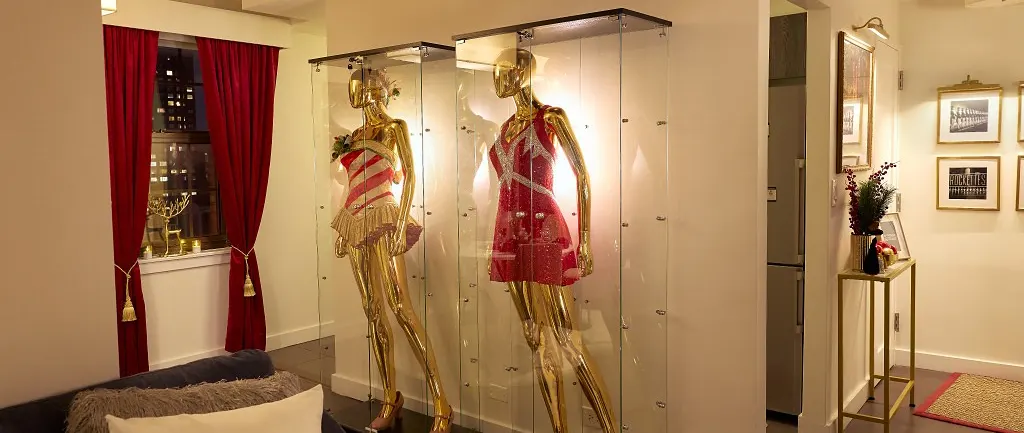
The Wyndham announcement identifies authentic costumes worn by the Rockettes as part of the suite's presentation. Its official press photograph shows two stage outfits displayed in illuminated glazed enclosures in the living area. One of the attractions of the arrangement is that the visitor can consider the costumes independently of the choreography for which they were made.
Theatrical costume design combines creative imagination with demanding practical requirements. A successful stage garment needs to accommodate movement, retain its intended appearance through repeated performances and contribute to the visual coherence of a group. Small details that may seem purely decorative at close range often have a functional role when seen under stage lighting.
For readers interested in bespoke clothing, textile craftsmanship or the history of performance, this is a distinctive aspect of the experience. A theatrical costume is not necessarily constructed according to the same priorities as an evening gown, even where both employ similar materials or decorative techniques. The relationship between garment and movement is central.
From a designer's sketch to the finished production
The inclusion of archival costume sketches adds another dimension. Sketches can help illuminate the development of a visual concept, showing how designers consider proportion, silhouette and decorative elements before an object is constructed. When considered alongside the finished garments, they offer a way to understand the translation of an artistic idea into a wearable stage object.
The original tap shoes included in the display similarly connect the visual spectacle with the physical demands of performance. Footwear is a particularly interesting element because it serves both the appearance of the dancer and the requirements of the choreography. It has to be considered as a working object rather than an accessory chosen solely for its appearance.
These pieces are not presented as an independently catalogued museum exhibition. Their context is a themed hospitality experience, and the announcement does not provide a detailed catalogue of dates, production credits or the individual performers associated with each object. Nevertheless, their presence makes the suite more interesting than a room decorated solely with reproductions or promotional graphics.
Guests should respect the display arrangements and establish with the property whether any objects are intended for handling. Looking closely at the craftsmanship does not require removing protected items from their cases.
Art Deco as an architectural connection
The Beekman Tower supplies a fitting architectural context. Art Deco and the history of New York entertainment have a strong association in the public imagination, not least because of the city's celebrated buildings and theatres. Radio City Music Hall is itself a prominent expression of the design culture of its era.
The suite's living-room decoration employs rich reds, navy and gold to create a theatrical atmosphere. Its bedroom adopts a quieter palette of creams and gold, with references to the Art Deco setting. This contrast separates a lively social area, where the stage material is displayed, from a room intended for rest.
The design approach is worth considering because themed accommodation can easily become overwhelming. Where a strong visual identity is carried into every surface and every room, the result may be less comfortable as an everyday living environment. Concentrating the more expressive elements in the living area while maintaining a subdued bedroom offers a more practical balance.
The concept also has relevance beyond seasonal hotel design. On a yacht, a distinctive collection or cultural theme can be introduced through carefully selected furnishings and framed objects, without requiring the entire interior to adopt the same visual treatment. The challenge is to establish a coherent atmosphere while preserving the primary functions of the space.
A self-contained base for exploring New York
The one-bedroom suite accommodates up to four guests through a queen bed and a queen sleeper sofa. It also includes a full kitchen and a private balcony. These facilities distinguish it from a standard room arrangement and will be particularly useful to families who prefer the flexibility of residential accommodation during a city break.
The package is advertised from $499 per night, excluding applicable taxes and fees, or 45,000 Wyndham Rewards points per night, with a two-night minimum stay. Each stay includes up to four tickets to the Christmas Spectacular. Select one-night stays are also being offered through the Wyndham Rewards Experiences auction mechanism.
These published starting prices place the package in a different category from Manhattan's most expensive luxury suites. Its positioning is more accessible, with the value concentrated in the unusual cultural theme and the inclusion of performance admission. Guests should compare the complete cost of their selected dates, including any charges, and establish the exact performance booking arrangements before committing.
For families, the kitchen and separate sleeping and living spaces may be more significant than the conventional hierarchy of hotel star ratings. The ability to have an informal meal, return to a private living area after an evening out and organise the day independently can make a short city visit easier to manage.
Planning the performance around a yacht stay
New York offers a very different shore experience from the beach and island destinations that dominate many luxury yacht itineraries. Its attractions are geographically dispersed, and a visit to the theatre needs to be organised around road transfers, the selected accommodation and the yacht's actual berth.
The themed suite could form part of a short Manhattan extension before or after time aboard a yacht. The included performance tickets offer a natural focus for that visit. Guests should establish the specific show date and time, leave sufficient allowance for seasonal traffic and avoid treating published hotel availability as confirmation of a particular theatre seating arrangement.
An itinerary can also leave room for architectural and cultural exploration around the performance. Manhattan's commercial buildings, public interiors, galleries and decorative arts collections provide a wider setting in which to consider the design traditions evoked by the suite. The experience becomes more rewarding when the visitor sees the accommodation and the show as complementary parts of the same journey.
Why cultural hospitality deserves attention
The Christmas Spectacular Suite demonstrates how a hotel can create interest through an association with a cultural institution rather than simply competing on room size or a greater number of amenities. Its objects connect the private environment of the guest with the craftsmanship of a live production, while the included tickets complete the relationship between the two settings.
The concept is deliberately temporary. Its scheduled conclusion on 3 January 2027 gives the accommodation a relevance tied to a particular festive period, and availability will consequently be limited by the single themed suite. Potential guests should obtain current booking information from Wyndham rather than assume the introductory prices or performance arrangements apply to all dates.
For Luxury Yacht Guide, the project is noteworthy as an example of culturally led hospitality and creative interior presentation. It offers a modestly scaled but distinctive alternative for guests who value storytelling, costume design and performance, and who wish to make their time ashore in New York more closely connected with the city's artistic identity.
Sources and lead image
Source documentation: https://www.prnewswire.com/news-releases/curtain-up-on-a-show-stopping-holiday-stay-the-christmas-spectacular-suite-by-wyndham-rewards-302937711.html. Lead image: Authentic Radio City Rockettes costumes displayed in the themed suite — Wyndham Hotels & Resorts / PR Newswire. Official issuer-supplied press photograph, reproduced for editorial coverage of the specific announcement and resized for web display.