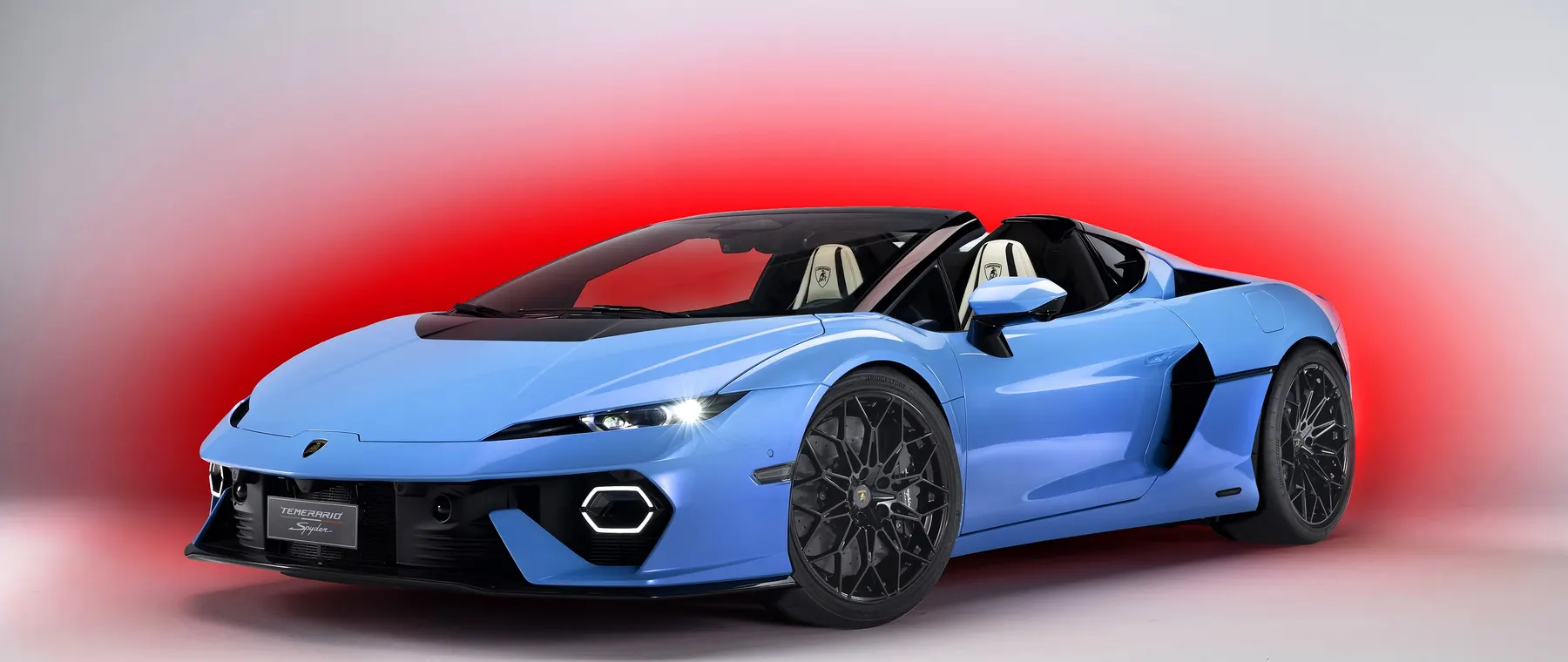
Open-air performance and the contact patch
Bridgestone announced on 19 November 2026 that it is extending its exclusive tyre partnership with Lamborghini to the new Temerario Spyder. The announcement concerns the tyres fitted to the open-top car, rather than the introduction of an entirely new model line. Lamborghini's coupé and the Spyder will share an approved selection of road, track-oriented and winter fitments. The tyres are manufactured in Europe and span eight dimensions in 20-inch and 21-inch wheel diameters. The focus on more than one operating environment is particularly significant for a car designed to serve both as a high-performance machine and as a vehicle for leisure touring. Many owners of luxury yachts also appreciate an open-air driving experience on land, and the two forms of transport share a dependence on equipment that performs reliably in variable conditions. In a car equipped with an exceptionally powerful engine, the four road contact patches are essential to translating the chassis and control systems into usable acceleration, braking and directional stability.
The engineering context of the open-top Lamborghini
The technical partner's announcement describes a four-litre twin-turbocharged V8 working with three electric motors to achieve a combined output of 920 CV, equivalent to approximately 677 kW. Lamborghini's vehicle figures quoted by Bridgestone include a claimed 0–100 km/h time of 2.8 seconds, a 0–200 km/h time of 7.3 seconds and a maximum speed of approximately 343 km/h. Those figures are manufacturer claims, not results of an independent road test by Luxury Yacht Guide. They indicate the scale of the challenge faced by the tyre engineer, not speeds appropriate for a public-road journey. Combining electric propulsion with a combustion engine can create demanding torque delivery characteristics, particularly during changes in available grip. The tyres, suspension geometry, braking system and electronic controls must work as a package. A tyre's suitability cannot therefore be inferred from a single performance specification or an identical nominal diameter. The relevant homologated fitment and the condition of the actual equipment should be checked for the vehicle concerned.
Potenza Sport as the road-focused option
The Potenza Sport is identified in the announcement as the principal ultra-high-performance choice for road use, with a tread pattern intended to support handling in dry and wet conditions. A road tyre must manage more than the grip required during maximum acceleration under ideal circumstances. Surface changes, drainage, debris, repeated heating and cooling, and the way a vehicle responds to steering and braking inputs all contribute to its usefulness. Tourers may encounter a motorway, a shaded village street and a relatively uneven mountain road in the course of the same journey. Even on familiar roads, the surface changes substantially following rain. The purpose of a road-focused tyre is to operate within a wider envelope of normal driving than a specialised competition fitment. That does not imply that its capabilities are unlimited. Drivers must retain sufficient distance and adjust their behaviour to visibility and road conditions, particularly when using a vehicle capable of gaining speed very rapidly. A well-chosen tyre supports sound judgement rather than compensating for its absence.
Why a track-oriented fitment is a separate choice
Bridgestone also offers a Potenza Race fitment, drawing upon a compound developed with track use in mind. Its intended emphasis is distinct from that of a general high-performance road tyre. Repeated laps on a circuit place a different pattern of loads and temperatures on tyres than an ordinary touring journey. Choosing a fitment solely because its name suggests greater performance would miss that distinction. Owners who want to enjoy their super sports car in a controlled environment should discuss tyre selection, pressures, warm-up procedures and inspection requirements with an appropriately qualified specialist or the manufacturer's track support team. A road-approved tyre used during a circuit session may need particularly careful assessment before being used again on the highway. Track sessions also offer a more responsible setting in which to explore the character of a high-performance car than attempting to replicate published acceleration figures on public roads. For yacht owners taking a motoring holiday, an organised driving event can be planned separately from transfers and ordinary journeys, with the necessary equipment and support arranged in advance.
Run-flat technology and the limits of mobility
A homologated run-flat version of the Potenza Sport is available as an alternative according to Bridgestone. The supplier describes continued travel following pressure loss for up to 50 miles at a maximum of 50 mph, subject to operating conditions. This is a conditional mobility provision, not a guarantee that any punctured tyre can safely be driven those distances. Vehicle load, ambient temperature and the moment at which the pressure-monitoring system warns the driver all influence the potential outcome. Damage involving the wheel, severe impact or a compromised sidewall may require a different response. The owner's manual and applicable tyre guidance remain the relevant authority, and professional inspection is necessary before any continued ordinary use. For a long-distance touring itinerary, a useful practical consideration is the availability of assistance along the route. Highly specialised dimensions may not be stocked at every repair centre. Knowing how roadside support will be organised offers a greater degree of reassurance than assuming that the presence of run-flat technology removes the consequences of tyre damage.
Seasonal conditions and the Blizzak fitment
The third part of the announced portfolio is the Blizzak 6 winter choice, developed for the Temerario and now offered for its open-top counterpart. Winter motorway journeys and trips into mountainous regions raise questions that differ from those encountered on warm coastal roads. Temperatures, surface moisture, snow and ice can vary substantially over a short distance. The use of an approved winter tyre may be a sensible part of preparing the car, but it does not establish that every route is suitable or that all local winter-equipment requirements have been met. Owners should check the requirements of the countries and roads on their actual itinerary, including any restrictions that apply to specialised wheels or additional equipment. A seasonal change also deserves attention to storage and periodic inspection of the unused set. A super sports car may be driven infrequently during part of the year, and the age and physical condition of its tyres matter independently of remaining tread depth. Expectations of performance should be based on the condition of the equipment currently installed, not simply its original specification.
The significance of a common approved portfolio
The decision to extend the coupé's tyre selection to the Spyder indicates continuity within the Temerario family. This is helpful conceptually because owners can understand the broadly distinct uses for which the supplier is offering its products. It does not follow that tyres of the same nominal size can be exchanged without regard to the vehicle manufacturer's specifications. Different axles may have different requirements, and load ratings, speed ratings and variant-specific markings are relevant to compatibility. Service personnel should use the current Lamborghini instructions when identifying replacements and checking wheel alignment and tyre condition. The supplier's announcement does not provide a detailed test comparison between the two body styles, nor does it establish the relative performance of each fitment under every condition. That is a useful reminder of the difference between a published technical partnership and comparative evaluation based on controlled testing. Readers interested in the exact equipment fitted to a vehicle should consult its individual specification and the authorised service network.
A touring approach for the luxury yacht owner
A motoring itinerary ashore can complement time spent aboard a yacht, providing opportunities to explore landscapes that cannot be experienced from the water. A convertible sports car adds a particular sensory dimension to that journey, but the decision about which car and equipment to use should reflect the distances, weather, baggage arrangements and preferences of the people travelling. A short drive to a hillside restaurant requires different planning from a multi-day circuit through unfamiliar mountain roads. Where a car is to be transported separately between destinations, appropriate professional logistics should be arranged rather than assuming it can accompany a midsize yacht. The Bridgestone announcement is most useful when considered in that practical context. It demonstrates that a manufacturer and technical partner recognise several ways in which the same high-performance car may be used. The owner is left with the responsibility of matching the approved equipment to the journey and maintaining it properly. The reward is not a claimed maximum speed, but a well-prepared vehicle that can be enjoyed with confidence and appropriate restraint.
Sources and lead image
Source documentation: https://www.prnewswire.com/news-releases/bridgestone-extends-lamborghini-partnership-as-exclusive-tire-partner-for-new-temerario-spyder-302944685.html. Lead image: Lamborghini Temerario Spyder fitted with Bridgestone Potenza tyres — Bridgestone Americas / PR Newswire. Official issuer-supplied press photograph, reproduced for editorial coverage of the specific announcement and resized for web display.