A prototype that was never sold is heading to Paris
Mercedes-Benz has announced that one of its original C 111-II experimental sports cars will be offered at auction through RM Sotheby's on 3 February 2027. The sale is scheduled for the Palais du Louvre during Rétromobile Paris. The company's European announcement appeared on 18 November 2026, following the US newsroom release the previous day.
The event is unusual because Mercedes-Benz has never previously sold a C 111 from its collection. The manufacturer says it has undertaken not to sell another example for at least twenty-five years. Only seventeen prototypes of the C 111 programme were built, and the model did not enter series production.
The example to be offered is known within the Mercedes-Benz collection as Car 33, an internal designation rather than its production number. It is the third C 111-II built and retains the four-rotor Wankel engine installed in 1970. Proceeds from the sale are intended to support the development of the Mercedes-Benz Museum and its digital presentation of the company's heritage.
For readers interested in collecting, the announcement represents an opportunity to examine a very different kind of automotive object: one made to explore engineering possibilities rather than to fulfil orders from customers.
The design of an experimental sports car
The original C 111 appeared at the Frankfurt International Motor Show in 1969. Mercedes-Benz conceived it in the context of its earlier work on the 300 SL and its evolving ideas about performance car design. The experimental programme provided a means of investigating technologies and design approaches that would have been difficult to accommodate within an ordinary production development schedule.
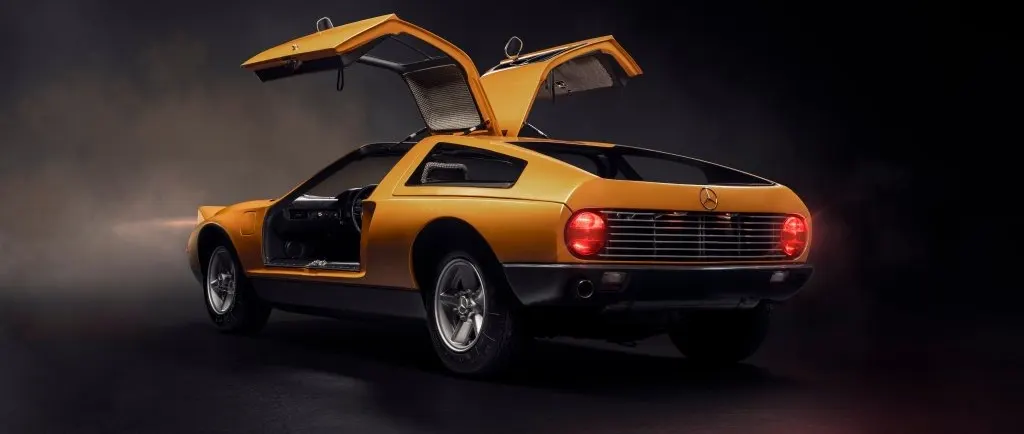
The C 111-II's shape is particularly striking in the official photograph of the car with its doors raised. A low body, a tapering cabin and the door openings establish proportions that distinguish it from the more conventional saloons associated with the marque. The rear section of the vehicle is substantial, reflecting the position of the engine behind the occupants.
Its appearance communicates the priorities of a particular period in automotive design. A sports car could be presented as a vision of the future while remaining dependent on the materials, engineering knowledge and production techniques available to its designers. The result was not necessarily intended to establish an exact pattern for a future range of customer cars.
The visual prominence of the upward-opening doors also establishes a connection with the earlier 300 SL. That resemblance should not obscure the important differences between the two programmes. The earlier car entered production, while the C 111 remained an experimental vehicle.
A four-rotor alternative to conventional engines
The car being offered was fitted in August 1970 with a 2.4-litre Wankel rotary engine identified by Mercedes-Benz as type M 950 W 48. The company gives its output as 257 kilowatts, equivalent to approximately 350 metric horsepower or 345 mechanical horsepower. It also gives the vehicle's weight as 1,240 kilograms and identifies a maximum speed of approximately 300 kilometres per hour.
Those figures should be understood as characteristics published by the manufacturer for the historic design rather than results of an independent contemporary performance test of the auction car.
The rotary engine provides an important part of the context. In a conventional reciprocating engine, pistons move back and forth within their cylinders. The Wankel arrangement instead uses rotating components within shaped chambers to carry out the successive stages of the combustion process. This offers a different relationship between the geometry of the engine and the movement of its internal parts.
The experimental cars gave Mercedes-Benz engineers an opportunity to examine how such technology could be incorporated into a high-performance vehicle. The appeal of the arrangement to an engineering historian lies in the questions the programme explored, including how alternative engine architecture might influence packaging and vehicle performance.
A collector acquiring such a machine faces a different prospect from that of owning a conventional production model. Specialist knowledge, maintenance documentation and access to suitably qualified technicians may be especially important where the mechanisms were developed for a small experimental programme.
The identity of Car 33
Mercedes-Benz identifies the example as having been built from March 1970 onwards. It retains its characteristic Weißherbst exterior colour and sports seats with a grey and white houndstooth pattern. The interior also includes a four-spoke steering wheel and a vertically positioned Becker Europa radio.
These details help establish the relationship between the vehicle and its period. They reveal the way a manufacturer developing a radically shaped prototype could nevertheless incorporate recognisable controls and equipment into its cabin.
The condition and originality of each component should be assessed through the documentation accompanying the sale. The manufacturer's description of the original engine is particularly significant, but it does not replace inspection of the particular object or review of its maintenance and conservation history.
The car is accompanied by its contemporary 8-by-15-inch light-alloy wheels and a separate set of wider magnesium wheels used for circuit activity. Mercedes-Benz specifically warns that the latter are now suitable only for display because of their age and condition. This qualification is essential: equipment that once served a competition or testing purpose should not automatically be regarded as fit for its original use many decades later.
The combination of the car and associated equipment can nevertheless help tell the story of the experimental programme. Accessories and components may provide additional information about the ways in which the vehicle was used or prepared.
A museum object moves into private ownership
Car 33 has been exhibited at the Mercedes-Benz Museum in Stuttgart, where its design forms part of the account of the company's automotive heritage. The November announcement establishes that the car is being released from the manufacturer’s collection rather than offered by an unrelated private consignor.
For an institution, a historic prototype can possess significance beyond its value as an individual collectible. It can provide a tangible record of decisions that might otherwise be understood principally through photographs, engineering drawings and written documents.
Mercedes-Benz says the auction proceeds will be directed towards its Museum 2.0 project. The plans include further work on the physical museum and an interactive digital representation of the collection, developed with The Classic Car Trust and its Roarington platform. The company expects initial results during 2027.
The digital project has a different purpose from the ownership of the physical prototype. A digital representation may provide access to information and visual details for people who cannot travel to Stuttgart, while the original machine remains a material record of the work undertaken by its designers.
The forthcoming auction
The auction is scheduled to take place in the Salles du Carrousel beneath the Palais du Louvre. Mercedes-Benz and RM Sotheby's have previously collaborated on the sales of important historic competition and experimental vehicles. Those earlier results do not establish a valuation for the C 111-II, and the November announcement does not provide an agreed sale price.
Prospective bidders should obtain the full catalogue description and the applicable sale conditions. Matters such as the scope of the accompanying documentation, the maintenance requirements of the car, registration eligibility, storage and insurance deserve attention. The manufacturer describes it as drivable, but this does not establish that it is currently licensed for ordinary public-road use in any particular jurisdiction.
For an owner accustomed to the responsibilities of maintaining a historic yacht, there is a recognizable distinction between acquiring an exceptional object and establishing the arrangements necessary for its long-term care. In both cases, the availability of appropriate expertise and the preservation of records can become important elements of ownership.
The value of an unrealised production car
The C 111-II is interesting precisely because its story did not end with a conventional production launch. It remained an opportunity for Mercedes-Benz to investigate ideas that appeared promising at a particular point in automotive history. The November announcement provides collectors with an unusual opportunity to consider a vehicle whose identity was shaped by experimental work rather than a production order.
The eventual price will be determined through the auction process, subject to its terms. Its cultural and engineering significance is a different matter. The opportunity to examine the car, its unusual engine configuration and its associated objects provides a direct connection to the development of performance vehicles in the early 1970s.
Sources and lead image
Source documentation: https://media.mbusa.com/news/legendary-super-sports-car-for-the-first-time-a-mercedes-benz-c-111-is-offered-for-sale-and-paves-the-way-for-the-further-development-of-the-mercedes-benz-museum, https://media.mercedes-benz.com/en/article/efcef2e2-555d-4fab-8cb1-edd581a069cc. Lead image: Mercedes-Benz C 111-II Car 33, rear view with gullwing doors open — Kamil Koźlarek — Photo: Kamil Koźlarek / Mercedes-Benz; official US newsroom press photograph, editorial use only under the asset page terms.. Official issuer-supplied press photograph, reproduced for editorial coverage of the specific announcement and resized for web display.