A Swedish driving route with two very different characters
Porsche has published a new instalment of its Sunday Drives series on 19 November 2026, following former competition driver Anton Marklund through the countryside of Västerbotten in northern Sweden. The journey takes in rural roads around his home region near Skellefteå and the Drivecenter Arena circuit outside Fällfors. Porsche describes the outing as a round trip of approximately 100 kilometres, in addition to laps of the circuit.
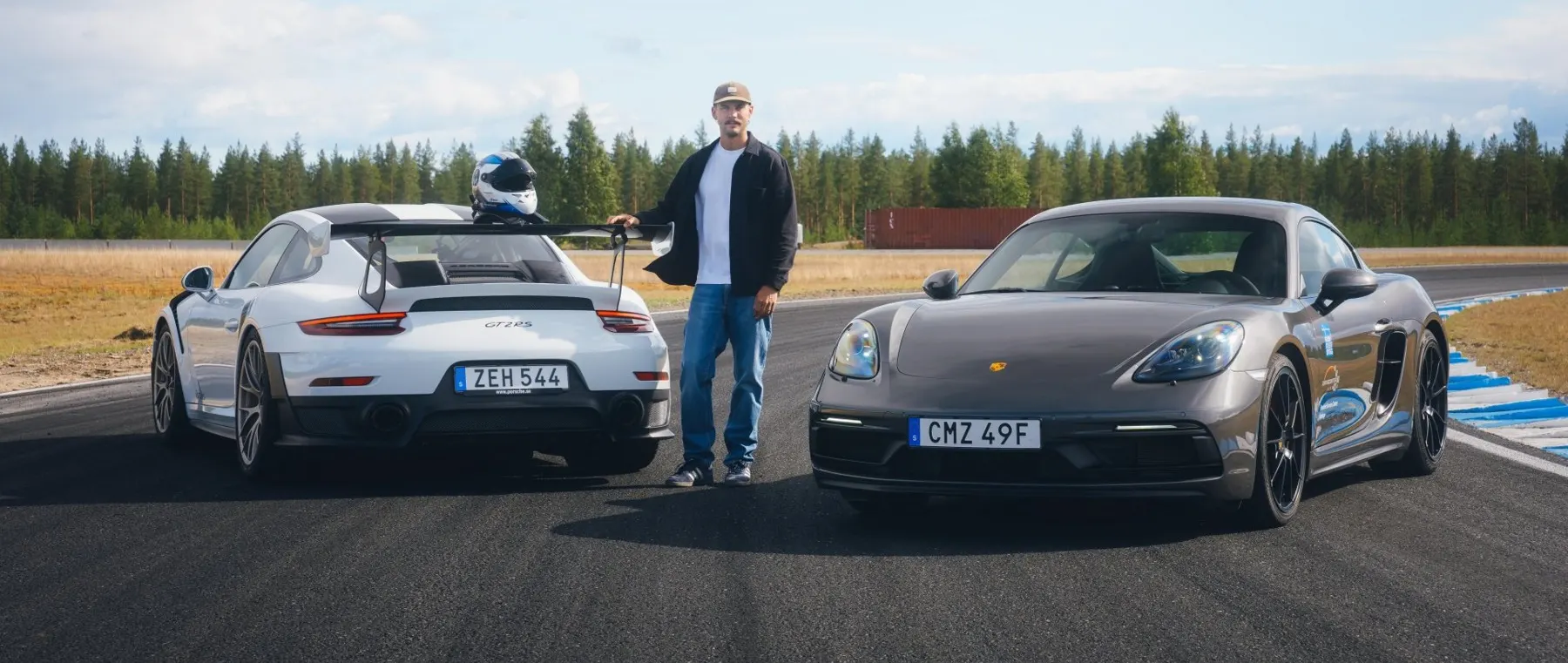
The route is particularly interesting because Marklund chooses two contrasting cars for its two elements: a 718 Cayman GTS on the road and a 911 GT2 RS at the circuit. The story is less about evaluating the maximum performance of either car than about understanding why a driver might enjoy different qualities of a sports car according to its surroundings.
For Luxury Yacht Guide readers accustomed to exploring coastlines under their own power, there is a familiar distinction between a purposeful journey and an excursion made for the enjoyment of travelling. Northern Sweden offers a landscape in which the journey itself can become a substantial part of the holiday.
From a racing career to the enjoyment of a quiet road
Marklund has won four European Rallycross championships across different classes and competed in Porsche Carrera Cup Scandinavia and Swedish touring cars, according to the manufacturer. He has also instructed customers at Porsche driving events, including experiences held on frozen lakes.
It is therefore striking that his preferred recreational road drive does not depend on recreating the intensity of professional competition. The forest roads around his home offer a different experience from that of a closed circuit. They provide a sense of distance from busy urban areas, with relatively small settlements and extensive stretches of trees.
The enjoyment of a sports car in such a setting can involve many qualities other than speed. The steering, the position of the driver and the response of the engine can contribute to the feeling of connection with the road at ordinary legal speeds. The driver can also appreciate the light, changing landscape and opportunities to stop and investigate a place encountered along the way.
Marklund's approach is relevant to travellers who might otherwise try to construct a road trip entirely around a succession of well-known destinations. A day's driving can instead be organised around the scenery between them. It should still be planned with regard to the distance between fuel stations, weather, road works and the availability of assistance.
The Cayman GTS as a road-going companion
Marklund's chosen 718 Cayman GTS has a four-litre engine rated by Porsche at 400 horsepower in its account of the journey. The company says he originally acquired the car because some of its characteristics were similar to those of his Swedish Touring Car Championship machinery, making it useful for preparing for the season on a circuit.
The relevance of that connection is the ability to use a car in different environments. A road-going model needs to accommodate the interruptions and variable surfaces encountered during a normal journey. On a track, by contrast, the driver can explore a more consistent driving environment in which the demands of braking, turning and acceleration can be examined in a controlled manner.
A sports car intended for recreational touring need not be the most expensive or powerful vehicle available. The important qualities depend on the person driving it and the kind of road encountered. A compact car can be rewarding on routes where the driver appreciates its proportions, while a more spacious grand tourer might be preferable for a longer holiday involving luggage and extended periods behind the wheel.
For a prospective owner, the useful comparison involves more than engine output. Driving position, visibility, ride comfort, the arrangement of luggage space and the suitability of the vehicle for the anticipated weather can all influence whether it will be enjoyable during an actual journey.
Exploring the countryside responsibly
Porsche's feature describes roads leading towards Fällfors, through a landscape in which moose, reindeer and other wildlife may be encountered. A quiet rural road is not necessarily a predictable one. Forest edges and changes in visibility can conceal animals, vehicles or other hazards until relatively late.
The opportunity to drive through an unfamiliar landscape should therefore be approached with attention to local limits and conditions. A traveller should allow enough time to reach the intended destination without feeling compelled to maintain a particular pace. That may involve making fewer stops during a short winter day or setting aside additional time if the route is affected by snow or ice.
The article does not supply a turn-by-turn itinerary. Marklund's drive is presented as an exploration of his local region rather than a fixed route visitors should attempt to reproduce exactly. Guests planning a similar holiday need to check the actual public roads, accessibility and seasonal requirements for their vehicle.
A visitor arriving from a warmer coastal destination may also need to consider clothing, daylight and the possibility of temperatures quite different from those encountered on a sailing holiday. The conditions illustrated by the manufacturer's photographs should not be taken as a forecast for the date of a future visit.
The former airfield at Fällfors
After around 50 kilometres of countryside driving, the Porsche feature moves from public roads to the Drivecenter Arena outside Fällfors. The circuit opened in 2019 on a former airfield and measures 4.235 kilometres. Porsche identifies it as Sweden's longest racetrack, with sixteen corners encompassing both faster and more technical sections.
This is the point at which Marklund changes to the 911 GT2 RS. A more track-focused car offers a different proposition when the environment is specifically arranged for motorsport. The driver can concentrate on matters such as consistency from one corner to the next without the same mixture of public traffic and unpredictable road users.
The distinction between road and track is fundamental. Techniques appropriate to a supervised track session are not necessarily appropriate to public roads, and the fact that a car can operate at high speeds does not establish that its driver can safely explore those speeds outside a controlled environment.
Visitors interested in the circuit should obtain the relevant information about organised driving days, eligibility, supervision and the requirements placed on individual vehicles. Porsche's article describes Marklund's access to a family-owned venue; it does not establish that a visitor can enter the circuit at any time.
Precision rather than spectacle on the circuit
Marklund emphasises repeatability in describing his approach to the 911 GT2 RS. The ability to place a car consistently in relation to a corner is a different objective from producing one dramatic lap. It involves understanding the way the car responds and making decisions sufficiently early to maintain control over successive sections of the circuit.
This is an important aspect of driver training. A participant does not need to approach the performance threshold of an experienced professional in order to gain something useful from an organised session. Familiarity with the car, the way its controls respond and the ability to recognise developing situations can all be valuable.
A track day should be arranged around the experience of the participant and the operating requirements of the vehicle. Insurance, vehicle condition, the competence of instructors and the rules of the venue should be established before attending. A car that is enjoyable on a public road may need additional preparation for a track session, and the nature of that preparation depends on the equipment and organiser.
Planning a northern driving holiday
A trip to Västerbotten might be combined with a longer visit to Sweden or approached as a destination in its own right. The most useful starting point is to decide whether the purpose of the journey is rural exploration, a supervised driving experience or a combination of both. Each has different logistical requirements.
The manufacturer's Sunday Drives feature provides an example of the contrast between those activities without suggesting that every visitor should follow the same pattern. Marklund's familiarity with the region and extensive competition experience form part of the context of his outing.
For someone whose leisure interests encompass both yachts and cars, the attraction lies in the opportunity to move between different environments and appreciate the qualities of each. The Cayman and GT2 RS illustrate two ways of enjoying automotive engineering, and Västerbotten provides a setting in which the difference between those experiences is particularly apparent.
Sources and lead image
Source documentation: https://newsroom.porsche.com/en/2026/scene-passion/porsche-sunday-drives-sweden-anton-marklund-43620.html. Lead image: Porsche 911 GT2 RS and 718 Cayman GTS with Anton Marklund in Sweden, Porsche AG — Porsche AG; official newsroom photograph supplied under Porsche Newsroom editorial-reporting terms. Official issuer-supplied press photograph, reproduced for editorial coverage of the specific announcement and resized for web display.