A modern Mustang commemorates a race from 1901
Ford has revealed a special livery for the 2028 model-year Mustang GTD, drawing on the racing car that Henry Ford drove to victory in 1901. The manufacturer announced the GTD 1901 on 17 November 2026 through its editorial media site. It is a new configuration of the modern high-performance Mustang, not a reconstruction of the early competition car.
The latest edition combines a deep red exterior with dark graphics and a cabin that carries related colour details into its leather and other finishes. Its historical inspiration is significant because the race preceded the establishment of Ford Motor Company. Rather than celebrating a particular Mustang model from the company's more recent history, the project looks back to a period when racing helped demonstrate the potential of its founder's engineering work.
For collectors of performance cars, this makes the GTD 1901 interesting as an example of how a contemporary machine can carry references to a very different era without attempting to reproduce the technical form of the earlier vehicle. Its announcement also provides a first indication of some refinements intended for the wider 2028 model year.
The origin of the anniversary concept
The name refers to the year in which Henry Ford competed with his two-cylinder racing car, subsequently known as Sweepstakes. The event took place at a time when the development of motor vehicles was still closely associated with the personal work of individual engineers and entrepreneurs. Ford's account places particular emphasis on the attention generated by the victory and its significance for the development of his business ambitions.
A racing car of that period belonged to a mechanical world far removed from that of the current Mustang. Engine design, the methods of transmitting power and the arrangements for controlling the car were determined by the technologies available at the time. The event nevertheless provided an important opportunity for a builder to demonstrate the performance and dependability of its engineering.
The modern edition connects those two periods through its presentation rather than through an attempt to imitate the original machinery. Ford describes both vehicles as examples of its desire to demonstrate engineering possibilities through competition-oriented cars. The modern road-going GTD is subject to an entirely different set of design requirements, and the connection should be understood in that historical context.
Interpreting the exterior colour
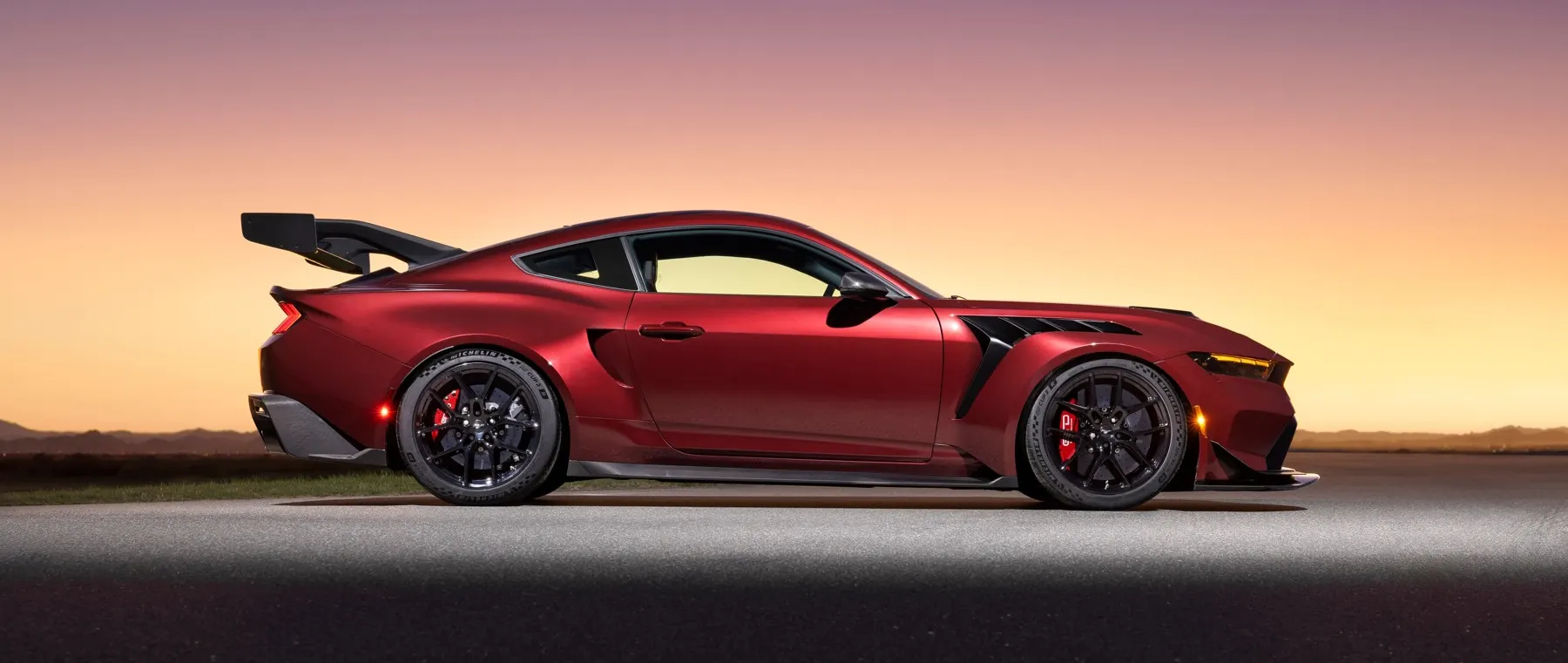
The 1901 edition uses Royal Red for the principal body colour, with a broad dark stripe positioned away from the centre of the car. A narrower red detail within the graphic establishes a relationship with the appearance of the original racing car, which had a dark body and red frame.
The off-centre treatment is useful in distinguishing this edition from a car with a symmetrical pair of traditional racing stripes. The visual line moves across a body whose surfaces have been shaped partly by the requirements of aerodynamic performance. The colour arrangement consequently works with an existing three-dimensional form rather than acting as an isolated decorative motif.
The official media photographs also illustrate the prominent rear aerodynamic assembly and the relationship between the low roof and the bodywork. These features belong to the underlying GTD design, not solely to the historical livery. The edition's identity comes from the way the selected colours and additional details are applied to that existing machine.
A collector comparing alternative GTD configurations may wish to consider whether the historical association has lasting appeal independently of the rarity of a particular specification. A distinctive colour scheme can give a car a recognisable identity, but the announced livery alone does not establish its eventual collectable value.
A cabin with related material choices
Ford's media album identifies Mahogany Red leather upholstery with brighter red stitching. Related details on the seatbelts connect the appearance of the cabin with the exterior stripe. The result is a more coordinated visual treatment than would be achieved through a body colour alone.
This is especially relevant for a car whose owner spends far more time seeing the cabin than looking at it from outside. The interior has a distinctive relationship with the driver through the position of controls, the materials used around them and the way they appear in different lighting. A restrained exterior may therefore be complemented by a more expressive interior, or a particularly bold exterior can be extended into the cabin through a limited number of related colour choices.
The official photographs provide a useful basis for examining these arrangements, but they do not communicate every characteristic relevant to a purchase. The feel of a surface, the position of the seat and the visibility of instruments are better evaluated during an opportunity to examine the vehicle itself. Owners who intend to use the car regularly should consider these requirements alongside the visual treatment.
Reclaimed titanium in optional trim
For the 2028 model year, Ford has also announced an optional titanium trim package. It includes revised shift paddles, details around the gear selector and a dashboard plaque bearing part of the vehicle identification number. The manufacturer says that the titanium is reclaimed from components of retired F-22 aircraft and that the new parts are produced using an additive manufacturing process.
The shift paddles are longer than the preceding design, according to Ford. Such a change is particularly interesting because the geometry of a control can affect the way the driver reaches and uses it. The advantage of an individual arrangement depends partly on the position of the driver's hands and personal preferences. It is therefore useful to distinguish this functional revision from the decorative appeal of titanium.
The gear selector incorporates a pattern that takes its inspiration from a structural feature in the engine compartment. This is another way of carrying a reference to the engineering of the car into a surface encountered by the occupants. An otherwise familiar control becomes an opportunity for a designer to express something about the wider vehicle.
The manufacturer does not establish that the titanium option is standard on every 1901 car. Buyers interested in these items should confirm the equipment schedule and the available combinations for the specific vehicle they intend to order.
The GTD's performance proposition
Ford identifies the 2028 Mustang GTD as having a supercharged 5.2-litre V8 rated at up to 815 horsepower, equivalent to 826 metric horsepower. Its published description also refers to the availability of active aerodynamic technology and extensive carbon-fibre components. These are important characteristics of the modern model's engineering identity.
The presence of equipment developed with track performance in mind does not make the car exclusively a competition vehicle. Nor does its capacity for high performance imply that such performance can be explored safely on public roads. An owner interested in circuit use should arrange appropriate instruction, insurance and vehicle preparation through qualified providers and follow the rules of the venue.
A collector may instead regard the car primarily as a road-going example of a particular period in Ford's engineering development. The suitability of the car for ordinary journeys involves matters such as access, ride characteristics, the arrangement of the cabin and the operating requirements of the particular configuration. Those questions are separate from the maximum output quoted by the manufacturer.
The announcement does not provide a complete set of revised performance measurements for the 1901 livery itself. It would therefore be misleading to attribute an improvement in lap times or acceleration to the colour scheme.
A new edition rather than an immediate delivery
The designation as a 2028 model is important when interpreting the November 2026 announcement. A reveal date, a model year and the date of delivery to an individual buyer are separate milestones. The manufacturer's European release does not establish individual allocations, the final price of a particular configuration or delivery dates for every market.
Prospective buyers should obtain the actual order conditions, equipment choices and ownership support arrangements. The rarity of a special edition can be an attractive characteristic for a collector, but an expectation of future financial appreciation should not be based only on its historical theme or the manufacturer's description.
What the GTD 1901 offers at this stage is a deliberate connection to an early moment in Ford's racing history. The Royal Red colour, the interior details and the availability of titanium components illustrate how a company can bring historical references and contemporary manufacturing together within an existing sports-car platform. The finished specification and the experience of owning the car will ultimately matter more than the anniversary alone.
Sources and lead image
Source documentation: https://www.fromtheroad.ford.com/eur/en/articles/2026/the-mustang-GTD-1901-pays-tribute-to-henry-ford. Lead image: 2028 Mustang GTD 1901 in Royal Red, official Ford media photograph — Ford Motor Company, original media photograph provided for editorial use under the From the Road media site terms. Official issuer-supplied press photograph, reproduced for editorial coverage of the specific announcement and resized for web display.