A new way to read a fashion house
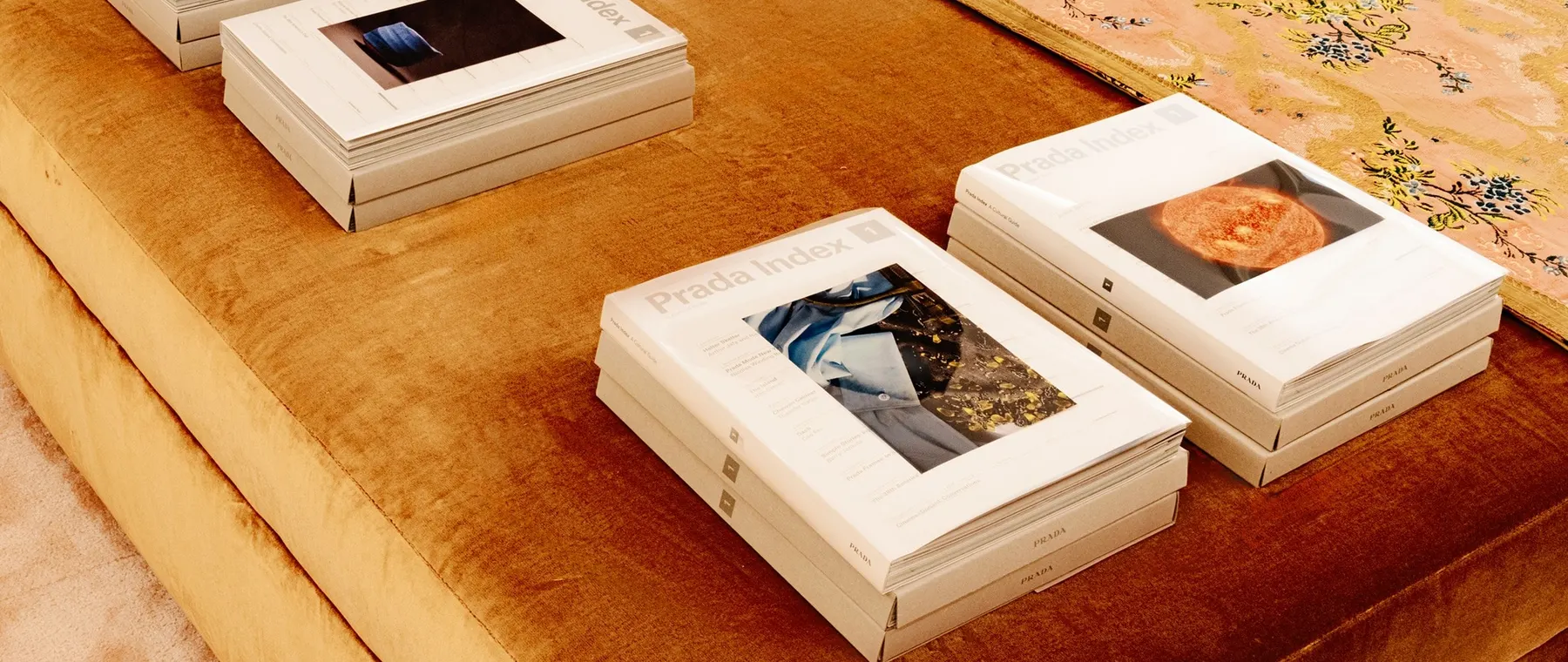
Prada has launched a substantial cultural publication that is more ambitious than a conventional seasonal magazine. Announced in Milan on 19 November 2026, Prada Index is a new guide to the work of Prada, Fondazione Prada and Luna Rossa, with an inaugural issue of almost 400 pages. The group says it is available in print and online, with a design developed by the New York studio 2×4. Its contents stretch across exhibitions, filmmaking, architecture, craft, science and high-performance sailing. This matters because the publication does not present luxury solely as a sequence of products to buy. It asks readers to understand the projects, conversations and creative experiments that surround a brand, including work that does not result in a garment or accessory.
The editorial structure is the story
Prada describes the first edition as a look back at major projects during 2026, rather than a standard quarterly issue built around one approaching season. The company says future editions will have a quarterly scope. That sequence gives the inaugural publication a distinctive role: it establishes a map of activities that might otherwise appear disconnected. A film project, an art exhibition and a sailing campaign may occupy separate parts of a corporate website, but they acquire new relationships when placed alongside one another in print. The design challenge is not simply to put attractive photographs on paper. It is to give readers useful routes through a complicated network while preserving the voices and purposes of individual contributors.
A cast from several creative disciplines
The announced contributors include filmmaker Barry Jenkins, game creator Hideo Kojima, poet Amanda Gorman, and artists Arthur Jafa, Richard Prince and Hito Steyerl. Their presence signals an editorial project that cannot be reduced to the usual format of celebrity endorsements. People from cinema, interactive entertainment, literature and visual art approach narrative, technology and audiences in very different ways. A credible cultural publication can make those differences productive by placing perspectives in dialogue without forcing an artificial agreement. The group also identifies 2×4 New York as the developer and designer of the guide, a significant credit for a publication whose form must carry such varied material. The full value of the editorial design will be clearer to readers examining the printed object.
Art examined through difficult subjects
The first issue revisits Helter Skelter, the Fondazione Prada exhibition of Arthur Jafa and Richard Prince that opened during the 2026 Venice Biennale at Ca' Corner della Regina. Prada says the publication includes a long-form conversation between the artists, reproductions of work and material from a collaborative zine. The exhibition's engagement with American culture and violence does not belong to an uncomplicated luxury mood board, and that is part of the point. Cultural participation can be challenging rather than comforting. An independent reader should distinguish the artists' own statements from the brand's framing of the project and should not assume that inclusion in a magazine settles any critical debate around an exhibition. The editorial opportunity is to make substantial work visible to a broad audience without smoothing away its complexity.
Technology, images and the unsettled present
Hito Steyerl's installation The Island at Fondazione Prada Osservatorio forms another component of the issue. The group says the magazine explores links between archaeology, quantum physics, science fiction and AI-generated imagery through an interview with the artist and curator Niccolò Gravina. This mixture of topics is instructive because contemporary visual culture is increasingly shaped by systems that operate far beyond the studio. The fact that generative imagery is discussed within an arts publication does not mean every image in it was artificially produced, nor that technology is being celebrated uncritically. Steyerl's practice offers a context for questioning how images acquire authority and how seemingly unrelated disciplines influence what viewers accept as real. Those questions also matter to collectors seeking clear provenance for contemporary work.
From games to performance at the Hotel Chelsea
The publication also examines Prada Mode New York: Satellites II, in which filmmaker Nicolas Winding Refn and video-game creator Hideo Kojima helped transform the Hotel Chelsea into a programme of performances and encounters. Prada says their conversation explores communication across language barriers and the possibilities of images and music. The project is useful evidence of a broader move toward cultural experiences that cannot be captured in a single object photograph. A visit, a conversation and a performance have different lifespans from a piece of furniture or a watch. Their documentation must therefore do more than record who attended. A magazine can preserve ideas, decisions and process for people who were not in the room, extending the intellectual life of a temporary event.
Theaster Gates and the knowledge held in a bowl
One of the most tangible stories concerns Theaster Gates's Chawan Cabinet, a ceramic installation associated with the opening of Prada Home in Milan. The group says Gates reflects on craft and material knowledge, beginning with the making of a tea bowl and extending to the renovation of an entire space. There is a revealing change of scale here, from an object held in the hand to an architectural environment. The lesson for design collectors is not that every small craft object secretly functions as a building. Rather, methods of attention, testing and respect for material can persist across very different sizes of project. A publication that preserves the maker's process may help readers understand a finished object more deeply than a list of dimensions and finishes.
Agriculture and imagery in Cao Fei's Dash
Prada Index includes an examination of Dash, the Cao Fei project presented in Milan that explores agricultural drones and changing rural life in China and Southeast Asia. According to the group, the publication brings together research voices including farmers, engineers, architects and philosophers, alongside images from the artist's film and virtual-reality work. This is a striking topic in a publication associated with a luxury fashion house because it shifts attention to labour, technology and landscapes often absent from conventional luxury media. It also demonstrates how contemporary art can connect imagination to practical systems. Readers should not confuse a work of art with a technical report about agricultural equipment; its value lies in the questions it makes possible and in the perspectives it brings into view.
Cinema and the craft of storytelling
Barry Jenkins appears through Simple Stories, the Prada autumn-winter 2026 campaign, which the company describes as an exploration of narrative, character, colour and improvisation. In a conversation involving 2×4's Michael Rock and Prada Index editor India Ennenga, Jenkins discusses his working method. That attention to process can be more informative than reproducing the campaign's final frames without explanation. Film direction involves decisions about rhythm, sound, framing and the relationship between performers and space, all of which may affect how a viewer understands an image. The magazine's broader approach suggests that fashion communication can be considered alongside other forms of visual storytelling. The distinction between creative commentary and promotion remains important, especially when the publisher is also the brand responsible for the original campaign.
Prada Frames asks who controls the image
The Prada Frames symposium In Sight, curated by Formafantasma, is represented through contributions adapted from lectures by Kate Crawford and Akram Zaatari. The group's official description places subjects such as AI-generated imagery, archives, data and the environmental or cognitive costs of digital image production within the discussion. These are not peripheral concerns for luxury and design publishing. An image can be visually persuasive while being poorly sourced, and a beautiful digital asset may have a complex chain of authorship or generation. A magazine that takes those questions seriously creates the possibility of self-examination: how are pictures selected, credited, stored and circulated? Readers should judge the depth of that engagement in the actual essays rather than treating a programme title as proof of a particular conclusion.
Luna Rossa is the maritime heart of the issue
For yacht owners and sailing enthusiasts, the most immediate reason to notice Prada Index may be the section on Luna Rossa and preparations for the 38th America's Cup. The official announcement says it includes a timeline of boat-design development and Giulio Bertelli's photographic essay Anatomy of a Vessel, a close examination of an AC75 through textures, fittings and forms. That makes the publication directly relevant to the world of advanced yacht design, where aerodynamics, hydrodynamics, materials and human control must work together. The photographs promise an unusually detailed way to look at a racing yacht beyond a spectacular exterior profile. The announcement does not provide new measured performance data, and this article makes no claim to possess proprietary design specifications. It is the act of looking closely at a complex vessel that makes the project valuable.
What racing design can teach other disciplines
An AC75 cannot be treated as a direct design template for a comfortable cruising yacht. The operational aims, regulations, crew arrangements and performance compromises are fundamentally different. Yet the racing context makes the consequences of design decisions exceptionally visible: weight, structural form, the placement of equipment and the interaction between human decisions and engineered systems all matter. Prada Index's chosen photographic approach could help a non-specialist appreciate those relationships without pretending to be an engineering manual. There is a corresponding lesson for the luxury world. Material choices acquire meaning through use and constraints, not only through appearance. An object can be sophisticated because its parts work together under demanding conditions, whether it is a sailing vessel, an interior fitting or an artwork with a complex fabrication process.
Cinema Godard and the importance of archives
The guide includes conversations with actors and filmmakers connected to Fondazione Prada's Cinema Godard programme, among them Juliette Binoche and Bruce LaBruce. It also proposes an archival feature called Revisiting, with the inaugural issue returning to Mariko Mori's 1999 Dream Temple commission. These decisions suggest an interest in historical continuity as well as current announcements. Cultural organisations risk becoming a sequence of isolated events if they do not preserve and reinterpret their archives. Bringing an older commission into conversation with new work can reveal changes in technology, taste, institutions and critical language. This makes the guide potentially useful as a reference, although its authority still depends on transparent credits, careful editing and the accuracy of the information assembled.
Print, digital access and the geography of the launch
Prada says the guide launched on 19 November in print and online, with material available at Prada Galleria in Milan. The announcement also identifies a Monocle Café event in London beginning 3 December and distribution in selected Monocle stores, while a dedicated Discord channel is intended to extend discussion beyond the pages. These formats reach different audiences and create different habits of engagement. A substantial printed issue encourages slower reading and physical collecting; online access allows reference and wider circulation; a discussion channel may make the project more conversational. None of these channels guarantees a thriving community by itself. Their significance is in the decision to treat cultural publishing as an ongoing activity rather than a single campaign.
A useful test for cultural luxury publishing
The launch of Prada Index raises a simple but demanding question: can a luxury company's own publication be interesting to readers who are not shopping for its products? Its unusual range of contributors and topics makes the attempt credible, but the answer depends on editorial depth and a willingness to examine questions that may resist easy commercial conclusions. The inaugural issue is substantial enough to warrant that scrutiny. For owners, collectors and designers, the most distinctive element may be the way art, craft and a high-performance sailing programme sit within the same account of making. The primary evidence is Prada Group's 19 November 2026 announcement. A considered reading should preserve the contributors' different voices, with Luna Rossa's visual investigation offering a particularly compelling entry point for a maritime audience.