A current exhibition built around looking closely
The Museum of Modern Art in New York opened Philip Guston: In the Studio on 21 November 2026, bringing a selection of paintings into a focused encounter with the artist's methods, recurring images and unsettled ideas. The exhibition runs through 7 February 2027, according to the museum's official press material. Guston is frequently discussed through the dramatic changes in his career, but this presentation places special emphasis on what happens within the studio: looking, remembering, questioning and making. That is a more useful frame than treating a painter's life as a simple progression from one recognisable style to another. The exhibition is already open as of 26 November, so this is coverage of a current museum programme, not an announcement of a future installation.
Everyday objects acquire difficult meanings
Guston painted light bulbs, cigarettes, eyes, hands and figures that sometimes seem to have wandered out of ordinary life into a troubling dream. The objects are familiar enough to be named immediately, but their relationships refuse quick explanation. According to MoMA, Guston drew on observation, memory and imagination while using light and shadow to make his subjects emotionally charged. This approach matters because recognition is not the same as comprehension. A viewer can identify an object yet remain unsure why it feels threatening, comic or strangely vulnerable. The studio becomes a place where ordinary things are reconsidered, rather than a neutral room in which ideas simply become finished pictures. That difference makes the exhibition relevant to anyone interested in the visual language of interiors and objects.
History is present in the work
MoMA's account of Guston does not separate visual experimentation from the political history that concerned him. Born in Canada to Ukrainian immigrant parents, he moved to the United States in 1919. During the 1930s and 1940s, he made murals addressing turmoil, racist violence and other pressures of the period. Those concerns remained important even when his painting later changed form. It would be misleading to discuss the artist's uneasy figures only as clever visual inventions divorced from their historical context. The museum presents an artist who wanted his work to confront uncomfortable conditions, including the forces that make violence possible. A thoughtful exhibition visit should therefore allow both formal appreciation and historical questioning to take place, rather than choosing one as a substitute for the other.
The movement through abstraction
In the 1950s Guston developed abstract compositions, participating in a major strand of twentieth-century painting that emphasised gesture, colour and relationships across the canvas. His later return to identifiable figures and objects was not simply a surrender of complexity in favour of illustration. The familiar forms gave him a new way to concentrate ambiguity, memory and critique. MoMA's focus on the studio invites viewers to see these phases as related investigations into what painting can communicate. A brushstroke that once contributed to a field of abstraction might later help describe a room, a body part or an imagined landscape. This is an interpretive possibility rather than a claim that one exhibition displays every stage of his career. The selected works ask viewers to follow the questions that persisted across changing visual vocabularies.
The privacy of making and the public result
The museum describes Guston's increasing withdrawal from the art world and his long sessions working in Woodstock, New York. His studio was not just a picturesque setting; it was a working environment in which repetition and hesitation became part of the creative process. A collector usually encounters the completed picture, carefully lit and installed, with the difficult hours of making largely invisible. This exhibition's title encourages a different kind of attention. What was being reconsidered or rejected before the final canvas emerged? How did the artist's remembered images change through repeated treatment? The official materials do not offer a minute-by-minute reconstruction of his working day, and such a claim would be artificial. They do provide a basis for treating the studio as a place of intellectual labour rather than romantic mystery.
The 1970s paintings carry the argument
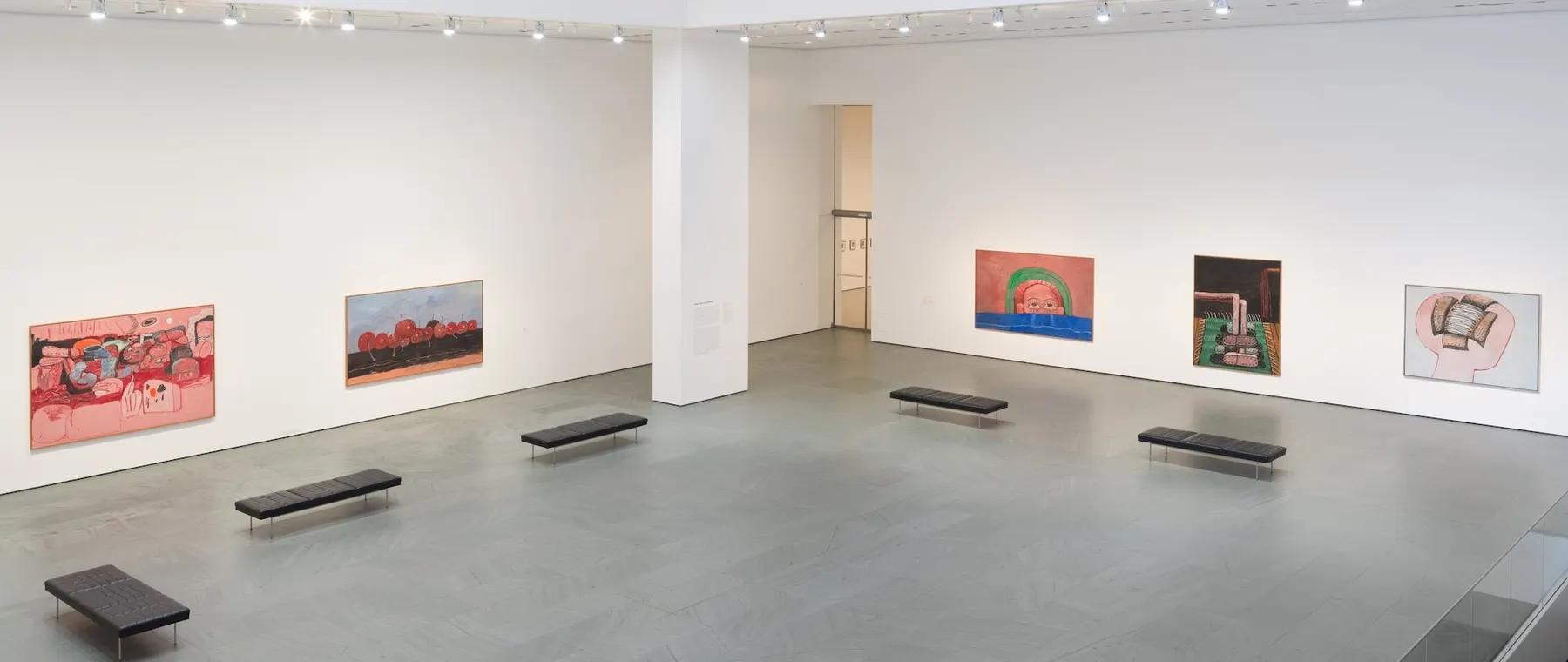
MoMA identifies works from the 1970s, the last decade of Guston's life, as central to the exhibition. The museum's press checklist includes City Limits, Deluge II, Green Rug, In the Studio, Head, Source and Cherries, among other material documented for the show. These titles convey how far the artist travelled from purely abstract naming, but they do not make the pictures straightforward. A word such as cherries might suggest domestic comfort; the painting can place such references within an unstable visual world. Eyes and hands recur in the museum's description as particularly important motifs. They evoke acts of seeing and making while remaining fragments of the human figure. The paintings therefore reflect on the work of perception even as they present troubling subjects for perception to confront.
Looking at an installation, not only an image
A reproduction is helpful for identifying the components of a painting, yet scale and the relationship between works change how they are experienced. Some canvases in the exhibition are large enough to dominate a room, and a viewer's physical position affects the distance at which a figure becomes legible. MoMA has released installation photographs showing the exhibition in place after its November opening. Those photographs are valuable contextual evidence, although they cannot replace direct inspection of surface, colour and arrangement. An independent editorial report should distinguish a documented installation view from a claim that its author personally visited the gallery. The present coverage uses the museum's published information and image documentation, not invented first-hand impressions of the room.
What collectors can learn from difficult paintings
A collector may be drawn to an artwork because it brings pleasure, excitement or an unexpected relationship to a space. Guston's late painting shows that an important work can also resist easy harmony with its setting. Images of doubt, history or discomfort are not necessarily decorative, and their presence can give a collection intellectual substance. This does not imply that confronting work is automatically more valuable than quieter work, or that investment performance can be derived from an artist's seriousness. A responsible acquisition begins with understanding the object, its provenance and the questions it raises. Museum exhibitions can help by providing historical and formal context outside the immediate pressure of a sale. Guston's work is especially instructive because its accessible imagery should not be confused with simple meaning.
A studio portrait for designers
The exhibition has an additional resonance for architects and interior designers because so many late Guston images are anchored in rooms, objects and strange spatial enclosures. A painting can make a wall, tabletop or ordinary light source feel psychologically charged without changing the literal function of those things. This reminds designers that occupants read interiors through memory and association as well as comfort and material specification. It would be irresponsible to claim that Guston offers a design formula for luxury rooms; his concerns were artistic and historical, not a guide to furnishing. The useful connection is more modest: an object or space carries meanings that exceed its measurements and retail description. Good design criticism should be attentive to that complexity rather than treating visual atmosphere as neutral.
The yacht collection has a particular responsibility
Owners who display art aboard yachts must balance the pleasure of living with works against environmental and conservation constraints. Paintings can be sensitive to humidity, temperature fluctuation, vibration, physical movement and light exposure, and the appropriate approach depends on the work and its materials. A museum display of important historical canvases is not an implicit recommendation to move similar objects onto a vessel. On board, specialist advice may be needed on secure fixing, condition checks and whether a reproduction or alternative work is preferable for a particular location. The wider lesson from the exhibition is that art deserves serious stewardship. Understanding a painting's history and visual language should be matched by care for its physical survival, not merely by selecting the most impressive wall.
Credit and authorship remain essential
MoMA's press materials list not only the artist and titles but also ownership and photographic credits, including images of the installed exhibition made by Jonathan Dorado. That detail matters in a media environment where artwork photographs can circulate detached from their origins. An image of a painting is not a free-standing anonymous visual asset. It may involve rights held by the artist's estate, the collecting institution and the photographer. The museum permits press images for current exhibition coverage subject to restrictions and clear credit, while additional permissions may still be necessary. Editors should therefore avoid using a museum photograph as generic decoration for an unrelated commercial message. The distinction between factual reporting and promotional reuse is part of responsible cultural publishing.
Why a focused exhibition can be revealing
Large retrospectives offer a panoramic view, but a smaller presentation organised around one question can make repeated motifs easier to follow. The studio focus encourages visitors to notice how objects, body parts and spatial relationships return in different configurations. It also brings attention to the artist's effort to articulate a difficult experience rather than to a sequence of stylistic labels. The museum identifies Lydia Mullin as organiser, with Elizabeth Wickham in a curatorial role. Their framing offers a point of entry for viewers who may not already know Guston's career in detail. It remains important to distinguish the museum's curatorial interpretation from the artist's own statements, even when they illuminate each other. An exhibition is an argued selection, not the complete biography of a life.
A careful way to describe the experience
The best response to Guston's work is not to force every mysterious image into a fixed symbolic dictionary. A disembodied hand may suggest making, vulnerability or separation, but its precise force depends on the canvas and the viewer's attention. The museum's text emphasises a continuing process of looking, remembering and doubting, and those verbs are useful guides. They leave space for uncertainty without making the artwork arbitrary. This is especially important when history and personal memory intersect in a painter's visual vocabulary. A visitor can remain open to ambiguity while also taking seriously the documented political and biographical context. The resulting encounter is more demanding than a quick photograph, yet it may be the reason an exhibition stays in the mind long after a museum visit.
Practical details and the source of the account
Philip Guston: In the Studio is scheduled at The Museum of Modern Art in New York from 21 November 2026 to 7 February 2027. The museum's public press record identifies the curatorial team, discusses the artist's career and supplies photographs of individual paintings and the installed exhibition. The present report does not claim interviews, sales information or observations not provided by those materials. Readers planning a visit should consult MoMA for current admission, hours and programme changes, while those reproducing images must follow the press permissions and full credits. The source is MoMA's official exhibition press kit and overview. For collectors and designers alike, the exhibition's lasting question is how familiar forms can be made to carry the complicated experience of the world.