The book as an artistic encounter
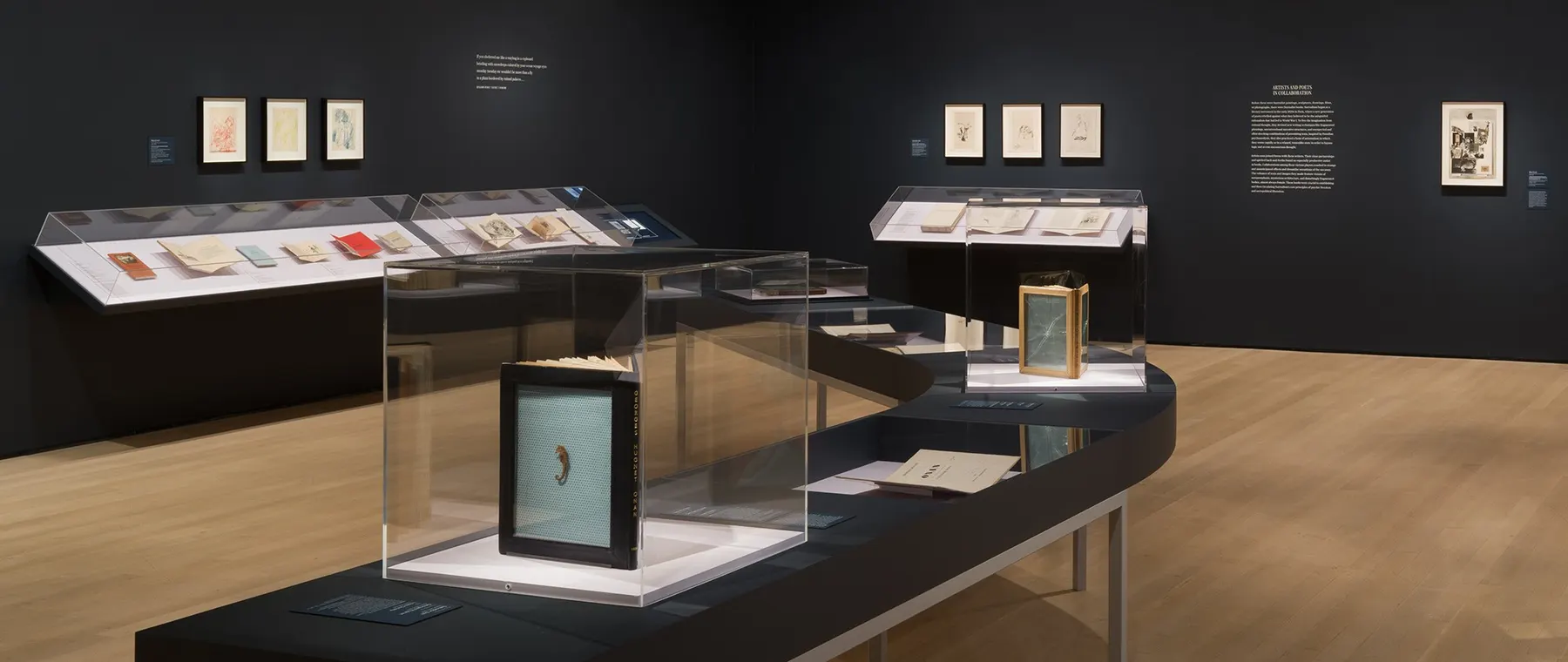
The Museum of Modern Art in New York is showing The Surrealist Book: Tomorrow Lives in Mirrors, an exhibition that asks visitors to look at rare books as original artworks rather than simply containers for writing. The show opened on 4 October 2026 and continues through 23 January 2027, according to the museum's official press kit. It brings together volumes connected with André Breton, Claude Cahun, Salvador Dalí, Paul Éluard, Max Ernst, Toyen and other artists whose experiments challenged familiar divisions between words and images. That is a distinctive proposition for collectors: a book can possess an intellectual content, a material structure and a visual identity that are inseparable. Understanding one of these objects means considering all three, even when it is encountered behind museum glass.
Surrealism looked beyond predictable narrative
The Surrealist movement sought to disturb the familiar logic by which people order experience. Dreams, unexpected associations and unconscious impulses offered alternatives to conventional explanation, while collaborative methods allowed one artist's response to interrupt another's intentions. The bound volume was an especially useful field for such experiments because it forces material into a sequence. The reader turns pages and discovers images, gaps, fragments or juxtapositions at a pace partly determined by the design of the object. A text need not explain a picture, and an illustration need not merely decorate a sentence. A book can become a deliberately unstable encounter in which each element changes the meaning of what came before.
A visual object with a physical life
An artist's book is more than a manuscript printed on paper. Its size, binding, typography, paper stock, foldouts and treatment of images can all become decisions through which an artistic idea takes form. The spine determines how the object opens; a page's transparency or texture may alter how an image is understood; repeated elements can establish or disrupt rhythm. When a rare volume is displayed in a museum, some of these characteristics may be difficult to appreciate through a single open spread. Curators face the challenge of revealing the book's design without exposing delicate pages to excessive handling. This tension is part of the exhibition's subject, not a practical detail to be ignored. A book remains an object designed to be turned, even when preservation requires it to remain still.
André Breton's role and the limits of authorship
André Breton is central to the history of Surrealism, and his writing helped articulate the movement's ambitions. Yet this exhibition's premise makes it impossible to understand a Surrealist book through the name of its author alone. Designers, illustrators, printers, binders and collaborating artists may all shape the reader's encounter. The museum's gallery of press images includes material connected with Breton and the bookbinder Paul Bonet, revealing the importance of form around the printed words. It would be inaccurate to present every such collaboration as identical or to assume that the binding and text were necessarily produced together. The larger principle is that provenance and credit must capture the contributions of more than one person when the object depends on their combined work.
Women and the changing picture of Surrealism
Claude Cahun and Toyen appear among the artists highlighted by the museum. Their presence matters because accounts of twentieth-century avant-garde movements have often been constructed around a relatively small group of prominent male figures. Attention to the book allows a different history to emerge through printed experiments, photography, typography and visual relationships that may not be as familiar as the movement's most reproduced paintings. Cahun's work, developed in close collaboration with Marcel Moore, is especially instructive as a challenge to simplistic ideas of individual authorship. The exhibition does not claim that every historically neglected contribution has now been recovered. It provides an opportunity to recognise how the archive can alter the story once curators ask different questions of the surviving material.
Images do not always illustrate words
A Surrealist publication can use familiar devices such as captions, portraits or recurring motifs while denying the reader the explanation those devices usually promise. A photograph might be juxtaposed with a text that seems unrelated, prompting a search for connections that the editor never resolves. This is not the same as random assembly. Deliberate choices about order, scale and contrast can make a surprise feel purposeful. The reader's uncertainty becomes part of the work. For a contemporary audience accustomed to highly directed digital interfaces, these older experiments remain surprisingly relevant: a publication can give a person room to interpret rather than delivering every message as a completed instruction. That freedom may be one reason rare Surrealist books retain their appeal beyond the historical specialists who first studied them.
Salvador Dalí and the unexpected page
Dalí's name is strongly associated with memorable painted images, yet his participation in Surrealist print culture is a reminder that artists were often active across mediums. The museum's official image list includes book material connected with Dalí, Breton, Éluard and other collaborators. The point is not to claim that each volume is a miniature version of a famous painting. Printed form creates different possibilities: images can be repeated or partially revealed, and a reader chooses how long to dwell on a spread. Physical books were also capable of circulating ideas among people who could not visit exhibitions. Their usefulness as portable artistic experiments helped transform the nature of the movement's public engagement. The exhibition makes those material and social possibilities visible.
Conservation creates an unusual problem
A painting can often be appreciated in a single view, but a book has many possible states depending on the page opened. Displaying an irreplaceable volume creates a choice about which moment will represent the whole. Light exposure, paper acidity, binding tension and handling can affect its condition. A conservator may limit opening angles, use custom supports or rotate displays to reduce strain. The exact measures for each object in the exhibition are not specified here and should not be invented. Nevertheless, this general conservation problem is essential to understanding why owners of rare books cannot treat them as ordinary volumes kept continuously open on a coffee table. Collectibility brings stewardship duties that may conflict with the desire to see every page.
The relevance of rare books to luxury collections
Private collections often include artworks, jewellery and furniture, while books are sometimes treated primarily as research material. Artist's books challenge that hierarchy. Their rarity may reflect a small edition, unusual handwork, a distinguished provenance or the survival of a particular combination of components. A thoughtful acquisition involves more than recognising an artist's signature. Collectors should ask whether pages are complete, whether a binding is original or later, how any restoration was carried out and what documentation supports the object's edition and ownership history. Not every attractive Surrealist-themed book is an original Surrealist artist's book, and not every publication carrying a famous name is equally significant. The museum context helps make such distinctions intelligible without presenting market values as established outcomes.
Libraries and interiors as designed spaces
A room containing books can be designed for use, display or both. Its shelves and cabinetry determine how objects are stored; seating and illumination affect how readers spend time with them. A rare illustrated volume may require a cradle or controlled viewing arrangement rather than placement in a casual stack. The Surrealist Book exhibition suggests that a library can also be understood as a collection of designed objects whose physical features are meaningful. That does not justify stripping a book of its practical or literary identity and treating it as decoration alone. The most interesting library is one in which reading and preservation remain possible, with materials selected for their significance rather than solely for the colour of the spines.
A special challenge aboard yachts
Yacht owners with book collections should consider the consequences of vibration, movement, humidity and salt-laden air for vulnerable paper and bindings. Direct sunlight, cleaning chemicals and rapidly changing temperatures may also create risks. A fragile Surrealist first edition is not automatically a suitable item to leave unsecured in a salon, even if it would make a striking display. Professionally made facsimiles or carefully selected modern editions may be more practical for reading afloat, while originals are protected in an appropriate environment. These are general conservation considerations, not instructions for a specific artefact without inspection. The exhibition provides an opportunity to reconsider the relationship between possession and care, especially when an object is attractive precisely because its physical condition and history have survived.
Exhibition design can reveal an unseen sequence
One of the curatorial difficulties is to communicate the experience of turning pages without permitting extensive handling. Installation photography can show the case, the chosen opening or surrounding interpretation, but it does not reconstruct the full sequence of a volume. Video documentation, selected page reproductions and carefully written labels can help, though each medium has its limitations. The official MoMA press images include installation views as well as examples of works and catalogue material, offering useful evidence of what the exhibition presents. Readers should not mistake a photograph of one open page for a complete digital edition or a licence to reproduce an entire book. The artwork's photographic and literary rights may involve different owners, and editorial reuse should respect the institution's stated terms.
The people behind the exhibition
MoMA identifies Jodi Hauptman and Starr Figura as the curators of The Surrealist Book: Tomorrow Lives in Mirrors. Their project foregrounds books as central instruments of artistic experimentation, rather than side products created after major paintings or exhibitions. That adjustment of emphasis is significant because art history often depends on which kinds of material institutions decide to catalogue and display. A well-documented paper object can reveal a network of personal connections, printers, workshops and collaborators that is harder to perceive from a single large work. The exhibition's selection remains an interpretation of a complex movement, not an exhaustive catalogue. Its value lies in prompting visitors to look at artefacts and artistic relationships they might otherwise have passed over.
Why these experiments still matter
Contemporary publishing often uses digital tools to make pages fluid, interactive and easy to distribute. Surrealist books demonstrate that physical publishing explored unpredictability, collaboration and unusual sequencing long before digital platforms. A folded image, unusual typography or deliberately disruptive page order can create interaction without a screen. The lesson is not that paper is inherently more authentic than technology. It is that sophisticated communication can be built through limitations as well as through expanding capability. An artist who understands the form of a book can make the reader's physical participation meaningful. This possibility is particularly relevant to collectors who value material craft and to designers who see an interior as a sequence of experiences rather than a static photograph.
Visiting and verifying the record
The Surrealist Book: Tomorrow Lives in Mirrors opened at MoMA on 4 October 2026 and is scheduled to continue through 23 January 2027. Its official press kit lists the curatorial team and examples of historical books, along with credited imagery for coverage of the current show. This account does not claim to have personally examined every rare volume or to know unpublished loan values or private market estimates. Visitors should consult the museum for current operating details and the permitted photography policy. The primary evidence is MoMA's official Surrealist Book exhibition material. For those who collect art or design, the lesson is both simple and profound: a book can be an original artistic environment, and turning its pages can be part of the work itself.