More than a survey of a familiar art movement
MoMA PS1 opened Hard Art on 5 November 2026, turning its galleries in Long Island City into a sustained conversation about the history and continuing possibilities of abstraction by Black artists in the United States. The museum's official announcement describes more than 90 works by over 40 artists, spanning practices that became prominent around the 1970s and work being made today. The exhibition runs through 15 March 2027, making it a current destination for visitors rather than an advance announcement. It is not simply a chronological collection of abstract paintings. By placing sculpture, moving image, sound and painting into the same conversation, it asks what abstraction can do when the conditions in which an artist lives are also part of the work's meaning.
Why the dates matter
The exhibition takes 1969 as a significant starting point, a choice that places abstraction amid intense political and cultural change rather than within a timeless history of pure form. Art histories often tell a familiar story in which figuration conveys recognizable political subjects while abstraction operates at a distance from them. Hard Art deliberately complicates that separation. A painting can be abstract and still be shaped by the experience of exclusion, freedom, bodily movement, urban space and institutional power. Equally, a work's relation to social life cannot be inferred merely from the identity of its maker. Each individual project needs careful interpretation and historical grounding. The exhibition offers an opportunity to revisit this period without turning several generations of distinct artists into one uniform school.
The earlier generation comes into focus
The official artist list includes Frank Bowling, Peter Bradley, Barbara Chase-Riboud, Ed Clark, Melvin Edwards, Joe Overstreet and Raymond Saunders. These artists developed strikingly different responses to the possibilities of material, colour, structure and gesture. Some worked in painting, others crossed into sculpture or installation, and many resisted being defined entirely by a single movement. Their inclusion matters because an influential artistic history can become narrow when it repeatedly presents the same few figures as representative of an entire period. The project creates space to encounter individual choices about scale, surface, colour and engineering rather than treating historical abstraction as a fixed vocabulary. Viewers should approach the work as a collection of particular investigations, not evidence that every participant shared one artistic intention.
Recent work changes the question
The museum pairs these earlier contributions with work by artists including Aria Dean, Torkwase Dyson, Nikita Gale, Jennie C. Jones, Rindon Johnson, Carolyn Lazard, Eric N. Mack, Charisse Pearlina Weston and SoiL Thornton. Their participation broadens the conversation beyond the canvas. Contemporary abstraction can involve sound, a constructed environment, video or arrangements that make viewers more conscious of their own movement through a room. Yet a museum roster does not automatically tell us what every displayed object looks or feels like. The important editorial task is to avoid substituting a generic description for the specificity of each practice. The shared exhibition framework suggests questions about history and space; the responses must be discovered through the actual works, their labels and the artists' own statements.
Space is not a neutral container
Torkwase Dyson's newly commissioned architectural environment is a particularly revealing part of the museum's announced project. MoMA PS1 describes it as a freestanding structure within the double-height gallery, extending the artist's investigation of Black spatial liberation. A construction that visitors can perceive in relation to their own bodies changes the meaning of exhibition architecture. The gallery is no longer merely a silent white envelope around objects; movement, distance and boundaries become part of the experience. This does not make the project an architectural proposal for a real building, nor should it be described as a completed residential design. It does show why contemporary art can ask serious questions about the way spaces organise freedom, access and visual attention.
Materials have social histories too
Abstraction is sometimes discussed as though the choice of material were purely formal. Yet steel, wood, paint, fabric and industrial components carry histories of labour, manufacture and cultural meaning. An artist who selects an everyday material may be questioning the distinction between ordinary work and fine art. Another might use a highly polished surface to draw attention to the viewer's reflection, or deploy repeated geometry to create a particular sense of pace. These examples are interpretive possibilities, not claims about unnamed works in the exhibition. The broader lesson is that craftsmanship need not imply decorative refinement. It can involve a deliberate refusal of polish, a technical struggle with a substance or a structural decision that changes how the viewer understands an object.
The museum is making an argument
A significant exhibition is not a neutral warehouse of important things. Its curators choose which works to put near one another and which histories deserve greater visibility. Hard Art argues that the story of abstraction has been too frequently told without adequate attention to generations of Black American artists whose work reshaped the field. That proposition can be assessed through the selection, research and public interpretation the institution provides. The exhibition is accompanied by a fully illustrated publication with contributions from several writers, artists and historians, offering a way to examine the argument beyond the gallery floor. A serious reader should treat that publication as a source of researched perspectives while remaining open to critical disagreement about what the exhibition includes or leaves out.
A challenge to the collecting instinct
Collectors often begin with a visual preference: a colour field, a sculptural silhouette or a particular technique. Hard Art makes it difficult to stop there, because its works invite attention to historical conditions and the institutions that shaped whose work was seen. This does not mean that pleasure in colour, texture or proportion is suspect. Rather, a more knowledgeable collector can enjoy those qualities while asking how the work developed, what the artist intended and whether its provenance and exhibition history are understood. An artwork's market price should not be treated as a substitute for that inquiry. The exhibition offers context, but no museum presentation guarantees that a given object will appreciate financially or that every individual interpretation will become critical consensus.
Relevance for contemporary interiors
Large abstract works can have an extraordinary relationship with the rooms in which they are displayed. Their proportions affect sightlines; their material surfaces may react differently under daylight and artificial illumination; the space needed around an object can be an essential part of its experience. For designers, the temptation is to treat such works as final colour accents selected after a room is otherwise complete. The practices explored by Hard Art suggest a more integrated conversation. Art can be engaged early as an intellectual and spatial presence, while still requiring respect for its independent meaning. A work concerned with access, constraint or identity should not have its purpose casually reduced to matching upholstery. That is a curatorial and ethical question as much as a visual one.
The specific requirements of yachts
On a yacht, the relationship between art and architecture becomes even more demanding. Limited wall space, curved surfaces, movement, vibration and environmental fluctuations can make installation complicated. Sculpture may need engineered restraint, and fragile surfaces may require protection from cleaning routines or direct salt exposure. None of the works presented by MoMA PS1 should be assumed suitable for marine installation merely because a photograph looks compelling in an interior. A collector contemplating any comparable acquisition would need guidance from the artist or estate, a conservator and qualified marine professionals. The wider value of the exhibition is that it reinforces the need to understand an artwork's construction and conceptual purpose before deciding where it will live.
What images can and cannot tell us
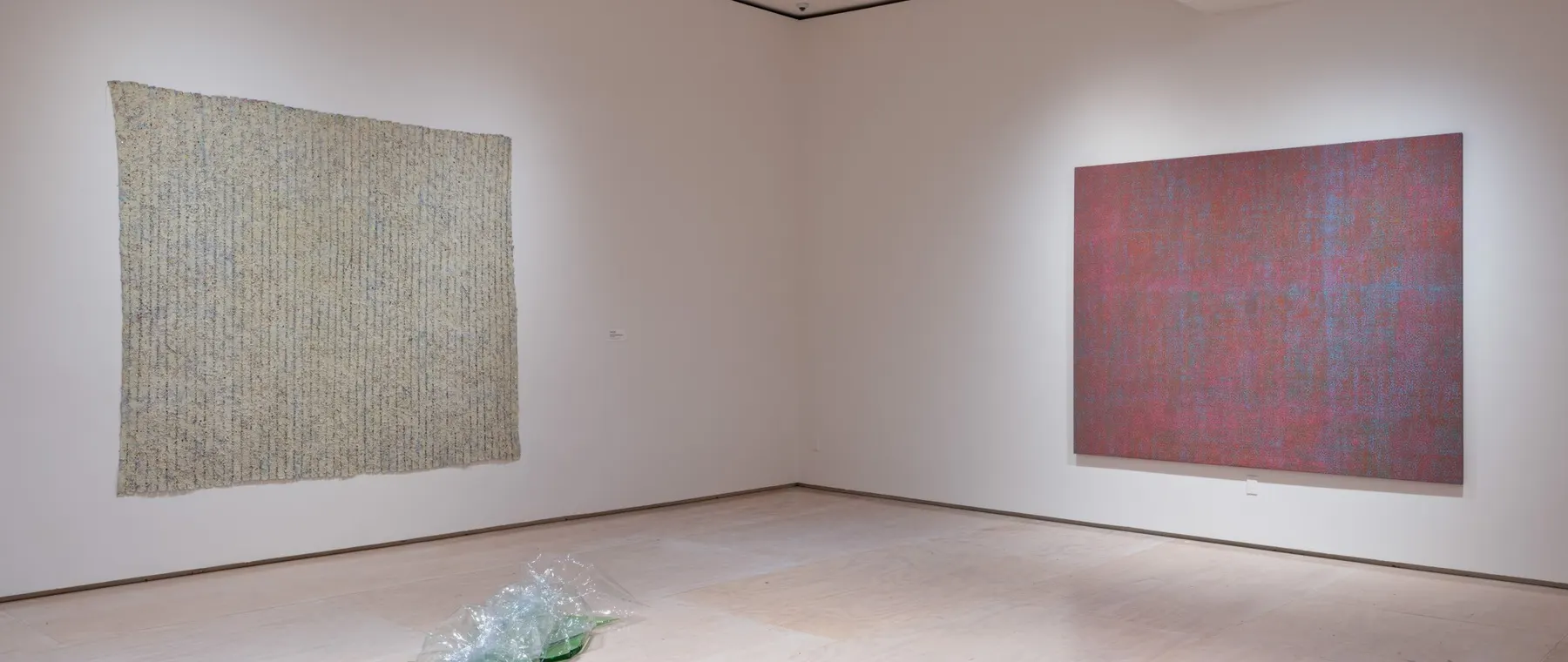
The museum has released official photographs associated with the current exhibition. They are valuable for documenting arrangement and atmosphere, but still images cannot reproduce changing perspectives, the physical size of installations or the sound of multimedia work. Even the most accurate photograph is a record made from one position under particular conditions. An editorial article should not pretend that looking at those press images is the same as personally walking through PS1. The accompanying image is a credited museum installation view, used to identify the actual exhibition, and not an anonymous stock illustration. Press use is subject to the museum's permissions and additional rights holders. These distinctions matter especially when images are subsequently shared beyond their original editorial setting.
Three generations without a single conclusion
The most compelling feature of Hard Art may be its refusal to resolve decades of visual experiment into one neat definition. Abstraction is a way of working with relations between form, scale, sensation and idea; it is not one style that can be copied without change. Artists of different generations may respond to different pressures while learning from or challenging one another's work. The exhibition's structure creates an opportunity to notice those continuities without denying disagreement. A collector or visitor who arrives expecting a sequence of pleasing geometries may instead encounter work that asks for sustained attention to history and bodily presence. That is not a defect in the museum experience. It is a reminder that strong art can reward uncertainty as well as immediate recognition.
How to engage with the exhibition
The first practical step is to allow enough time for the different media rather than treating the gallery as a background for quick photographs. Read labels for dates and materials, attend to the distances between works, and compare the earlier generations with the more recent projects without assuming one is a direct continuation of another. Where installations involve sound or moving images, a brief glance may miss the work's duration and structure. The illustrated publication may be valuable for visitors who want deeper historical discussion after leaving the museum. Anyone unable to visit can begin with MoMA PS1's published exhibition description, but should distinguish research based on that account from first-hand observations or critical reviews made after attending.
Dates and independently verifiable details
MoMA PS1 identifies Hard Art as opening on 5 November 2026 and continuing through 15 March 2027 in Long Island City, New York. Its official press material describes more than 90 works by over 40 artists, with multiple generations of work and a particular interest in the cultural and political implications of abstraction. No attendance figures, sale results or personal gallery impressions are asserted here. The original source is the MoMA PS1 Hard Art press kit, which supplies the programme, artist information and credited press photography. For collectors, designers and the broader art audience, the exhibition's importance lies in its insistence that the history of form is also a history of people, spaces and whose creative work receives sustained attention.