An exhibition that asks visitors to listen to space
The Museum of Modern Art in New York opened Na Mira: NO SMOKING on 14 November 2026, presenting the Korean American artist's first solo museum exhibition in the city. The installation occupies MoMA's Marie-Josée and Henry Kravis Studio and is scheduled to remain on view through 15 February 2027, according to the museum's current press page. It combines projected images and a site-responsive sound environment, creating an encounter that extends beyond the straightforward act of watching a film. Mira works with technological signals, photographic processes and locations marked by political and historical tensions. The result is a project that asks how places become visible and how sensory technologies influence the way people understand them.
The space itself becomes part of the work
A conventional film screening places the image at the front of a dark room and invites the audience to direct its attention toward a single rectangle. Mira's installation engages the architecture of the Studio more actively. MoMA describes spectral projections and a site-responsive sonic environment, suggesting an artwork whose relationship to the room matters as much as any individual image. It would be premature to describe exact sound levels, visitor pathways or the timing of every sequence without a firsthand examination of the installation. The public documentation does make clear that the environment is conceived as a whole. A visitor is encouraged to notice not only what is projected but where it appears, how it relates to the room and how sound affects the surrounding perception.
A practice shaped by experimental media
Mira's earlier work has included experiments with radio-frequency disturbances, infrared video and holography. These methods are not interchangeable. Infrared imaging can reveal characteristics of a scene that differ from what conventional visible-light photography shows, while disturbances in a radio signal may expose the limits of systems designed to appear transparent. Holographic approaches suggest yet another relationship between image and spatial experience. The artist's practice uses such technologies to ask what becomes perceptible and what remains concealed. The exhibition's description does not establish that every named technique appears in the finished installation in the same form. It offers context for understanding a maker who treats the medium's own behaviour as part of the subject.
Landscapes can carry political meaning
MoMA identifies the late-1960s Japanese film theory fûkeiron as an influence on NO SMOKING. The theory argues, in broad terms, that landscapes can express political conditions without relying solely on conventional narration. This reframes the relationship between a place and its depiction. A street, building or apparently empty environment may contain evidence of rules, labour and structures of power that are not immediately named in the image. Mira's project follows this interest in landscapes marked by rupture. That does not mean every viewer will identify the same political reading from the projected material. The work appears to invite attention to the gap between what a place seems to show and the forces that make it function as it does.
The geography behind the new footage
The museum says Mira recorded material in the summer of 2025 inside an empty cinema at Fort Bliss and at the adjacent White Sands Missile Range near the United States–Mexico border. These places are associated with military operations and large-scale infrastructure, giving the source footage a context distinct from a studio-built fictional set. An empty cinema is an especially suggestive location for a project about images: a space designed for collective spectatorship appears without its audience, inside a larger institution shaped by an entirely different purpose. It would be inappropriate to infer restricted operational details from the artwork or to claim the footage discloses information not described by the museum. Its public significance lies in the artistic choice of place and the ways that choice affects the act of looking.
The role of the absent audience
A cinema without viewers can feel both familiar and strange. Its seats, projection arrangements and fixed orientation suggest an activity that is not taking place. For an artist interested in the histories of media, that absence can become a powerful device. It asks a visitor to think about who is invited to watch, who controls the image and how the conditions around a screening influence the story perceived on the screen. These questions are interpretive rather than a description of a particular sequence in Mira's film. The documented setting provides a foundation for them. The work's larger achievement must be assessed through the completed installation, where sound, projection and duration may complicate what a still image can communicate.
Sound can alter the meaning of an image
Audio in an installation does more than accompany the visuals. A low tone, a changing spatial cue or a disturbance in a signal can make the visitor more conscious of the room and of their own position. MoMA's description of a site-responsive sonic environment means the project should be understood partly through its relationship to the specific exhibition space. It does not disclose the full acoustic system or give enough information to claim any precise physiological effect on visitors. The relevant design issue is how sound becomes a material of experience, shaped by architecture and attention. For people accustomed to conventional gallery displays, such work can demonstrate that an artwork's composition extends beyond its visible surfaces.
The boundaries between documentation and invention
An installation that uses images captured at real sites may still transform those images through artistic processes. This distinction matters because documentary value and aesthetic invention are often discussed as though one excludes the other. Mira's project draws on material recorded in identifiable locations, but the result is not described as an unedited surveillance record or a neutral field survey. The artist's decisions about technology, sequence and setting are central to its meaning. A responsible account should identify the location and methods supplied by the institution without inventing narratives for people or events not documented in the press kit. The subject is the work as a constructed experience that questions how representations are made.
The museum's curatorial framework
The exhibition is organised by Sophie Cavoulacos, an associate curator in MoMA's Department of Film, with Abby Hermosilla in a curatorial role. Their framing positions Mira within a contemporary conversation about experimental moving images, installation and the relationship between media and power. The museum also identifies a partnership with Richard Mille supporting its media and performance programming. Such institutional information helps readers understand how a project is presented, but it should not be confused with a claim that a commercial partner authored the installation. Artistic credit belongs to the maker and relevant collaborators. A clear distinction between sponsorship, curatorial interpretation and creation is essential whenever cultural programming intersects with luxury brands.
An unusual connection to luxury design
At first glance, an experimental installation concerned with military landscapes may seem far from luxury interiors. Yet it raises questions that designers of complex environments also face: how do sound, light, movement and the structure of a room affect the person inside it? High-end design sometimes reduces atmosphere to a sequence of appealing images. Mira's work suggests that atmosphere is also temporal and spatial, changing as a visitor listens and moves. This is not a recommendation to copy the work's political imagery in a domestic setting. It is an invitation to take the experiential dimensions of architecture seriously, especially when digital projection and audio are being incorporated into carefully designed rooms.
Yacht cinemas and media rooms provide a practical parallel
Private yachts increasingly include dedicated media environments, integrated sound systems and lighting that can be adjusted for different kinds of experience. A well-designed installation at sea needs to consider the physical room as much as the equipment. Reflections, seating positions, vibration and the distribution of sound can all affect how a screening is experienced. Mira's installation is not an engineering specification for a yacht cinema, nor does the museum claim its systems are intended for marine use. Nevertheless, its site-responsive approach provides a useful conceptual parallel: media becomes more compelling when it is understood as part of a space rather than an accessory attached after the interior design is complete.
Technology also has a conservation problem
Works involving projections, software, electronic hardware or audio systems can be challenging to preserve over time. Components may be discontinued, formats can change and recreating an installation in a different room may affect the artist's intentions. Collectors interested in media art should ask about authorised exhibition conditions, technical documentation and responsibilities for future maintenance. A photograph of the installation is not the work itself, and the museum's press imagery does not establish the terms on which the full installation could be acquired. These questions are especially important for an artist whose practice uses the characteristics of signals and projection systems rather than treating technology as invisible machinery. Preservation may require safeguarding a method as well as a physical object.
Press photographs show only one part of the experience
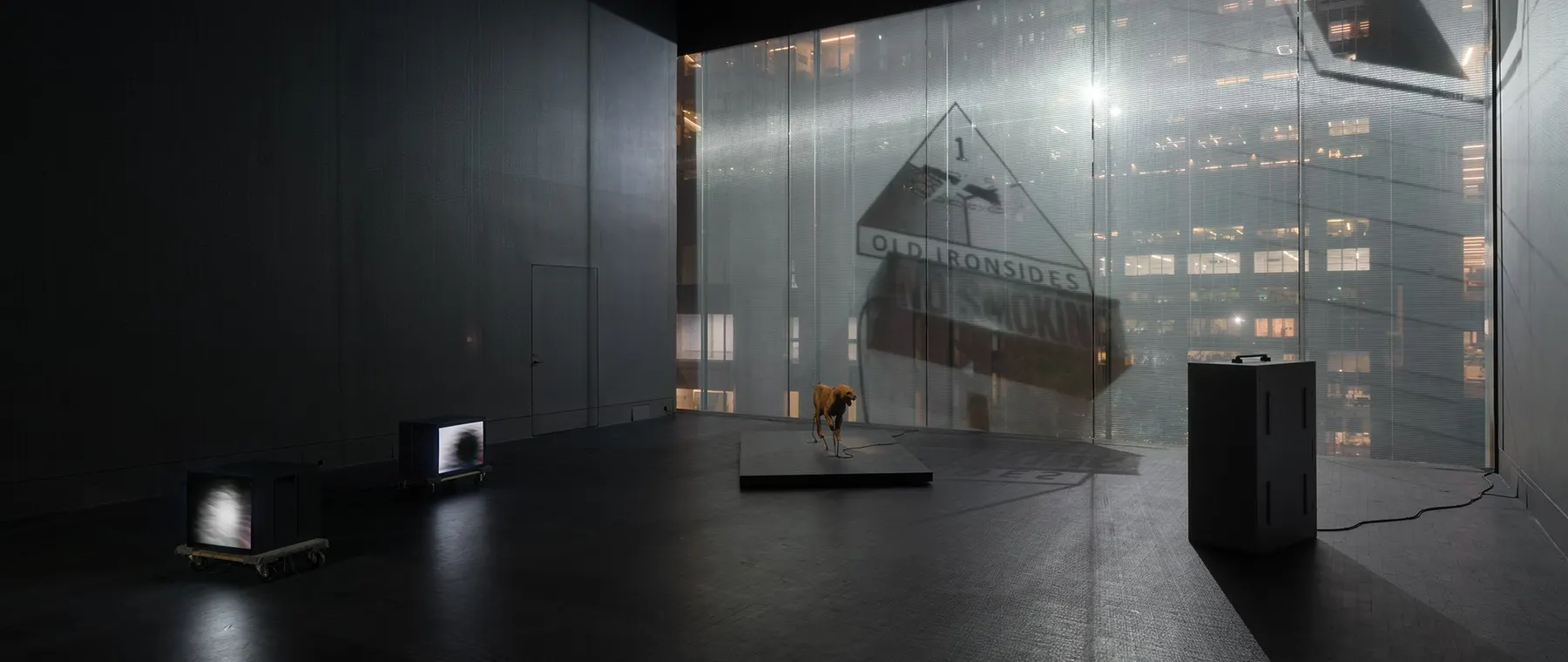
MoMA has issued an official installation photograph by Jonathan Dorado associated with the current NO SMOKING exhibition. Such images are important evidence for confirming the physical existence and visual character of a display. They cannot, however, reproduce its sound, the changing sequence of projections or the way a visitor's attention moves within the room. Any editorial report based on the museum's public material should make that limitation clear. It should also preserve the full credit and respect the institution's permissions for current exhibition coverage. The photograph accompanying this article is identified as an installation view, not a fictional rendering or a substitute for the time-based work itself.
The artist's first solo New York museum exhibition
MoMA describes NO SMOKING as Mira's largest new commission to date and her first solo museum exhibition in New York. Those facts explain its institutional significance without requiring exaggerated claims about its future influence. The exhibition brings together long-standing interests in media history, technological disruption and charged landscapes in a form designed for one of the museum's dedicated performance spaces. A visitor may encounter the piece through questions of cinema, political geography, sound or the nature of the image. These are overlapping ways of approaching a difficult work, and none should be treated as the only correct interpretation. The curatorial information provides a starting point for attention, not a finished answer to every question the installation raises.
Dates and source record
Na Mira: NO SMOKING is on view at The Museum of Modern Art from 14 November 2026 through 15 February 2027 according to its current official exhibition press page. The museum identifies the use of imagery recorded in 2025 at Fort Bliss and White Sands Missile Range, and describes spectral projection and a site-responsive sound environment. No private technical specifications, attendance figures or visitor reactions are asserted in this report. For collectors, curators and designers, the central lesson is that media art occupies more than a screen. Its meaning can arise through the architecture, technological systems and shifting sensory attention that make an image possible in the first place.