Buildings as a record of changing nations
The Museum of Modern Art in New York is presenting Architects of Liberation: Modernism in Western Africa, an exhibition examining the architecture created during and after a period of political independence across several West African countries. The show opened on 5 July 2026 and is scheduled to continue until 2 January 2027, according to MoMA's official exhibition material. It brings architectural drawings, models, archival photographs and new visual documentation into a single account of how buildings helped express ideas about modern national identity. The subject goes beyond famous facades. Schools, housing, government structures and urban plans reveal how new administrations and architects grappled with questions of public life, climate, cultural continuity and the physical legacy of colonial rule.
Independence transformed the architectural brief
The period from the late 1950s through the early 1980s brought enormous political change to countries across western Africa. As new states sought to express their ambitions, the built environment became one way to make those ambitions visible. A new national library, civic centre or educational building could signal an intention to invest in public institutions, while a housing project had to address practical needs within a changing urban society. Architectural modernism was therefore not simply imported as a neutral visual style. The exhibition explores how buildings became sites where ideas about independence, Africanisation and Pan-Africanism intersected with available technologies and local conditions. It would be misleading to assume that every project represented a successful or uncontested national programme.
Seven countries and many different histories
MoMA's overview identifies Benin, Cameroon, Côte d'Ivoire, Ghana, Nigeria, Senegal and Togo as the geographical focus. They are connected by regional histories but differ in political experience, languages, climate, cultural traditions and the pace of urban development. An exhibition bringing them into one frame must therefore preserve the differences as well as the connections. A visitor should not expect one architectural movement to explain every building or one national leader's ambitions to represent an entire continent. The museum uses a series of anchor projects to organise questions around cityscapes, education and housing. That structure can make comparative study possible while drawing attention to the specific local decisions behind an individual school, public building or planned district.
The importance of the first generation of trained African architects
One of the exhibition's major contributions is its attention to African architects whose work has often received too little space in the international histories of modernism. Architectural narratives have sometimes highlighted foreign experts while leaving local professionals in supporting roles. MoMA specifically identifies the first generation of trained African architects as a subject of study. That shift matters because authorship is central to understanding a building's cultural and political significance. It also reminds collectors and design historians that a modernist form cannot be separated from the people who commissioned, interpreted, adapted and built it. A more accurate history requires patient work with archives and local expertise rather than attributing an entire generation of construction to one imported aesthetic.
A remarkable body of research
MoMA says the exhibition resulted from four years of extensive research in the region. It includes approximately 450 objects from more than 50 lenders located in 17 countries. Such numbers are significant not as a competition for scale, but because they indicate how much archival material was needed to make the subject visible. The museum reports that many of the objects had never been shown publicly and that numerous architects had not previously been featured in a major exhibition or scholarly publication. Research of this kind can alter the historical record by making previously scattered work accessible to readers and visitors. It also underscores the need to identify the sources and institutions responsible for preserving those archives.
Drawings can reveal unrealised intentions
An architectural drawing does not simply reproduce a finished building in miniature. It may show alternative plans, design decisions and ambitions that were later changed by budgets, engineering constraints or political events. For collectors of design, this makes original drawings compelling documents of the creative process. A plan or elevation can reveal how architects organised a public space, thought about circulation or responded to the surrounding city. Yet the drawing must be distinguished from evidence that the planned feature was actually built. MoMA's use of archival material alongside photographs and models allows a visitor to ask both what designers intended and how buildings came into being. The gap between those stages can be as historically revealing as the finished structure.
Models make political ambitions tangible
A physical model can compress a complex urban or architectural idea into an object that viewers can navigate with their eyes. It makes relationships between streets, volumes, public areas and entrances visible in ways that written descriptions may not. The exhibition includes original and specially commissioned models, a useful distinction because not every model was necessarily made at the time of the underlying project. Newly commissioned representations can help explain research, but they must be labelled accurately to avoid confusion about age and authorship. For the design collector, this distinction is familiar: a historic presentation model, a contemporary reconstruction and a decorative miniature have different relationships to the original building, even if they look superficially similar.
Photography helps recover a changing landscape
Buildings are exposed to time in ways that works kept in a museum may not be. They can be extended, repainted, altered, abandoned or demolished. Historical photographs document earlier conditions, while new commissioned images can reveal how a structure exists today. MoMA's inclusion of both creates a dialogue between architectural intention and continuing use. Neither type of photograph is a complete record. An archival image may have been staged to emphasise a particular message, and a contemporary photograph is shaped by the maker's framing and access. Responsible interpretation compares images with plans, documents and local accounts where possible. That approach is particularly valuable in contexts where architectural records have been dispersed or underrepresented in international collections.
Climate and place complicate an imported label
Modernism is often discussed through geometric forms, concrete construction and the visual vocabulary of European architectural history. Yet buildings in the cities and regions featured by the exhibition had to contend with tropical sun, rainfall, ventilation, available labour and patterns of local use. A thoughtful architectural response might involve shading, airflow and materials as much as an abstract formal ideal. The show provides an opportunity to examine how international design languages were adapted and contested within specific settings. This article does not claim that every featured structure employed a particular environmental technology; those details belong to the individual projects. The general lesson is that place transforms architecture, even when designers share a broader interest in new construction methods.
Education and housing extend the discussion beyond monuments
Prestigious government buildings may dominate photographs of newly independent states, but schools, universities and housing projects can reveal the daily consequences of design policy more clearly. They affect how people move, learn and live, often over several generations. MoMA's categories include education and housing precisely because national identity is expressed through more than ceremonial architecture. A campus layout can suggest a vision of public knowledge; a residential scheme can expose difficult trade-offs among density, cost and collective space. The exhibition is not a comprehensive evaluation of every building's social success. It offers the material through which those questions can be researched without reducing architecture to a list of photogenic monuments.
Why this matters to contemporary design practice
Designers working today may recognise some of the problems encountered by earlier architects: balancing international influences with local needs, accommodating rapid urban change and giving meaningful form to public institutions. The exhibition encourages a broader professional memory by showing responses developed outside the better-known centres of modernist historiography. This is not a sourcebook from which contemporary practitioners should extract motifs without context. The value comes from understanding how decisions were made under particular political, environmental and economic conditions. A building becomes more instructive when its constraints and intended users are part of the story. That approach can improve contemporary design criticism by replacing surface resemblance with historical attention.
An unexpected connection to yachting
Luxury yacht interiors frequently draw on international architectural references, including modernism, handcrafted finishes and the use of light. There is a danger in treating such references as a neutral collection of shapes available for immediate appropriation. Architects of Liberation illustrates why provenance and context matter. A form developed for a national civic project cannot be understood fully by copying its geometry into a salon. The more relevant lesson for yacht designers is methodological: study the site, the intended occupants, available materials and the social meaning of a space before choosing an aesthetic. The physical requirements of a vessel are different from those of land-based buildings, but respect for context is a principle that travels across disciplines.
Collecting architectural documentation
Some private collectors are drawn to original plans, photographs, presentation drawings and models. Such material can have historical importance, especially when it preserves work that has otherwise been poorly documented. Responsible acquisition requires clarity about authorship, ownership rights, reproduction permissions, condition and whether the documents should remain accessible to a public archive. Objects representing relatively under-researched architectural histories demand particular sensitivity to their provenance. A collector should not assume that a document's rarity means it ought to disappear into private storage without scholarly access. The exhibition demonstrates what can be achieved when institutions and lenders bring records together for study. Its significance lies partly in making a broader history visible to people who have not previously encountered it.
The press image and the limits of exhibition coverage
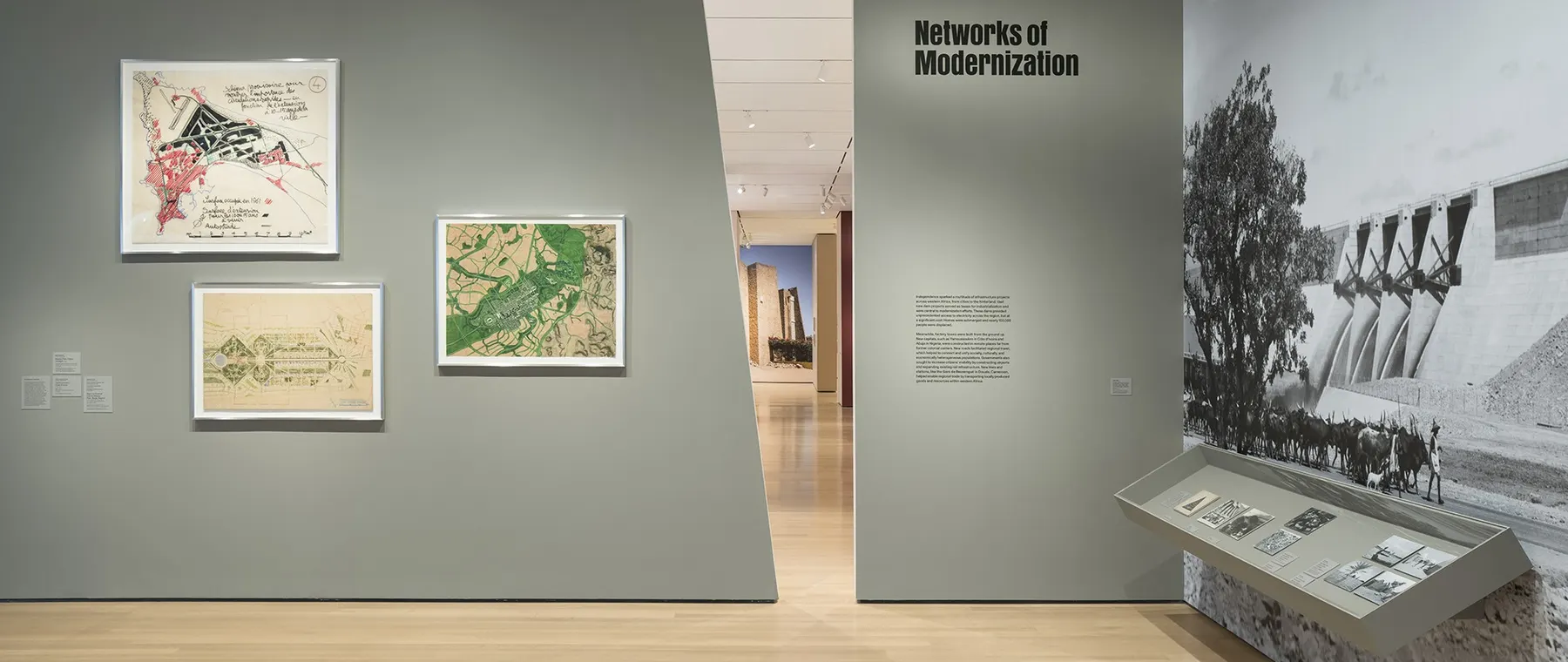
MoMA has issued installation photographs of Architects of Liberation, including an official view by Martin Parsekian. These images confirm the exhibition's physical setting and show how objects and documentation are arranged. They are not substitutes for the full gallery experience, nor does the inclusion of an archival object in a photograph transfer copyright in the underlying work. The image used for this report is credited as a current museum installation view and is connected directly to the exhibition being discussed. Editorial use must follow the press permissions and respect additional rights held by architects, photographers and collections. This is especially important when material travels from historic archives into digital publications, where context can be lost easily.
The curators and the framework for understanding
The exhibition is organised by Martino Stierli, MoMA's chief curator of architecture and design, and guest curator Ikem Stanley Okoye, with curatorial associate Mallory Cohen. Their project assembles decades of architectural production into a research-based account of modernism amid decolonisation. Every major exhibition is also an interpretation, and the choice of projects and organising categories can invite further scholarly debate. That is a strength of rigorous historical work, not an embarrassment. Visitors can use the exhibition as a starting point for reading about individual architects and cities, paying attention to how local politics and everyday use shaped buildings. The wider argument is that international architectural history becomes more accurate as previously overlooked voices enter the record.
What visitors can verify now
Architects of Liberation: Modernism in Western Africa opened at MoMA on 5 July 2026 and remains scheduled through 2 January 2027. The museum describes approximately 450 objects from more than 50 lenders in 17 countries, focused on seven western African nations and a period of intense change from the late 1950s to the early 1980s. No personal gallery visit, unpublished archival finding or commercial value estimate is claimed here. The primary evidence is MoMA's official Architects of Liberation press kit. For collectors, architects and anyone interested in the built environment, the exhibition's greatest contribution may be its insistence that architectural modernism is not one uniform story. It is a history of particular people and institutions using space to imagine different futures.