A strong result for collectible handbags
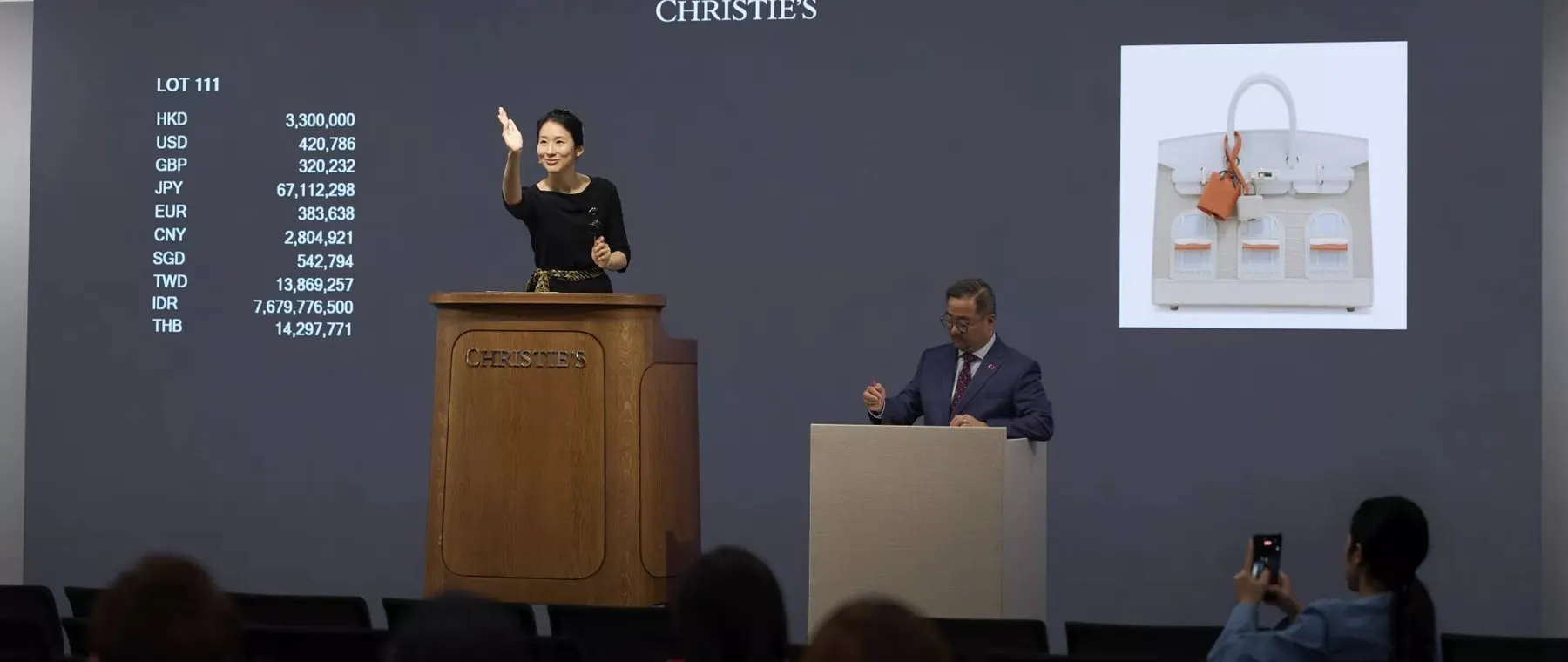
Christie's Hong Kong Handbags & Accessories sale on 23 November 2026 realised HK$59,534,080, equivalent to approximately US$7.59 million at the auction house's published conversion. The results, announced the following day, give a specific view of demand for exceptional handbags during Hong Kong Luxury Week. Christie's reported 93 per cent sold by lot, with the aggregate hammer total 126 per cent of the low estimates. Several rare Hermès Birkins helped establish the event's identity, including record results for particular Faubourg configurations and a distinctive shoulder design. These figures are important, but they are not a general price index for all handbags. They describe the objects, bidding conditions and participants in one carefully curated sale.
The Snow Faubourg takes the leading position
The highest-priced lot was an Hermès Snow Faubourg Sellier Birkin 20, which realised HK$4,224,000, approximately US$538,606. Christie's reported that the result exceeded three times the lot's low estimate. The bag's appeal belongs to the world of highly specialised collecting, where particular sizes, colourways, finishes, rarity and condition can matter as much as the broad identity of a familiar model. A Birkin 20 has proportions and presentation quite different from a larger bag intended primarily for everyday carrying. The auction result does not mean every Faubourg Birkin will achieve a similar amount. Buyers should examine the exact variant, original accessories and documentation before considering any comparable transaction.
A group of Faubourg records
Christie's also reported two record-setting Faubourg results: a rare black Night Faubourg Birkin achieved HK$2,688,000, about US$342,750, while a gold Day Faubourg Birkin achieved HK$1,920,000, about US$244,821. These objects share a family identity but are not interchangeable. The colourways, edition characteristics and market availability may influence their appeal to different collectors. The use of the word record must remain tied to the category specified by the auction house rather than expanded into a claim that the sale established a record for all handbags or all Hermès products. The distinction is essential in luxury reporting, where a headline can become misleading if qualifiers around an exceptional result are removed.
The Shoulder Birkin extends the range
Another highlight was an exceptionally rare Leopard Print Ponyhair Shoulder Birkin from the Susan Casden Collection, which achieved HK$2,048,000, approximately US$261,143. Christie's described it as an auction record for an Hermès Shoulder Birkin. The piece demonstrates that collectors may place substantial value on designs that differ from the most recognisable rigid Birkin silhouette. Material and form can change how a bag is perceived, while a documented collection provenance may attract attention. None of that removes the need to examine condition, repairs and authenticity. Exotic or delicate surfaces can also have conservation and transport considerations beyond those of conventional calf leather. A buyer should seek expert guidance before assuming that every rare bag is practical for regular use.
Quelle Idole contributes a different character
The auction's published highlights include an orange leather Quelle Idole and a rouge H leather Quelle Idole, each reported at HK$704,000, or approximately US$89,768. Christie's said each set a new house auction record for a Swift leather Quelle Idole. The bags are distinct from the formal Faubourg pieces, showing how the category can encompass playful shapes as well as highly constructed collectors' editions. A handbag may be sought because it represents a particular creative period, expresses a humorous design idea or occupies an unusual place within a house's archive. Market value is only one dimension of that interest. Understanding why a particular object has become collectible requires attention to its design history and the records that establish its original identity.
The sale's totals require context
The reported 93 per cent sold-by-lot figure indicates that a large proportion of the offered objects found buyers, while the hammer-to-estimate comparison reflects their performance against presale expectations. These measures do not reveal the reserve on each lot or the profit that an earlier owner may have earned. Sale totals are generally reported including buyer's premium, whereas estimates and hammer comparisons may be calculated differently. Christie's own release gives a headline result and a set of top lots, not a fully adjusted measure of risk or return across every past transaction. The correct interpretation is therefore focused: bidders competed actively for the particular handbags offered in Hong Kong, with especially strong prices for certain rare Hermès designs.
A substantial annual category result
Christie's said the 23 November sale brought its Asian Handbags & Accessories annual total to HK$172,896,060, approximately US$22.05 million, the highest annual total the house had recorded for the category in Asia at that point. This is a more useful figure than a vague claim that the entire global handbag market has reached a new peak. It describes one auction firm's regional sales performance, and its own reporting frames the achievement within the wider international luxury-auction calendar. The result also reflects the concentration of high-profile events during Hong Kong Luxury Week. A collector should not infer that every geographical market or price segment has experienced the same increase. Luxury auctions remain selective, and different categories may behave differently.
Digital bidding has become integral
The release reported that 67 per cent of lots sold through Christie's digital platforms. That statistic indicates the importance of remote participation even in a category where material inspection and condition are central to an acquisition. Online bidding can broaden the potential audience and make it easier for a collector to participate across borders, but it does not eliminate the need for due diligence. High-quality photographs may not show every sign of wear, and colour can vary across screens. A remote bidder should examine condition reports and provenance documentation, ask questions about repairs or refinishing, and understand the auction house's rules for payment and collection. Digital access changes the mechanics of bidding, not the physical nature of the object purchased.
A younger group of new participants
Christie's said new buyers accounted for 25 per cent of the auction's participants, with Millennials and Generation Z making up nearly 60 per cent of that group. The result adds a useful dimension to the discussion of collectible luxury goods. Participation is not confined to established buyers of fine art, and a handbag may be an entry point to broader collecting interests. Yet these statistics describe one sale and one auction house, not a representative survey of an entire generation's assets or preferences. The motivations of new buyers are not revealed by their age alone. Some may buy to use, some for design history and others to build a collection. The published figures establish the presence of younger participants, not their future purchase patterns.
International reach and regional strength
Collectors from 31 countries across five continents participated, according to Christie's report, with Greater China and Southeast Asia leading activity. This combination of regional concentration and international reach is characteristic of major luxury auctions, where a physical saleroom can serve a much broader network of buyers. Hong Kong's role as a collecting centre reflects infrastructure, specialist expertise, exhibitions and established private relationships as well as the objects in a given catalogue. Still, the geography of participation should not be confused with the location of every eventual owner, which has not been publicly disclosed. A responsible account protects bidder privacy and reports only the aggregate information provided by the auction house.
Rarity needs more than an evocative name
Terms such as Snow, Night, Day, Leopard Print and Quelle Idole can make for memorable headlines, but they do not substitute for an item-specific record. A serious collector needs to know the object's precise construction, year or series where documented, materials, condition, original hardware and accompanying accessories. For handbags, authenticity and the history of repairs may be especially important. A piece can be visually striking yet less desirable to a particular collector because of a condition issue or an undocumented alteration. Equally, a less theatrical object may have an unusually compelling provenance. The auction result illustrates the role of rarity, but the expert task is to verify the exact thing being offered rather than buy an appealing category name.
The relationship to fashion history
High-end handbags can function as design artefacts that document decisions about proportion, craftsmanship and the changing way people carry personal belongings. A particular model may reflect a house's interpretation of travel, urban life or fashion's relationship to utility. As the collecting category matures, the history of those ideas may matter alongside scarcity. The Faubourg Birkins, with their distinctive visual identities, are examples of bags that collectors may regard as statements within a design archive as well as practical accessories. This does not mean every limited colourway has lasting cultural significance. Evaluation should be connected to the creative decisions and production circumstances of each object, rather than a blanket assumption that a famous label makes every release historically important.
Ownership raises practical considerations
A valuable handbag is not immune to wear simply because it has appreciated at auction. Leather, metal fittings, handles and decorative surfaces can react to light, humidity, oils and repeated handling. Long-term storage may require appropriate support and controlled conditions, while an item intended for regular use may benefit from a different care approach. Owners travelling between countries should consider customs obligations, insurance terms and documentation, especially when objects contain materials subject to import or export restrictions. A photograph of a handbag on a yacht does not establish that it is suited to salt air, direct sunlight or unsecured storage. These details belong to the responsible life of the object after a glamorous acquisition.
The yacht-travel connection
Yacht owners and guests may carry exceptional bags as part of their personal wardrobes while travelling through multiple jurisdictions. The value of an item is not always obvious from its size, making inventories and secure storage relevant to private travel arrangements. A crew member should not be expected to assess the condition or insurance requirements of an unusual collector's edition without appropriate guidance. A practical strategy separates decorative display, everyday use and longer-term preservation. Those are matters for the owner, relevant professional advisers and the vessel's own procedures. The auction's results do not supply a guide to yacht insurance; they demonstrate why unusually valuable personal accessories deserve more attention than their ordinary function might suggest.
What the Hong Kong result does not prove
A highly successful auction can prompt speculation about an effortless alternative asset class. That would be an overstatement. Buying and selling handbags involves fees, condition risks, market shifts and sometimes substantial differences between seemingly similar variants. The price realised by one rare Faubourg Birkin is not a forecast of the price of another. Auction houses curate their catalogues, and an exceptional collection can produce results that do not represent the broader resale market. A better approach is to treat the November numbers as a documented set of comparable transactions, to be assessed with full lot details and supplemented by further evidence over time. Enjoyment, design appreciation and financial reasoning should remain distinct.
The source record and the next sale calendar
The 23 November 2026 Handbags & Accessories sale realised HK$59.5 million, with 93 per cent of lots sold, according to Christie's official Hong Kong sale-results release. The release identifies the leading Hermès pieces, digital-participation figures and the house's reported annual Asian category total. It also distinguishes this completed handbag auction from the jewellery and watch events scheduled later in Hong Kong Luxury Week. No undisclosed buyer identities, investment returns or unverified market-wide rankings are asserted here. For fashion collectors and the luxury-yachting audience, the result illustrates both the appeal of distinctive design and the importance of precise documentation when an accessory becomes a major collectible object.