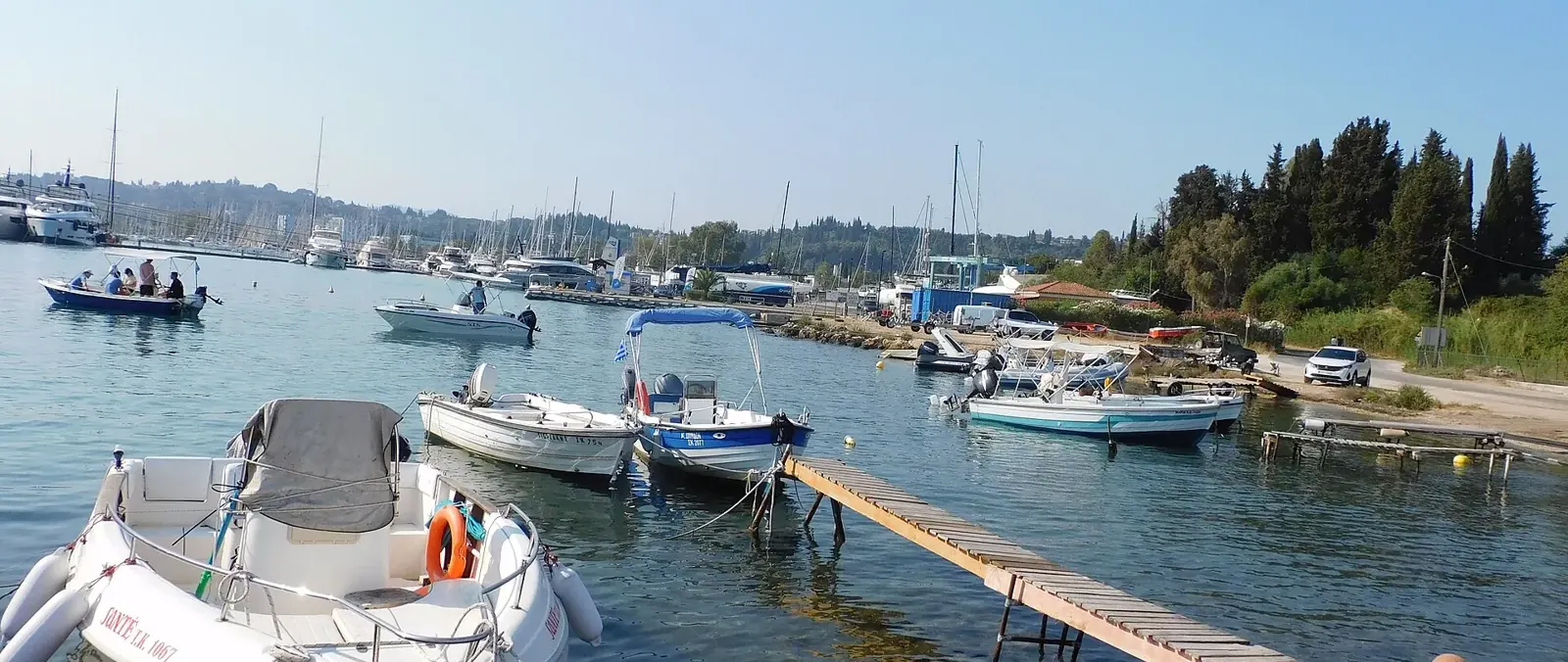
The advantage of arriving by yacht
Corfu is often introduced through its beaches, but arriving by yacht reveals a more useful island geography. Gouvia Bay, just north of Corfu Town, offers the structure of a substantial marina without placing visitors far from the island’s most compelling urban heritage. For a family aboard a comfortable midsize motor yacht or a cruising sailing yacht, that combination matters. The boat can be secured, provisions addressed and routine engineering questions settled before the first proper evening ashore. The experience is less about rushing from one turquoise anchorage to another than choosing where the yacht should provide freedom and where a well-managed berth can improve the holiday. D-Marin presents Gouvia as a gateway to the Ionian islands, while Greece’s marina association describes a long-established harbour serving both permanent and visiting craft.
A marina with a working purpose
The published scale of the facility helps explain why Gouvia is more than a pretty stopover. D-Marin advertises capacity for 1,200 yachts, dry-storage capacity for about 500 and travel-lift and crane services. Its website also describes a programme adding 104 full-service berths and upgraded amenities. Those figures are operator descriptions, not a guarantee that any particular space will be free on a guest’s preferred dates. For a yacht owner, the important distinction is the breadth of operations: berthing, maintenance access and shore-side services sit together, meaning a stay can accommodate a practical jobs list as well as leisure. Owners should request the current berth dimensions, depth, available shore power and actual construction status directly from the marina before committing to an itinerary.
The right size of yacht for the visit
A yacht in the Luxury Yacht Guide size range can use a place like Gouvia quite differently from an exceptionally large vessel. A 15-metre family cruiser may need quick provisioning, a convenient vehicle transfer and straightforward help with its tender or generator. A 22-metre yacht may arrive with a skipper and guests who want privacy, predictable utilities and transport for an evening in town. Neither experience is improved by assuming that a high overall berth count means the precise berth required will be available. Beam, draft, shore-power demand and manoeuvring room matter more than a marina’s headline maximum length. State those dimensions in the first enquiry and ask whether a protected, suitable position can be reserved rather than relying solely on an automated confirmation.
A first day without unnecessary haste
The temptation on reaching Corfu is to depart again immediately for a celebrated beach. A calmer first day is usually more rewarding. Secure the yacht, confirm electrical connections and settle arrival paperwork; then walk the marina to learn where the supermarket, chandlery, water access and service desks actually are. D-Marin highlights dining, shops, security and round-the-clock support, making an easy evening within the complex possible. This is also a useful point to check the weather sequence for the days ahead. A well-sheltered berth is not a substitute for a carefully chosen cruising window, especially when the next plan involves more exposed passages or crowded summer anchorages. The luxury here is making tomorrow simple, not compressing every experience into the first afternoon.
Corfu Old Town deserves its own day
The island’s cultural centre is close enough to make a dedicated shore day sensible. The Greek national tourism organisation describes Corfu Old Town as an unusually rich meeting of Venetian town planning and later European influences; it has appeared on the UNESCO World Heritage List since 2007. Its narrow kantounia lanes connect tall buildings, balconies and intimate squares, while the Campiello quarter preserves an especially atmospheric urban fabric. It is worth avoiding an itinerary that treats this as a one-hour photo stop. Begin early, explore on foot, look up at the layers of masonry and pause for coffee away from the busiest thoroughfares. The boat can wait; the appeal of this town is the detail that only becomes apparent at walking pace.
Fortresses, squares and the island’s outlook
Two fortresses frame the historic city and remind visitors that Corfu was strategically significant long before recreational cruising became a local industry. The tourism authority points to the Spianada and the Liston as prominent gathering places; both provide room to slow down after the tight alleys of the older quarters. The Palace of St Michael and St George houses the Museum of Asian Art, an unexpected cultural counterpoint to the maritime setting. Rather than attempt every sight, choose two substantial visits and leave space between them. A long lunch and an unhurried return to the yacht are not compromises. They are part of the reason to travel by private yacht: the day can respond to guests’ interests rather than an excursion provider’s timetable.
The Ionian Sea as an invitation
Gouvia’s position becomes more interesting when viewed as the starting point rather than the entire destination. Corfu lies near a chain of islands and mainland shores that can reward a succession of short passages, swim stops and harbour evenings. The choice of direction should reflect the yacht’s range, the skipper’s local knowledge, forecast winds, safe approaches and the season. A power yacht may have the pace to combine a morning swim with a different overnight berth; a sailing yacht may benefit more from leaving time to enjoy the passage itself. Avoid setting an inflexible daily mileage target. A route that looks elegant on a chart may become tiring when berth availability, tender conditions and children’s appetite for travel are taken into account.
Anchorages are not interchangeable
The best-looking water from a hillside does not automatically make the safest overnight anchorage. Shelter varies with wind direction, seabed and swell, and busy Ionian areas may have local restrictions or extensive mooring arrangements. Guests should not be encouraged to drop anchor simply because photographs show other boats in place. Obtain current charts, notices and local advice, and assess holding ground, swinging room and the exit if conditions change. In areas with sensitive seabed or designated protections, follow the applicable rules and use authorised moorings where provided. For owners who value both ecological responsibility and peaceful nights, careful anchoring is as important as selecting a beautiful location. If suitable shelter is doubtful, a marina night can be the most comfortable luxury decision of all.
Dining ashore or aboard
Corfu offers a useful contrast between the informal meal taken aboard after swimming and a proper evening out in a historic setting. D-Marin describes everything from simple marina eateries to more polished dining, so guests need not travel far when tired after a passage. On another night, a reservation in Corfu Town can turn the excursion itself into the main event. Crew and owners should consider practicalities that rarely appear in glossy destination guides: whether a return vehicle can be arranged reliably, how far the restaurant is from the transfer point, and whether the entire party wants the same level of formality. An excellent meal can be a quiet local kitchen as readily as a waterfront terrace with a celebrated view.
What to do with one extra day
An additional day in Gouvia is best spent purposefully. Families may want the ease of a beach excursion with no change of berth, while active guests might choose watersports where conditions and local permissions allow. An owner undertaking a longer Mediterranean season could use the time for filters, laundry, provisioning or a minor technical inspection. Such errands need not spoil the holiday if distributed between a morning task and a pleasant afternoon. For guests flying in or out, the relative proximity of Corfu International Airport is another practical advantage; D-Marin describes it as roughly seven kilometres away. Travel time, particularly during busy months, should still be checked rather than inferred from the distance alone.
A more thoughtful charter handover
For charter guests, the first conversation with the captain should cover the experiences that genuinely matter. Is the priority swimming in clear water, eating ashore, exploring old towns or spending as little time underway as possible? Is anyone uncomfortable in an unsettled sea? Are children happiest with a predictable lunch routine? Those questions alter an itinerary more than a list of fashionable bays. If a charter begins at Gouvia, arrange enough time for a proper safety briefing, an explanation of tender procedures and a review of the day’s conditions. The best charter is not the one with the longest route. It is the one that feels considered, safe and personal for everyone aboard.
The marina information worth confirming
Several sources publish Gouvia’s facilities, but some details differ. The Greek Marinas Association lists the larger maximum yacht length in its directory than the current operator page, a reminder that capacities and operational limits can change. For a 12–23.99-metre yacht, this discrepancy is unlikely to be the deciding factor, but it demonstrates why printed data should not be treated as a live booking system. Contact D-Marin with length overall, beam, draft, preferred dates and electrical needs. Ask about visitor berths, water and power arrangements, fuel access, waste disposal, security, yard services and any works affecting pontoons. Confirm port entry instructions and VHF procedures against current official information shortly before arrival.
The luxury of knowing when to stay
Some of the finest yacht holidays are made by declining to move. If a promising forecast follows an unsettled day, waiting at a comfortable marina may open the door to a better passage. If the crew has enjoyed a long cultural evening in Corfu, a leisurely breakfast can be more restorative than a dawn departure. Gouvia works because it allows both choices: it is sufficiently practical to support the boat, and sufficiently close to the island’s cultural life to give the stay a real identity. A private yacht should expand options, not imprison guests in an ambitious schedule. Corfu rewards a slower rhythm, with the boat serving as a well-organised home between sea, harbour and city.
Photograph: Marina Gouvia, Corfu, by Panek (8 August 2026), via Wikimedia Commons, licensed CC BY-SA 4.0; image resized and converted to WebP. Photograph is of Gouvia Marina.