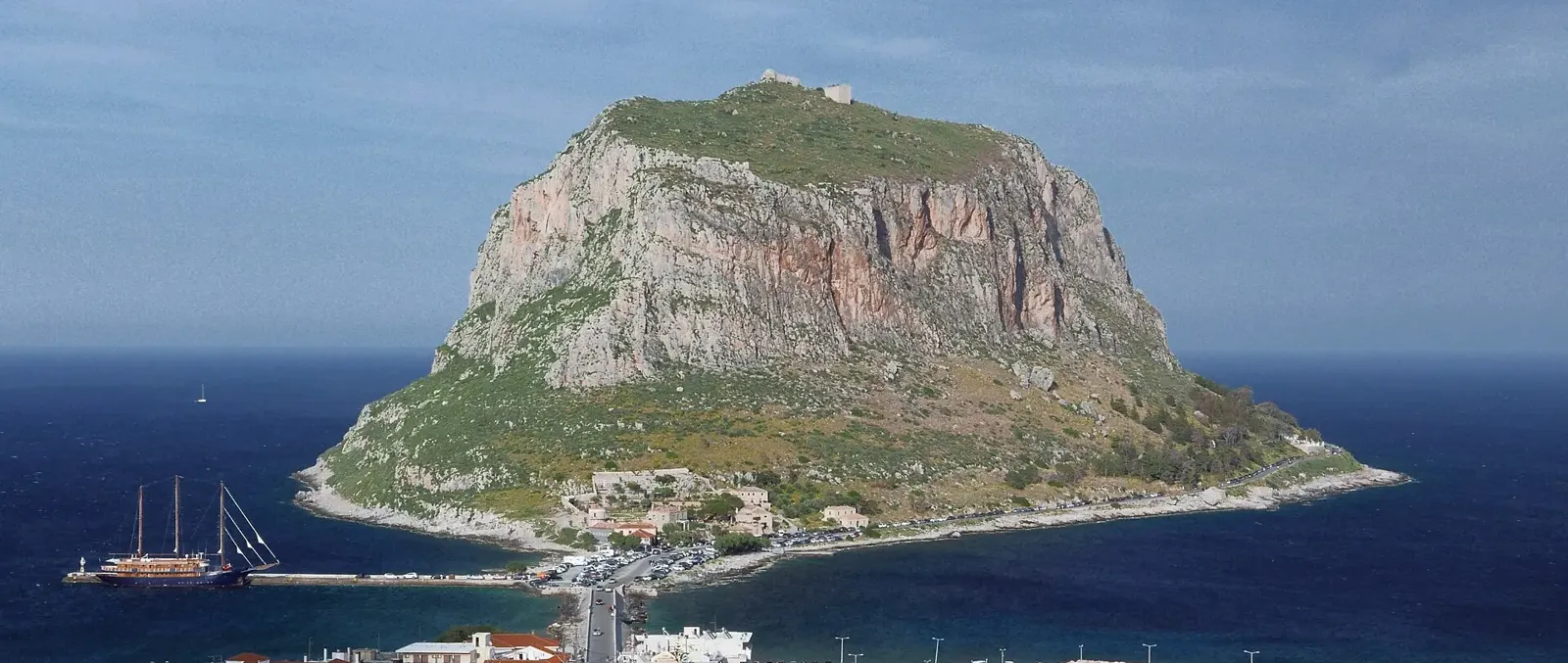
A fortress first seen from the sea
Some destinations seem designed to make an arriving yacht slow down and look. Monemvasia is among them. A great rock rises beside the south-eastern Peloponnese, carrying a medieval settlement whose entrance and historic layout explain its name. Greece's national tourism organisation describes a castle town built on a single imposing rock connected to the mainland by a narrow link. From the water, the relationship between the landform and its walls is the attraction: the settlement appears at once secluded and purposeful, positioned within a seascape shaped by centuries of passage and defence. The experience suits yachts from twelve to just under twenty-four metres when crews leave enough time for an unhurried visit ashore. It is not a destination where a dramatic view should lead an inexperienced skipper to improvise an overnight stop. Approach, anchoring or berthing options need to be established through current local maritime information. The editorial certainty is cultural and geographical; live navigational and berth conditions are separate operational facts.
Why the castle town is special
The Greek National Tourism Organisation identifies Monemvasia as a Byzantine castle settlement, with a Lower Town of stone houses, lanes, arches and churches and an Upper Town above it. The main historic area offers an intimate contrast to an open yacht deck: sheltered streets instead of sea horizons, old stone rather than polished composite surfaces and layered traces of former inhabitants instead of a contemporary marina atmosphere. One can spend a surprisingly long time simply following the lanes without trying to complete a checklist of attractions. The setting also changes as the day progresses. Morning light reveals the form of the buildings, while later hours can make terraces and coastal views feel particularly atmospheric. The town is neither a reconstructed film set nor a large modern resort; its appeal rests on the survival of a real historic urban landscape. Yacht guests who appreciate architecture and local history may find it more rewarding than a day devoted only to swimming.
The Lower Town: a place for slow exploration
The Lower Town lies within the walls and retains narrow pedestrian routes, old houses and religious buildings, many of which appear in official descriptions of the destination. Greece's tourism authority notes the Church of Christ Elkomenos as part of the historic experience and describes the poet Yiannis Ritsos's former house near the main gate as a museum linked to his life and work. These are natural focal points for a thoughtful shore visit, but visitors should verify opening times and accessibility before planning an exact schedule. Cobblestones, uneven steps and enclosed streets also mean that footwear and mobility need consideration. The luxury in this setting is freedom from haste: a long walk, pauses to look at masonry or the sea, and time for a locally prepared meal. A yacht provides a comfortable base, but guests should plan ashore as if visiting a living heritage site rather than demanding that every convenience be delivered to a schedule.
The Upper Town and the value of making time
Above the inhabited lower settlement, the Upper Town occupies the crest of the rock. Official tourism material explains that it is now uninhabited and contains historic remains including buildings associated with successive periods of settlement. Reaching higher ground can reward visitors with a broad perspective on the surrounding coast and the position of the fortress. It is not a casual extension of a short promenade for every guest, however. Heat, steps, uneven surfaces and the strength of the sun can make the ascent more demanding than it looks from a yacht. An itinerary should allow individuals to choose how far they wish to go and include water, suitable footwear and daylight. Guests who remain below still have a substantial cultural visit. The goal is not to conquer every staircase but to appreciate how this isolated site formed a strategic and domestic landscape. Crew scheduling should allow enough margin for a leisurely return to a correctly secured vessel.
A harbour stop is not automatically a booked marina stay
Monemvasia's strongest official visitor information concerns the castle and its surrounding region. The sources used for this guide do not constitute an up-to-date berth directory for 12–23.99-metre yachts. That absence is important. Some guidebooks use a destination name and a nearby coastal facility interchangeably, but a skipper needs to know exactly where a yacht will stop, who controls the place and what length, beam and draught are accepted. An overnight berth, temporary anchoring spot and tender landing are separate arrangements with different risks and permissions. Before making Monemvasia the centre of a charter itinerary, obtain local harbour instructions, nautical notices and a reliable charted option appropriate to the actual vessel. Review the forecast and possible changes in exposure over the intended stay. A more distant confirmed safe berth with a planned shore transfer may be preferable to an ambiguous quay. A dramatic castle-town photograph cannot replace those checks.
Planning the visit for guests and crew
A skipper's timeline should start with the sea passage and end with a safe departure, rather than beginning with a restaurant reservation. Establish which shore route is realistic from the yacht's lawful berth or anchorage, whether a tender would be appropriate in the conditions and how guests will move between the water and the castle entrance. Arrange accessible alternatives where needed. Cultural attractions, cafés and restaurants are best enjoyed with flexible timing; individual venue availability should be checked directly. Those spending only one afternoon may concentrate on the Lower Town and its central streets. A longer stay makes time for the Upper Town, unhurried photography and perhaps exploring the surrounding Peloponnese. A luxury yacht's accommodation lets guests return to privacy after the bustle of a popular destination, but the ability to do so depends on safe and properly agreed shore access. Good planning creates the freedom to be spontaneous once ashore.
Monemvasia within a Peloponnese cruising itinerary
The south-eastern Peloponnese has a geography of promontories, gulfs and historic communities, and Monemvasia can become one distinctive stop on a wider coastal cruise. A route should be evaluated using charted distances and the vessel's expected speed, not simple map proximity or holiday marketing descriptions. For sailboats, weather windows and the daylight available for unfamiliar approaches may determine how much can reasonably be covered. For faster motor yachts, the temptation to add too many stops can undermine the pleasure of each one. Monemvasia is best appreciated as an encounter with a place of unusual architecture and history, not a quick photo opportunity between fuel stops. Visiting with respect means giving its streets and monuments the time they deserve. There is also a useful balance between shore-based experiences and the yacht itself: a quiet breakfast on board, a substantial historic walk and a comfortable evening can be a complete day.
The final checks before a rock-fortress arrival
Assemble vessel dimensions, current charts, communications procedures and weather information before confirming the destination. Ask the relevant local port or harbour authority about visitor arrangements and any restrictions that may affect your exact yacht; do not infer suitability from images or old cruising notes. Plan contingency shelter and be prepared to change the shore programme if conditions make a tender transfer unsafe. For the cultural visit, confirm current access and opening details for any museum or historic section guests especially wish to see. Have water, appropriate shoes and time to wander. The verified source material establishes Monemvasia's rock setting, its Lower and Upper Town and the key heritage attractions; it does not certify a berth, promise a particular anchorage or provide real-time safety information. Approached with those distinctions clear, Monemvasia offers the luxury-yacht traveller something increasingly rare: a destination whose greatest value lies in the lived texture of its history rather than the size of its waterfront facilities.
Header photograph: View of Monemvasia rock, photographed 16 April 2017 by Alexander Manusevich (Manussik), CC BY-SA 4.0, Wikimedia Commons. Resized and converted to WebP. Archival landscape image, not a navigation or berth-availability illustration.