A yacht should work on Friday evening as well as Sunday afternoon
The appeal of a flybridge yacht becomes clearest on the ordinary parts of a weekend. Not the promotional photograph of an empty upper deck, but a late arrival with bags, groceries and tired children. Not the clean blue-water running shot, but the complicated moment when a breeze comes across the marina and everyone needs to know where to stand. A successful family yacht gives its owner tools to handle these transitions without letting operations overwhelm the holiday.
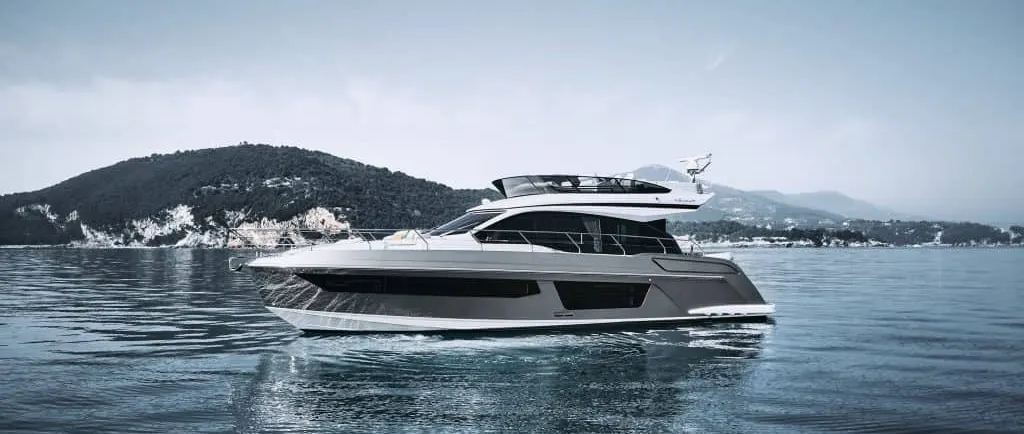
Azimut's Fly 53 is a useful illustration. The builder publishes an overall length of 16.78 metres, a beam of 4.95 metres and three guest cabins, plus a separate crew cabin in its specified arrangement. Twin Volvo Penta IPS 950 D11 engines of 725 horsepower each support a manufacturer's claimed maximum of up to 31 knots under stated test conditions. None of these figures is a substitute for checking the equipment and condition of a particular yacht. But they establish the scale of the design: substantial enough for a proper overnight family arrangement, yet still a vessel whose manoeuvres and storage demands require careful owner attention.
Why the flybridge matters beyond the view
The flybridge is often described as another social room outdoors, but its greatest value is the choice it offers. Azimut's published arrangement includes a convertible coffee table and lounge in the aft portion, with an upper helm and open-air gathering areas. When one group wants the sun and a second prefers the cockpit's shelter, the boat does not have to divide itself into competing activities. The flybridge can become a breakfast terrace in settled weather, or a place to sit quietly while the rest of the family sleeps.
There are limits to that freedom. The upper deck is exposed; weather, speed and the effects of motion can rapidly change its suitability for guests. Owners should establish when seating is appropriate, how items are secured, and which parts of the deck are off limits during manoeuvres. A flybridge is not automatically the best location for children at every stage of a passage. Its contribution to luxury comes from careful use and the possibility of moving between settings, not the assumption that every seat is available at all times.
The cockpit is where family life gathers
Azimut describes an asymmetrical cockpit intended to improve circulation while making more useful space for the table and seating. That design choice deserves more attention than the catalogue language suggests. A weekend on a yacht involves people passing between bathing platform, saloon and outside dining area many times. If movement is awkward, even a generously furnished cockpit can feel congested. Clear paths matter when guests return from swimming, food is being served or bags are carried below.
The family's preferred pattern should determine how the cockpit is arranged. Some groups want a long outdoor lunch after swimming; others prefer the early evening meal as the highlight. Either way, the crew or owner should secure loose service items before departure and keep a safe distinction between relaxed anchoring and the working conditions of docking. Luxury in this size category is rarely improved by staging an elaborate banquet that obstructs routine movement. A comfortable seat, timely shade and sensible access to drinks may do more for the entire party.
The saloon and galley create a useful connection
Aft-galley designs are frequently praised for blending interior and exterior living. On the Fly 53, Azimut describes a galley placed near the saloon's entrance and a main-deck layout with relatively uninterrupted sightlines. For a family, that connection is genuinely practical. The person preparing lunch need not feel isolated from conversation on deck, and guests can step inside as temperatures or wind change. Good sightlines also support the simple business of keeping an eye on what is happening around the boat.
Planning remains essential. One small galley cannot comfortably serve as a catering kitchen, luggage drop-off area and thoroughfare simultaneously. Owners who prepare fresh food aboard should decide which dishes are realistic for the available refrigeration, preparation surfaces and electrical supply. Loading provisions in meal-sized groups avoids rummaging through lockers with the whole party waiting. The best yacht galley is often the one that allows the host to spend less time in it.
Three cabins do not mean three identical experiences
The Fly 53's published accommodation is three guest cabins sleeping six, with a separate crew berth in the builder's arrangement. That is enough for several family combinations, but the comfort of each cabin and its access to facilities need consideration. Parents travelling with younger children may want to remain close to them. Teenagers may prize independent space. Visiting grandparents may prefer not to climb between decks repeatedly. Good berth allocation begins with the actual people aboard, not a desire to maximise occupancy.
Azimut highlights a full-beam master suite and describes separate guest accommodation below. Before an overnight cruise, the owner should explain which facilities are shared, where wet swimwear is stored and how the interior is ventilated. Personal privacy matters even on a sociable family holiday. Unplanned cabin visits, loud music late at night and early-morning engine preparations can spoil the feeling of retreat. A successful yacht weekend creates informal household rules without making guests feel they have joined a regimented operation.
Fuel capacity is not a weekend range promise
The manufacturer lists a 2,400-litre fuel capacity and publishes performance-test figures including consumption per nautical mile at specified speeds. Those figures are valuable context but should not be lifted wholesale into a personal passage plan. Sea conditions, load, propulsive efficiency, fouling, trim and the particular vessel's equipment can alter real consumption. A skipper should use verified vessel-specific readings, a conservative reserve and the actual forecast to determine whether a proposed route is sensible.
Equally important is the difference between fast travel and a restful holiday. A family that leaves early and runs at a comfortable cruising speed can arrive in better spirits than one that treats the day's highest possible speed as an objective. Sometimes a nearer anchorage offers warmer water, a better restaurant and more time together than a famous destination reached after a tiring passage. The yacht's performance should create options. It should not impose a timetable that requires everyone to tolerate uncomfortable conditions merely to keep an appointment.
The bow lounge is valuable when used thoughtfully
Azimut emphasises an additional lounge at the bow, one of the spaces that helps a compact flybridge yacht feel larger. A protected morning with calm conditions may make this an ideal setting for reading or a quiet conversation. It can also give family members the separation that keeps a small group relaxed over several days. When one person wants a peaceful moment away from the main gathering, the boat need not feel crowded.
But the foredeck is an operational zone too. Mooring equipment, anchoring tasks and movement during harbour manoeuvres impose real safety constraints. The skipper should establish which seats or circulation routes can be used in each operating condition and make sure guests understand the distinction. Never let the aesthetic promise of a photograph substitute for an assessment of exposure and motion. Good seamanship does not diminish the pleasure of a beautiful deck: it makes that pleasure repeatable.
Marina arrival: the most revealing moment
At 16.78 metres long and 4.95 metres wide, the Fly 53 requires a berth appropriate to the yacht as configured. The published draft of 1.04 metres includes the propellers at full load, according to Azimut, but the actual clearances for a particular yacht and location still demand verification. Marina operators need accurate dimensions and details of any relevant equipment. Arriving with a berth booked for the approximate length alone is a poor way to start the evening.
Azimut describes joystick controls among the Fly 53's technical features. Such systems may make controlled manoeuvres more intuitive for trained operators, but do not remove wind, current, traffic or the need for a considered approach. Crew roles, fenders and line handling should be agreed before entering a crowded fairway. Guests should know whether to remain seated and when they may disembark. A calm arrival is often the strongest expression of professional yachting, particularly when the owner is also at the helm.
The best itinerary needs space to be spontaneous
A Friday departure, Saturday at anchor and Sunday return is an appealing pattern, but a family yacht should accommodate a change without damaging the experience. A marina-based weekend may be better if the forecast is marginal. A sheltered lunch stop may replace the planned overnight bay. An early return may offer more comfort than insisting on the last possible hour afloat. Owners should identify a primary plan and a fallback before guests arrive; improvisation is easier when the alternatives have been thought through.
The Fly 53's accommodation, flybridge and connected saloon give families several ways to enjoy a short trip. None of those features guarantees an effortless holiday by itself. The owner's preparation, maintenance discipline and willingness to adapt are what bring the design to life. For a weekend aboard a 17-metre yacht, the lasting luxury may be surprisingly ordinary: breakfast without rushing, a safe swim in the right conditions, and enough room for everyone to feel at home.
Official source: See the manufacturer information. Model information: official product details. Official Azimut Yachts photograph showing the Fly 53 motor yacht.