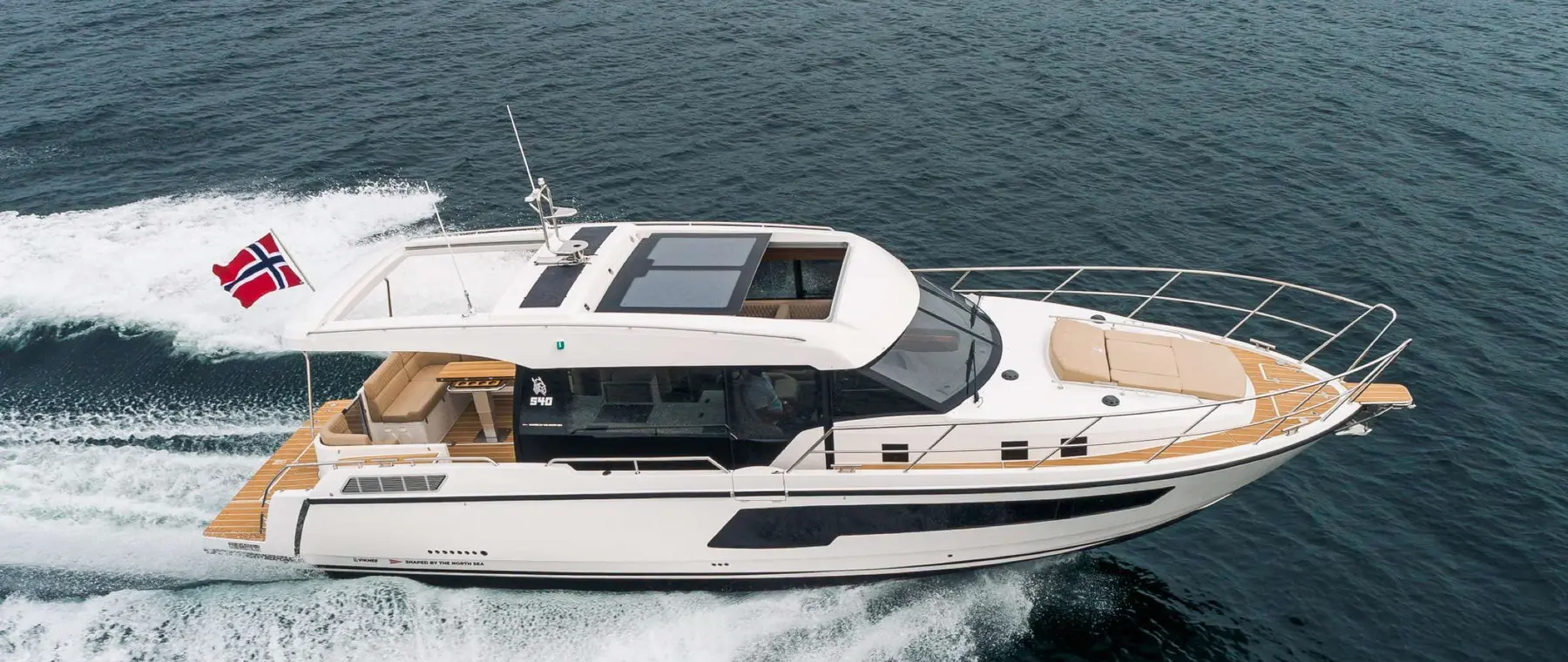
Why the Viknes S40 matters on awards day
The Viknes S40 Panorama is in the Best for Family category of the Best of Boats Award 2026, with the winners due to be announced in Berlin on Thursday 26 November at an evening ceremony. The Norwegian yard's 12.25-metre model offers a very different picture of family boating from open-deck sports craft. Its core argument is that a cruising boat should remain practical when the temperature drops, wind increases or the itinerary requires a longer passage. Its nomination is confirmed by the published award finalist list; a winner has not yet been announced. The S40 belongs at the entry to Luxury Yacht Guide's 12–24-metre coverage, where buyers often move between owner-operated boats and arrangements involving occasional professional support. In that band, the value of protected living space is not only comfort. It determines whether a family can continue a voyage when the forecast is merely inconvenient rather than perfect. The nomination offers an opportunity to examine those choices before an award result distracts from them.
The specifications need to be read in context
Viknes lists the S40 Panorama at 12.25 metres overall and offers a twin Yanmar 6LY 400 V-gear shaft-drive arrangement totalling 800 horsepower. These details establish the vessel's general size and one published propulsion configuration; they do not by themselves predict the performance of every hull or optional layout. A 12-metre yacht is large enough for meaningful overnight cruising yet compact enough that berth availability, handling arrangements and everyday expenses can remain more manageable than on larger motor yachts. Its overall dimensions also create design compromises. More volume devoted to enclosed accommodation means less may be available for an expansive open cockpit, and extensive glazing and a convertible indoor-outdoor saloon add light, but require careful attention to sealing and weather protection. Prospective buyers should seek the current technical specification sheet rather than assume that every advertised boat carries the same engines or equipment. What matters is how the total arrangement supports the family's actual cruising plan.
Enclosed cruising is an everyday advantage
A protected helm and saloon can change how often a boat is used. On an open model, a family may cancel a trip because of wind chill or persistent rain even when the sea state is otherwise manageable. A pilothouse-style cruiser allows passengers to remain sheltered, dry and near the skipper while still enjoying views of the water. That matters particularly to owners operating in Scandinavia, the British Isles and shoulder-season Mediterranean conditions. Large windows can improve the sense of connection, but they require careful attention to glare, demisting and visibility in rain. Heating and ventilation should be assessed together: a warm cabin with persistent condensation is not a comfortable cruising environment. Daytime socialising also needs to work without constantly moving between the saloon and deck. Families should walk a real vessel with everyone present, observe sight lines from seated positions and assess whether passengers can circulate safely while the boat is under way.
A panoramic saloon bridges the seasons
The Panorama version emphasises visibility and a flexible main-deck living area, rather than a separate upper helm. Large glazed surfaces and the ability to open the saloon toward the cockpit are useful when a family moves repeatedly between indoor and outdoor activities. On a cool morning, the enclosed saloon can become the social centre of the yacht, while a warm afternoon may encourage guests to keep a stronger connection with the aft deck. These arrangements need practical testing. Ask how the opening glazing seals against spray, how sliding sections are secured, where rainwater drains and what maintenance the manufacturer recommends for tracks and gaskets. Glare, condensation and visibility from seated positions should also be assessed. A panorama-style saloon earns its place not by offering the widest view in a catalogue photograph but by remaining comfortable and usable across the ordinary weather of a cruising season.
The family's use pattern should lead the specification
Families do not all cruise alike. One household may spend almost every weekend aboard, cook on board and make repeated short passages between familiar harbours. Another may take two long holidays each year, with occasional friends joining for the first leg. The optimum configuration is different in each case. Sleeping arrangements should be assessed by actual mattress dimensions, berth access and ventilation, not simply the advertised number of cabins. Wet-weather clothing, lifejackets, groceries and children's equipment all need dedicated storage. The ability to prepare a meal without blocking passage through the saloon can become an important everyday feature. A purchaser should ask whether tanks, waste arrangements and electrical capacity suit several days away from a marina. The family-award context is valuable because these practical features are often undervalued in quick boat-show inspections, when bright finishes and uncluttered demonstration cabins make almost every layout seem generous.
Manoeuvring matters more than the marketing photograph
A 12.25-metre family cruiser is often intended to be handled by its owner, perhaps with one family member helping during berthing. That makes close-quarter routines central to the purchase decision. Examine how easily the skipper can move from the helm to the side deck, how mooring lines can be prepared and whether there are secure places for children to stand away from pinch points. Check access to cleats from a typical pontoon height, visibility towards the stern and the effect of wind on the superstructure. Any bow or stern thruster fitted to a particular hull should be tested as an aid, not treated as a substitute for practiced seamanship. Marina staff and experienced instructors may be able to advise on handling characteristics in local conditions. The most valuable trial is one in which the prospective owner, rather than the dealer alone, performs ordinary manoeuvres under competent supervision.
How the S40 sits among family finalists
The official Best for Family list brings the Viknes S40 together with the Greenline 42, Marex 390, Grandezza 34 Outboard and Jeanneau Merry Fisher 1095 Fly Series 2. These models span distinct design priorities. Greenline places significant emphasis on energy management and alternative propulsion options; Marex is associated with practical Scandinavian cruising layouts; Grandezza and Jeanneau approach family boating through their own combinations of enclosed accommodation and outdoor living. The distinction matters because the award is not a simple contest to maximise cabin count or engine power. A real family needs to weigh weather protection, ride, ease of boarding, overnight privacy, service access and cruising frequency. For a buyer using Northern European waters, the Viknes character may merit particular attention. Owners spending most of their time on warm-water day trips might place different weights on openness and outdoor entertaining. There is no single universal answer for every household.
A practical ownership budget for this size
At about twelve metres, a family cruiser can still generate meaningful annual costs. Berthing contracts, insurance, winter storage, lifting, antifouling, engine service, safety-equipment renewal, fuel and replacement of domestic systems all require planning. The amount depends heavily on home marina, engine selection and how many sea hours the family accumulates. A year-round Northern European programme may involve heating-system care and extensive winter preparation, while a Mediterranean programme can bring high-season berth premiums and stronger ultraviolet exposure. Purchasers should request itemised quotes from actual service companies, not rely on informal percentage rules. It is sensible to reserve for failures that interrupt a planned trip: a refrigeration issue or steering component can matter more to family enjoyment than a cosmetic defect. Examining the boat's maintenance log, manuals and access to consumable parts helps turn a hopeful annual budget into an informed forecast.
What a useful survey and trial should cover
The S40 should be inspected with the same discipline as any significant yacht purchase. A surveyor can examine hull condition, moisture where relevant, machinery installations, structural connections, safety systems and evidence of prior repairs. Prospective owners should assess cabin ventilation, water ingress at doors and windows, electrical loading, escape routes and the practical use of any helm station. Test deck drains, pumps and domestic equipment rather than assuming they work because the boat appears new. A sea trial should include steady cruising, low-speed manoeuvres and conditions typical of the intended operating area, while respecting the builder's operating envelope. Family members should be invited to comment on noise and movement in the places where they would actually sit. Comparison photographs from a brochure are useful for recognising a model, but the certified specification and the particular vessel's condition must govern a purchase.
The real meaning of finalist status
The Best of Boats 2026 jury will announce its winners at OutVenture Berlin at 18:00 on 26 November. At the time of this report the Viknes S40 is a finalist, not an announced winner. Its inclusion in the Family category gives buyers a timely reason to compare sheltered Scandinavian-style cruising with competing layouts built around more open-air activities. The central question for a family is whether the boat makes it easier to use the sea often, safely and comfortably. If a model works well when the weather is less than perfect, stores real cruising equipment efficiently and can be handled calmly in a crowded harbour, those qualities can be more valuable than a spectacular first impression. The award decision will add one data point. Long-term satisfaction still depends on the match between the yacht, its owners, its maintenance support and its cruising waters.
Source record and photograph attribution
The nomination and award schedule are documented by the Best of Boats 2026 organiser and the OutVenture Berlin finalist listing. Manufacturer specifications and model context are taken from the official Viknes S40 Panorama page. The lead photograph is the Viknes shipyard image distributed in the official Best of Boats finalists press archive, which grants free editorial publication and prohibits promotional use. Photo credit: Viknes / Best of Boats Award 2026 press material. This article does not claim the boat has won its category.