A new seating range for different helm layouts
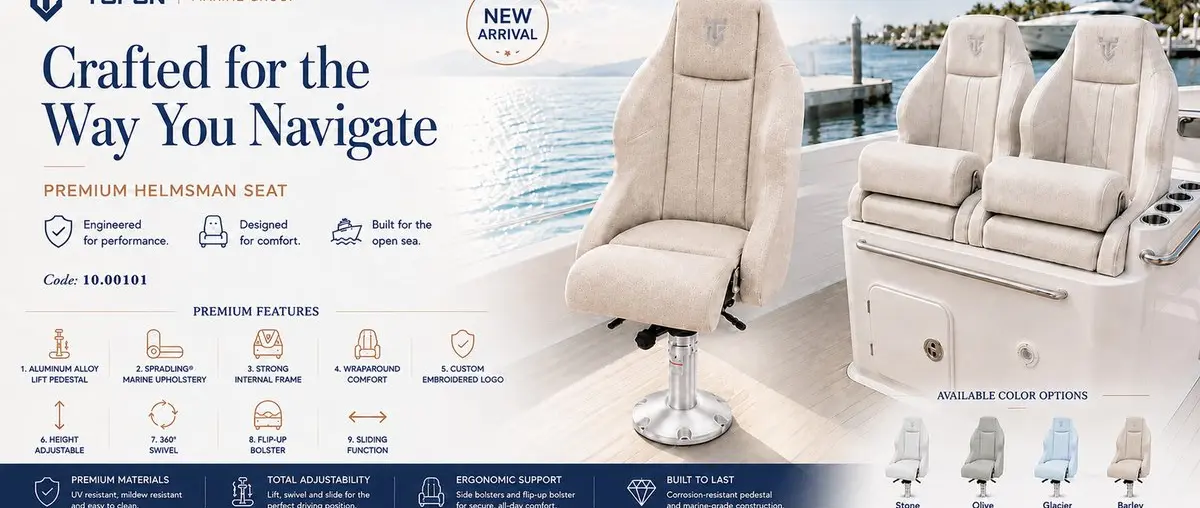
Tofun Marine Group has introduced two premium seating designs aimed at modern boat and yacht helms. The company published the announcement through its METSTRADE exhibitor profile on 17 August 2026, making the range available for discussion with marine professionals around the autumn trade season. One product is a pedestal-mounted Premium Helmsman Seat, while the other is a Premium Console Seat intended for direct integration with fibreglass console structures. Both are described as offering ergonomic support, marine upholstery and customisable finishing details. The news concerns a component range rather than a new vessel or a claim that either seat has passed a specific independent marine certification.
Why a helm chair deserves engineering attention
A seat at the helm must support the operator during repeated changes in course, speed and sea state. Unlike casual furniture in a saloon, it needs to accommodate focused observation and frequent interaction with controls. Height, fore-and-aft position, the location of armrests and ease of standing may influence whether a helmsman can work comfortably. Tofun's announcement emphasises adaptability to different installation requirements. Buyers should treat those claims as an invitation to inspect the mechanical arrangement and test the seat rather than infer comfort for every body size or vessel type. The dimensions of the helm, nearby surfaces and operator preferences all affect the result.
The pedestal-mounted Premium Helmsman Seat
The Premium Helmsman Seat is designed for a pedestal installation and offers height adjustment, a full 360-degree swivel, a sliding function and a flip-up bolster. Those features address common needs at a helm where an operator may alternate between seated and more elevated positions. A swivel can improve access to nearby equipment or conversations with passengers when the boat is not underway, while a slide can help align the operator with controls. The safe use of each adjustment depends on the installation, locking mechanism and operating conditions. A chair able to rotate does not mean it should remain unlocked in rough water or during a critical manoeuvre.
The integrated Premium Console alternative
The Premium Console Seat takes a different approach. It is intended for direct mounting into fibreglass consoles and helm modules, potentially creating a more integrated visual arrangement where a separate pedestal would occupy valuable space. Such a design may appeal to builders working within a compact cockpit or seeking a continuous surface. However, integration places demands on the supporting structure and the access needed for bolts, reinforcement and service. A builder should verify loading limits and fastening requirements before specifying the seat. The announcement does not provide a detailed engineering drawing or certification certificate, so those details belong in follow-up documentation rather than assumed product facts.
Swivel flexibility and its limits
A 360-degree swivel can be convenient when the helm area is used for social purposes at anchor, especially in smaller cruisers where a chair may also face a cockpit table. It can also help someone enter or leave a restricted driving position. The feature is useful only if the seat has enough clearance to turn without striking the wheel, screens or adjacent passengers. Operators need to understand whether the mechanism locks securely and in which directions it is intended to be used underway. The angle available in a showroom demonstration may differ from that of a real installation surrounded by instrumentation and cabinetry. Physical evaluation remains important.
Height adjustment helps sightlines
Adjustable seat height allows different users to alter their eye position relative to the windscreen and instrument panels. This can make a significant difference in a helm with deep consoles or a high coaming. But improving a seated view does not automatically guarantee safe visibility in every trim condition. The view can change with loading, speed and the boat's attitude. Builders should assess operator sightlines as part of the whole helm design, using realistic seating positions. A seat that rises to an attractive height must also preserve adequate foot support and reachable controls. The best arrangement suits operators across a reasonable range of sizes without awkward stretching.
The practical role of the flip-up bolster
The flip-up bolster on the Helmsman model is intended to accommodate different postures at the controls. Such arrangements can provide support when a person prefers to stand or lean in conditions where remaining fully seated is less comfortable. The mechanism should be easy to operate and secure in the selected position. A bolster is not a restraint system and should not be represented as protection against being thrown from a seat. Handholds, safe deck surfaces and appropriate operating practices remain essential. For prospective buyers, the question is whether switching positions makes real tasks easier rather than simply adding another feature to a list.
Fore-and-aft sliding needs careful positioning
The sliding function may allow the operator to adjust their distance from the wheel, throttle and displays. That is useful in a helm shared by people of different height, but it can also influence how easily the operator enters or leaves the position. A seat should not obstruct critical controls or an emergency route when moved to an extreme setting. A builder needs to consider locking and the loads imposed on the rails during operation. Tofun's public description confirms the feature without specifying its exact adjustment range, so buyers should request technical drawings and inspect a fitted example. A clear installation specification matters more than a general promise of flexibility.
Marine upholstery is a practical choice
Tofun highlights premium marine upholstery and customisable details. The appearance of fabric or synthetic coverings can be important to a high-end yacht interior, but durability depends on more than surface colour. Exposure to ultraviolet light, salt, sunscreen, cleaning products and repeated use can affect materials in different ways. The appropriate upholstery for an enclosed bridge may differ from that of an exposed cockpit. Buyers should ask for care guidance, replacement part availability and documented suitability for the intended environment. Calling a material marine grade is not, by itself, a complete technical specification. Maintenance expectations should be understood before an owner chooses a finish.
Comfort must be evaluated during motion
A seat may feel excellent during a brief inspection on land but perform differently when a boat is moving. Hull vibration, lateral loads and changes in posture can reveal deficiencies that are not apparent at an exhibition stand. A proper assessment should consider the support of the back and thighs, reach to controls and the security of adjustment mechanisms. Even a premium chair cannot compensate for poor overall helm ergonomics. Builders should evaluate seating, displays and foot support together. The company's announcement identifies a product concept and features, not independent motion testing, so buyers should avoid treating promotional photographs as evidence of real-world comfort.
A choice for production and custom builders
The two mounting approaches may suit different manufacturing workflows. A pedestal design can provide a relatively familiar way of placing a chair on a suitable reinforced deck, while direct-console integration may require decisions earlier in a fibreglass tooling or interior development programme. Neither approach is universally easier or less expensive. The structure underneath the mounting point and the need for future maintenance can determine installation complexity. Shipyards should obtain exact dimensions, mounting patterns and service guidance before finalising a design. For a custom project, reviewing a physical sample can help prevent expensive changes after the helm console has been completed.
Refit compatibility is not guaranteed
Owners upgrading an existing yacht may find a new helm chair appealing because it offers a visible improvement without changing the vessel's main machinery. However, an older pedestal base may not match the new seat, and a console-mounted product may not fit without structural alterations. The correct installation should preserve the integrity of the deck or console and maintain safe access around the wheel. It should also comply with the relevant standards and any classification requirements. The existence of a new product on the market does not guarantee it can be fitted into every boat. A competent yard or specialist installer should evaluate the particular arrangement.
Seating also influences the social deck
Many 12–24 metre cruisers use their helm area for more than navigation, especially while anchored or berthed. Passengers may gather nearby, and a helm seat may become part of a conversation or dining area. A swivel feature can help adapt the space, but it can also create a hazard if the operator is distracted or the seating blocks passage. Designers should distinguish the configuration suitable underway from that intended when stationary. The Tofun range gives manufacturers options for accommodating both social and operational requirements. Whether those options work together depends on the deck plan and the behaviour of the people using it.
Comparing price requires a complete specification
A premium seat may include adjustable functions, special upholstery and additional mounting hardware. Comparing price lists without knowing which elements are included can therefore be misleading. Buyers should request a quotation identifying the exact model, finish, supports and any installation accessories. Warranty terms, lead time and availability of replacement parts can also influence total ownership value. The original METSTRADE profile does not provide a verified price or distribution network, so none should be invented. Shipyards ordering multiple units may also have different purchasing arrangements from a private owner seeking a single replacement for an existing yacht.
Safety and compliance questions to ask
Before purchase, a builder should identify the standards that apply to seating and supporting structures on the relevant craft. These may depend on vessel category, intended use and operating jurisdiction. Buyers should seek documented load capacities, secure locking performance and appropriate installation instructions from the supplier. Marine seating is part of the operator's working environment, and its position must not undermine safe visibility or access to emergency controls. An exhibition listing does not certify that an installation is compliant simply because the chair is marketed for yachts. Technical assurance is established through evidence related to the specific model and mounting arrangement.
The role of METSTRADE exhibitor news
The announcement appeared on Tofun Marine Group's METSTRADE exhibitor page in August 2026, ahead of the November marine trade gathering. Such industry profiles help builders learn about products before they become familiar through dealer networks. The page is a first-party supplier description hosted by the exhibition platform, rather than a test conducted by the organisers. It is useful for identifying the products and their intended uses, but leaves questions about dimensions, certifications and long-term durability for direct contact with the manufacturer. Those limits are normal for an early promotional announcement and should be explicit in independent coverage.
A small component with meaningful implications
Tofun's Premium Helmsman and Premium Console seats illustrate how seemingly modest equipment decisions affect the practical quality of a yacht. The two designs address different structural arrangements, while their stated focus on adjustment and integration responds to common helm requirements. The company has provided a clear outline of features, not a complete independent performance record. Owners and builders can use the introduction to define more precise questions about support, reach, visibility and installation. Ultimately, the value of a helm seat is measured by how safely and comfortably it allows people to operate a vessel during the journeys that matter to them.