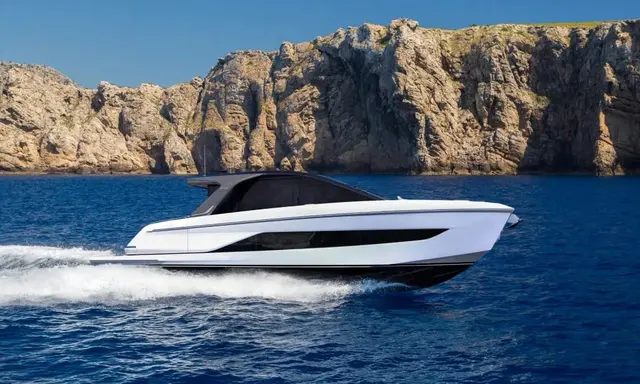
The FJORD 440 Sport is giving owners another way to experience the German brand's open-deck motor-yacht design. Introduced by HanseYachts AG on 4 November 2026, the new model was engineered specifically for outboard propulsion, using two Mercury Verado V12 engines with a combined rated output of 1,200 horsepower. The builder estimates a maximum speed of approximately 43 knots, while clearly noting that this preliminary figure remains subject to sea-trial confirmation. Beyond outright speed, the yacht introduces practical solutions around its aft deck, including a lifting seat that allows the engines to tilt clear of the water and substantial storage for water-sports equipment. For buyers considering a mid-size luxury day yacht with overnight accommodation, the more interesting question may be how these features change the experience of using the boat.
Purpose-built rather than converted
The builder emphasises that the FJORD 440 Sport was conceived around outboards from the outset. This is a significant design distinction. Engines mounted outside the hull impose different requirements on buoyancy, weight distribution, stern layout and access to the water. Simply replacing an inboard drivetrain with external engines would not necessarily preserve the original handling or cockpit arrangement. HanseYachts says it optimised the aft hull and buoyancy while maintaining design characteristics of the FJORD 440 Open. The claim describes the manufacturer's engineering approach, not a comparative test of both models under identical conditions. Prospective buyers should still examine the completed boat and its technical certification.
A combined 1,200 horsepower
The specified propulsion package consists of twin Mercury Verado V12 outboards producing a combined 1,200 hp. Large outboard engines can free internal space traditionally used for machinery and provide straightforward access to certain service points. They also influence the yacht's appearance and manoeuvring characteristics. The rated power alone does not establish acceleration, fuel efficiency or behaviour in a seaway. Those depend on hull shape, loading, weather and many other variables. The official announcement provides a headline configuration, while a complete performance assessment will require measured trial figures and clear test conditions.
A 43-knot projection with an important caveat
FJORD quotes a projected top speed of approximately 43 knots, explicitly stating that this estimate is preliminary and will require confirmation during sea trials. That caveat matters to buyers. A promotional estimate should not be converted into a guaranteed speed, especially when the loading condition, sea state and fuel carried have not been specified. It is reasonable to expect the powertrain to support spirited performance, but final operational figures must come from trials and the manufacturer's documentation. Owners should also understand how the boat behaves at ordinary cruising speeds, where comfort and efficiency may matter more than its highest possible speed.
Fuel capacity and real-world range
The declared fuel capacity is 1,430 litres, a substantial provision for a motor yacht in this size segment. Nevertheless, a tank volume is not a cruising range. Consumption can vary dramatically between displacement speeds, efficient planing speeds and high-power running. Wind, waves, underwater condition and guest loading also affect the result. The manufacturer presents the capacity as supporting longer days exploring beyond familiar anchorages. Buyers should request a verified fuel-burn table, understand usable fuel and apply prudent reserves. A yacht marketed for active cruising is most enjoyable when fuel planning is based on measured performance rather than a figure inferred from tank size.
More than 4.5 cubic metres of aft storage
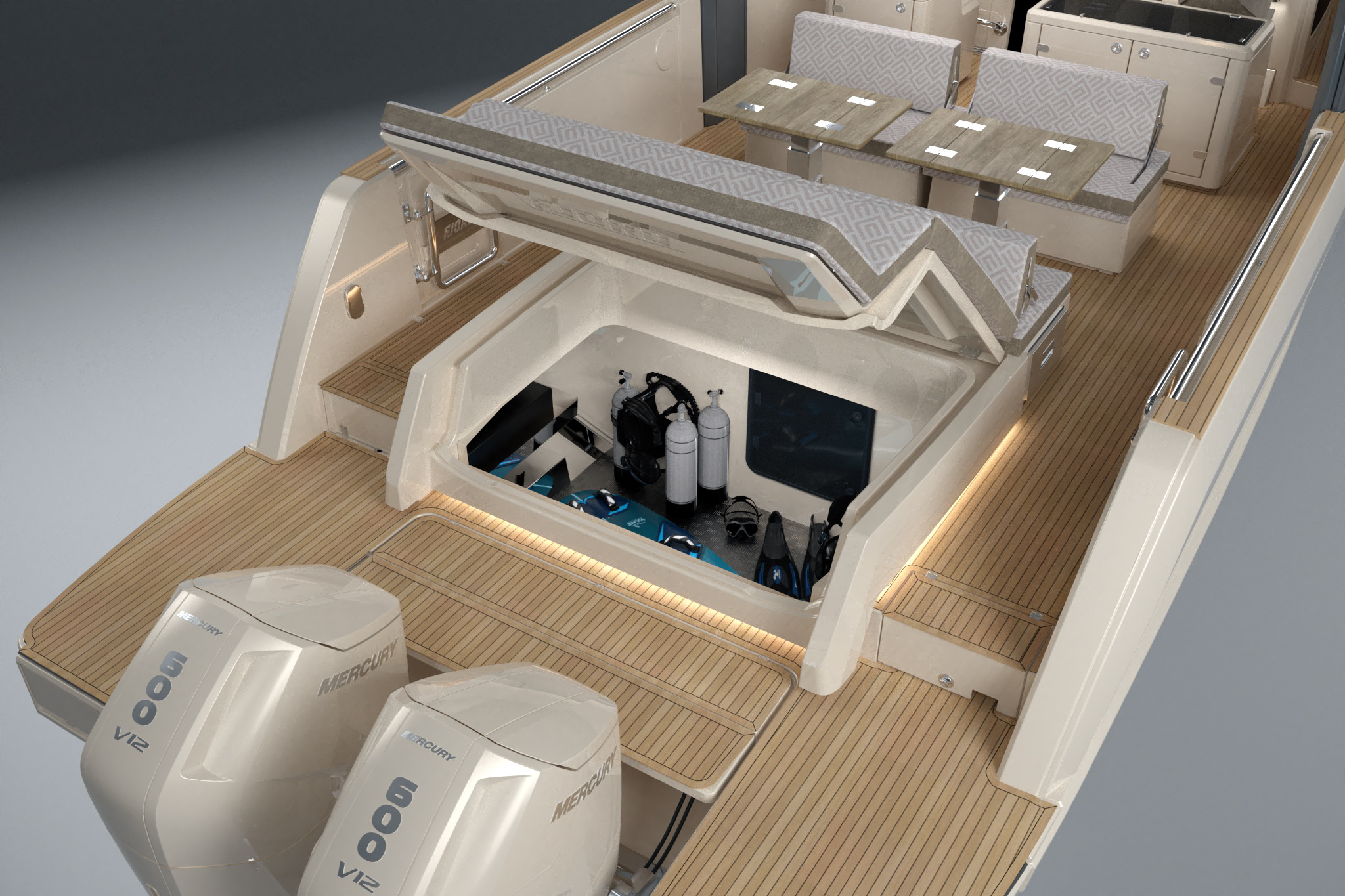
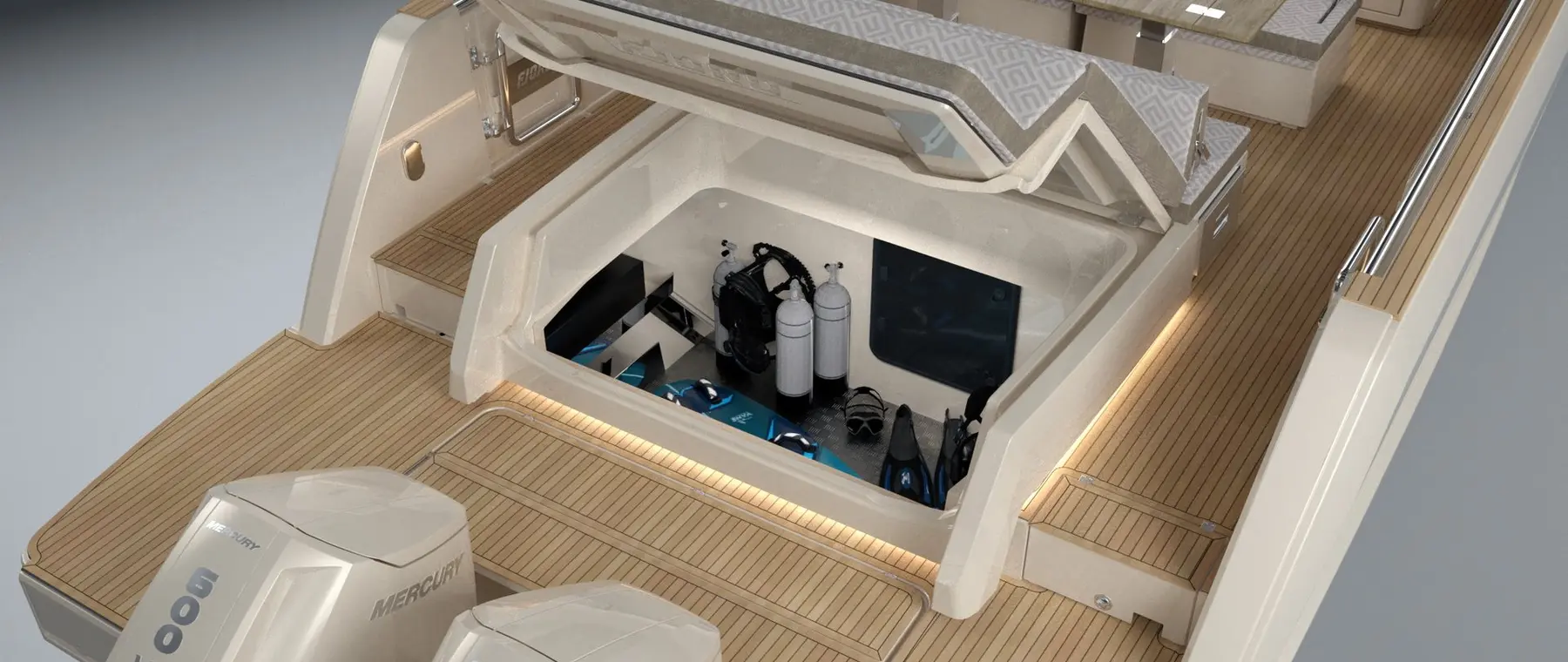
A particularly distinctive feature is an aft compartment providing more than 4.5 cubic metres of storage. The compartment is accessed through an electrically operated opening and is intended for equipment such as inflatable paddleboards, SEABOBs and diving gear. Storage volume is important for owners who want to carry toys without sacrificing the social function of the cockpit. However, volume is not the same as payload capacity, and heavy equipment must be secured according to the boat's limits. Buyers should ask for the maximum permitted loads and examine how easily the compartment can be accessed when the cockpit is occupied.
The lifting aft bench solves an outboard problem
A major practical innovation is the integrated lifting aft bench. The seat can be raised to provide clearance for both outboards to tilt fully out of the water. This addresses an issue inherent in a yacht with large external engines: machinery needs room to move without compromising seating and access. The solution allows the aft area to remain useful for guests while retaining necessary operational clearance. Buyers should assess how the mechanism operates, whether there are safeguards against accidental use and what maintenance it requires. The builder describes the concept but does not publish a complete operating manual in the announcement.
A dedicated gangway beside the engines
FJORD has positioned a stepped gangway beside the outboard engines, which also serves as a swim ladder. This provides a more direct route between deck and water than might otherwise be possible with two large engines occupying the transom. It could appeal to owners who regularly swim, dive or use water toys. Safe access still depends on proper engine shutdown procedures, sea conditions and supervision. It should not be assumed that a convenient platform makes swimming safe in every anchorage. For buyers, the value lies in understanding how movement around the stern has been designed into the boat rather than treated as an afterthought.
The social cockpit remains central
The FJORD design language is strongly associated with open-air use and a cockpit that functions as the main gathering space. The new Sport variant retains flexible aft seating while adapting the surroundings for outboard propulsion. Day-boat owners often judge a layout by where guests sit, how easily they move around and whether a meal or swim can be accommodated without constantly rearranging furniture. A highly stylised cockpit can succeed when those practical movements feel natural. The manufacturer's description confirms flexibility but does not list every possible configuration or its pricing. A buyer should inspect the selected version rather than assume a brochure example is standard.
A retractable television under the T-Top
An unusual hospitality feature is a 55-inch television that lowers from the yacht's T-Top at the touch of a button. It can support films or sporting events while guests remain in the cockpit. The detail shows how owners increasingly use day yachts as extensions of their social space, rather than solely as transport between marinas. Marine electronics and screens must also cope with movement, sunlight and environmental exposure. The manufacturer's announcement identifies the installation but does not describe service plans, power consumption or how it integrates with every entertainment source. Buyers interested in the feature should ask for a demonstration and the installed specification.
Shade and ventilation from the redesigned roof
The builder describes a redesigned T-Top that offers shade while allowing air to move naturally through the helm and cockpit. Good shelter is important for a yacht intended for warm-weather leisure, particularly when guests remain outside for long periods. At the same time, shade and ventilation are not interchangeable with climate-controlled interior comfort. Conditions vary by season, speed and region. A solid roof can alter the ambience and affect visibility or clearance in certain marina settings. Buyers should examine the boat at the helm and in the seating areas, noting the coverage that matters for their own likely cruising programme.
A more connected helm
The official account highlights intuitive placement of core controls and joystick manoeuvring for close-quarters handling. This reflects the needs of owners who may frequently move between marinas or anchorages with limited crew assistance. A joystick can reduce workload, but it does not remove the need to understand wind, current, propeller effects and the boat's dimensions. Prospective skippers should train on the actual propulsion system and determine its operating limits. The builder has not claimed that the boat can berth autonomously or that electronic assistance guarantees collision-free manoeuvres. The useful advance is additional control and visibility when properly used.
Six cameras support docking visibility
The FJORD 440 Sport is described as having a six-camera docking assistance system. Cameras can reveal areas around the hull that may be difficult to see directly, particularly in crowded marinas. Their effectiveness depends on camera position, image quality, environmental conditions and the skipper's familiarity with the display. A camera is a supplement to direct observation, not a replacement for it or for a competent crew member where needed. Buyers should check how the camera views are presented at the helm and whether glare, spray or low light affect usability. The announcement does not constitute an independent verification of detection or warning functions.
Two cabins for overnight stays
Below decks, the Sport variant follows the interior direction of the FJORD 440 Open, with two cabins providing private spaces for overnight use. This makes it more versatile than an open boat intended only for a few hours on the water. Accommodation design matters because cabins should remain practical when guests arrive wet, store bags or move about in limited space. The builder describes generous natural light and a choice of finishes, but detailed dimensions and berth configurations should be confirmed. A two-cabin arrangement can serve several kinds of ownership without suggesting that every group will find the same layout equally comfortable.
A separate head and enclosed shower
The interior includes a separate head with an enclosed shower, providing useful facilities for longer days afloat. On a boat used for swimming and water sports, a well-designed shower and bathroom can make the difference between a comfortable day and an improvised return to the marina. Buyers should consider freshwater capacity, hot-water provision, ventilation and the storage available for towels and personal items. The manufacturer's promotional announcement does not supply all of those specifications. An onboard visit gives a more reliable assessment of how the accommodation works than illustrations alone.
Flexible finishes and layout choices
FJORD says buyers can select interior details and layout options to match their intended use. Personalisation is meaningful when it responds to an actual cruising plan. An owner travelling with children may have different cabin priorities from a couple who regularly entertain friends for day trips. Some options can affect weight, space, maintenance and eventual resale. It is important to distinguish standard equipment from packages or individual modifications and to obtain a signed specification for the exact boat ordered. The introduction establishes flexibility but does not provide a complete menu of colours, materials or costs.
Outboards change maintenance considerations
Large outboard engines bring some practical advantages, including access to machinery outside the hull, but they also introduce their own servicing requirements. Tilt systems, transom hardware, steering and control interfaces must be maintained, and the environment can be demanding in saltwater use. The lifting bench is a distinctive integration feature, which also means its mechanism becomes part of the maintenance programme. Prospective owners should ask about authorised Mercury service, storage arrangements and warranty coverage in the locations where they plan to cruise. A design marketed as convenient is most valuable when continuing service can be arranged reliably.
An owner should assess more than speed
An impressive horsepower figure may attract attention, but the FJORD 440 Sport is also intended to support swimming, watersports, socialising and overnight accommodation. These activities impose different practical requirements. A buyer should evaluate noise at cruising speed, access to the water, capacity for equipment, cockpit shelter and cabin comfort. Sea trials should cover the conditions likely to be encountered in ordinary use, not only flat-water acceleration. Some questions will remain until the model's full operating data become available. The manufacturer's declared details are a useful starting point, but they are not a complete ownership assessment.
Its position within the FJORD family
The new Sport model complements the FJORD 440 Open while preserving a recognisable design identity. Their different propulsion arrangements may appeal to owners with different expectations about handling, cockpit organisation and service. It would be premature to claim that one version offers a superior range or fuel efficiency without directly comparable verified figures. Buyers may value the Sport's aft storage and outboard-specific solutions, while others will prefer the characteristics of the existing model. The development expands choice in a sector where owners increasingly look for a boat that matches their recreational activities and cruising habits.
What remains to be confirmed
As of the official introduction, the quoted maximum speed is a preliminary estimate and must not be treated as a sea-trial result. The announcement also does not disclose an independently verified range table, a universal retail price or confirmed delivery dates for every market. Local dealers will need to clarify which equipment is included and what options affect the final configuration. These gaps do not invalidate the introduction; they simply define the difference between a model announcement and a completed ownership decision. A serious buyer should retain that distinction throughout the process.
A performance yacht designed around use
The FJORD 440 Sport pairs twin V12 outboards and strong claimed performance with a carefully considered aft-deck layout. Its appeal lies in the combination of 1,200 hp, an estimated 43-knot top speed, 1,430 litres of fuel, a substantial toy compartment and a lifting seat designed to preserve engine clearance. Just as important are the two cabins, enclosed shower and systems intended to support everyday handling. The news is not only another powerful motor yacht: it is an example of a builder responding to the practical consequences of changing propulsion choices. Owners will ultimately judge the result by how comfortably and confidently it works on the water.
Sources and image credits
Reporting based on Official manufacturer editorial source for FJORD 440 Sport Adds Twin 600hp Outboards and a New Aft-Deck Concept, verified 26 November 2026.
Lead rendering: Official FJORD 440 Sport manufacturer model visual, not an independent sea-trial photo. © HanseYachts AG / FJORD and original photographer. Manufacturer-controlled original promotional photograph/visual. Rights retained. Original official image source.