The bridge is being treated as adaptable architecture
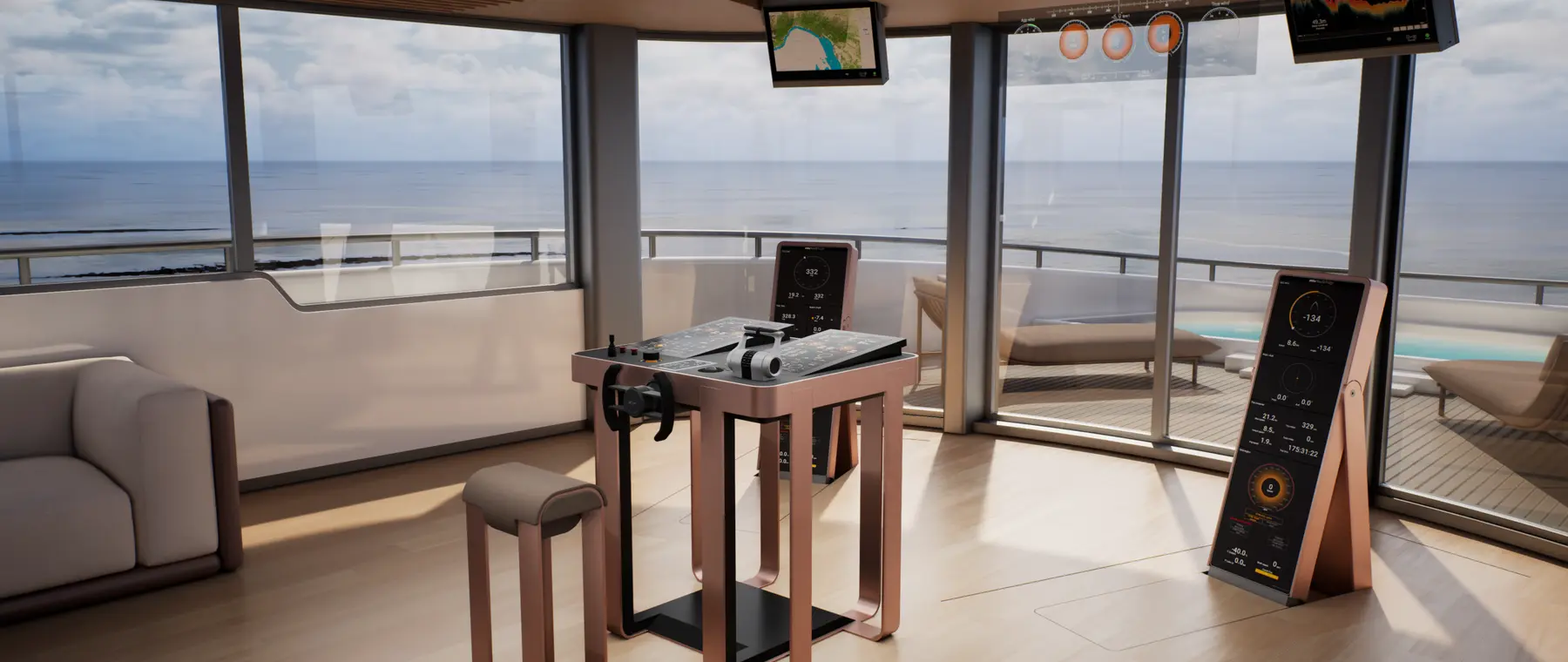
Point Break is based on the idea that the control position can remain fully capable when required but become part of a more flexible living environment at other times. This changes the traditional assumption that a wheelhouse must permanently occupy valuable interior volume regardless of whether the yacht is underway or at anchor.
For designers working within the tighter space constraints of series yachts and sub-24-metre craft, that principle is particularly interesting. Every square metre has competing uses, and technology that can consolidate displays and controls may create opportunities to improve circulation, visibility or social space without increasing overall yacht length.
Digital interfaces replace some physical complexity
The concept uses a next-generation human-machine interface together with head-up display technology to present navigational information in a more integrated way. Rolls-Royce is also looking toward future AI-supported onboard functions, suggesting a bridge where software increasingly helps organise information rather than simply adding more independent screens.
The challenge is to simplify without obscuring essential information. Owners and professional operators need immediate access to navigation, propulsion and alarm data, and any flexible bridge must preserve clear operating logic when conditions deteriorate. Successful digital design therefore depends as much on hierarchy and redundancy as on visual minimalism.
Integration reaches beyond the helm displays
mtu NautIQ forms part of Rolls-Royce's broader move toward integrated yacht systems that connect bridge controls, automation and propulsion. When these elements share a coordinated architecture, builders can reduce the number of isolated interfaces and potentially simplify both commissioning and fault diagnosis across the vessel.
That system-level approach also matters for owners because many modern yachts depend on several layers of electronics to deliver manoeuvring, monitoring and hotel functions. A coherent interface can reduce training time and make complex systems feel more predictable, provided the underlying engineering retains robust fallback modes and service access.
A concept study can influence smaller production yachts
Point Break was presented as a vision rather than a conventional production launch, but concept studies can shape future bridge hardware by testing how owners, designers and captains react to new ideas. Features that prove useful may later appear in more standardised products, even if the full architectural concept remains reserved for larger custom projects.
For the luxury-yacht market, the important direction is clear: bridge technology is moving from collections of separate instruments toward integrated digital environments. As hardware becomes less visually intrusive, designers gain greater freedom to decide how technical spaces should relate to the rest of the yacht rather than allowing equipment dimensions to dictate the room.
Official sources: www.mtu-solutions.com.