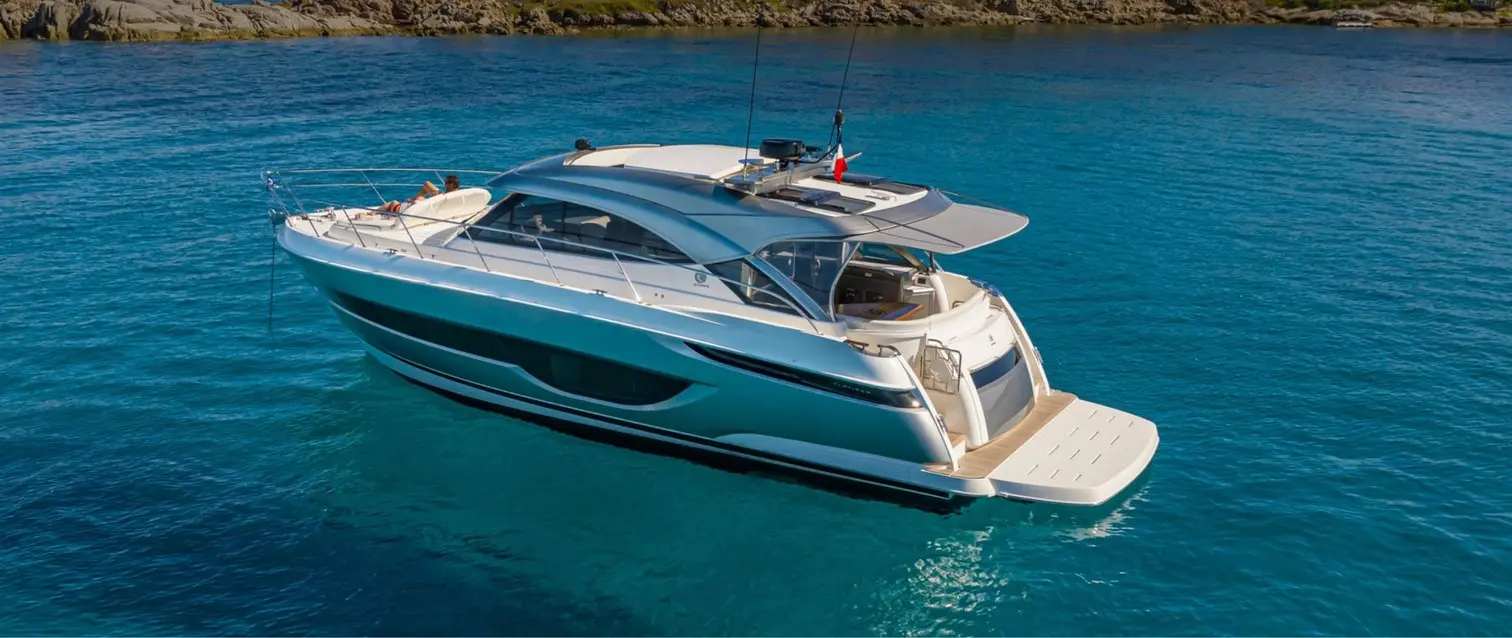
A 15.31m sport yacht built around one-level living
Riviera’s 4600 Sport Yacht Platinum Edition shows how much design attention can be concentrated into a 15.31-metre motor yacht without pretending to compete in the superyacht market. The Australian builder positions its Sport Yacht family around contemporary styling, the convenience of a largely single-level social deck and offshore-capable hull construction. The 4600 remains part of Riviera’s current model range, making it a relevant choice for buyers examining established cruising boats rather than searching only for newly unveiled concepts. Its practical attraction comes from the relationship between cockpit, saloon and accommodation rather than from headline speed claims.
Measured overall, the boat is 15.31 metres including platform and bow roller, with a 13.16-metre hull and a beam of 4.70 metres. Those proportions create room for a surprisingly elaborate arrangement while keeping the boat within a size class that many experienced private owners will recognise. Riviera quotes a maximum draft of 1.45 metres including propellers and approximate dry weight of 19,995 kilograms, subject to engines and options. These figures matter when planning berth dimensions, haul-out arrangements and cruising grounds. They should always be checked against the actual specification of an individual vessel.
The Platinum Edition designation is more than an exterior colour treatment. Riviera describes an elevated approach to fittings, appointments and finishes, applied across a layout that connects relaxation and dining on a single principal deck. The project was created by Riviera’s design team working with 4D Designs, and the builder attributes its interior volume partly to its hull and structural development. The result is meant to serve several different moments in a cruising day: an easy breakfast at anchor, a relatively sheltered passage, a swim stop and an evening with guests in the cockpit.
Outdoor spaces that do useful work on the water
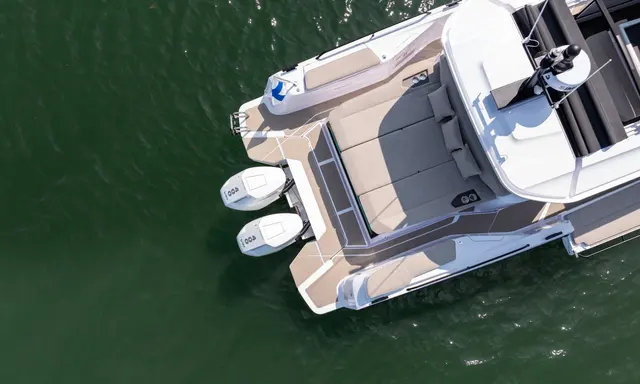
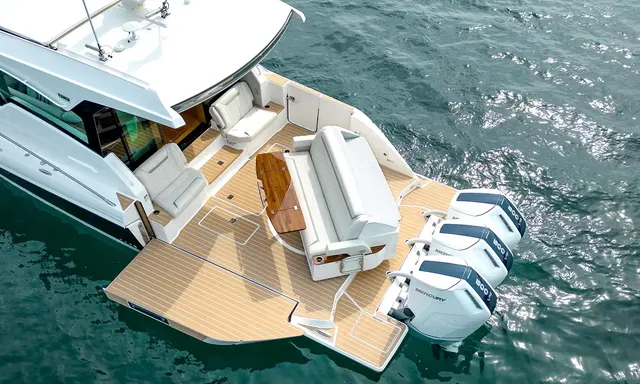
The after end of the boat is particularly revealing. A hydraulic swim platform lowers towards the water and deploys folding steps, helping guests get into and out of the sea without depending on a precarious ladder arrangement. The platform is also a useful interface for watersports equipment, although actual loading limits and safe use need to be confirmed for each boat. Above it, a garage accessed through an opening transom accommodates smaller toys such as a stand-up paddleboard of up to nine feet. That separation helps keep loose equipment away from the primary entertaining areas.
Riviera has also placed a barbecue centre near the cockpit, complete with an electric grill, refrigeration, ice-making, sink and preparation space. It is a sensible detail on a yacht whose owners may spend long periods away from waterside restaurants. Rather than moving everyone below for a simple meal, the arrangement brings the service area close to the cockpit where guests are likely to gather. The equipment sits under a moulded cover, so the working surfaces can be closed away when they are not in use. The exact inventory should still be checked during specification discussions.
The foredeck adds a separate lounging zone with a large sunpad, giving guests a different exposure to the breeze and surrounding view. On a boat of this length, that choice effectively increases the useful social footprint without demanding a flybridge. It is worth noting that outdoor spaces carry operational consequences: sun protection, safe movement underway, secure storage and the ability to re-enter the cabin quickly during changing weather all matter. Attractive renderings and promotional photographs are starting points, but they cannot substitute for an actual walk-through while the yacht is alongside.
Three cabins change the scope of a family cruise
Below deck, Riviera specifies three staterooms accommodating six people, with a full-beam master suite as the headline space. Having three distinct cabins matters for an owner who occasionally brings another couple, older children or relatives on a weekend passage. It can also make longer trips more comfortable by reducing the need to convert a salon into an improvised bedroom. The builder identifies a laundry station hidden in companionway cabinetry, another small operational detail with outsize value for people spending more than a night or two aboard.
The main saloon and cockpit are intended to behave as complementary rooms instead of isolated spaces. That is a central advantage of the sport-yacht format: guests who prefer shelter can remain part of the conversation, while others choose the open air. It also simplifies service during a relaxed cruise because the most used living areas remain close together. What the layout cannot do is erase all the compromises imposed by a 15-metre hull. Owners should inspect headroom, doorway widths, storage depth and how the yacht feels when six people are moving around simultaneously.
Capacity figures should be interpreted in the right way. Six people sleeping aboard is not a promise that every cabin will satisfy every guest’s expectations, and an elegant marina display offers little information about noise levels or comfort at sea. Buyers should also assess ventilation, lighting, laundry access and how wet clothing will be managed after watersports. These are the issues that distinguish a boat optimised for occasional entertaining from one that could support several weeks of serious coastal cruising. The 4600’s layout invites that conversation rather than avoiding it.
Twin IPS propulsion and the owner's practical checklist
The current Riviera specification lists twin Volvo Penta D8-IPS800 diesels, each rated at 441kW or 600hp. The IPS installation uses steerable drives, and Riviera highlights joystick control for close-quarters handling, alongside a Volvo Penta Glass Cockpit system that consolidates navigation and engine information. CZone digital switching integrates onboard electrical management, while Sentinel monitoring can provide selected information and alerts remotely. These technologies have clear practical value, although owners must still learn the underlying systems and should never assume digital assistance replaces watchkeeping or sound seamanship.
Capacities are as important as propulsion ratings for realistic journey planning. Riviera’s current page lists 2,100 litres of fuel, 460 litres of fresh water and a 151-litre holding tank. Those numbers can support preliminary calculations, but neither range nor time at anchor can be stated responsibly without knowing load, speed, sea conditions, generator use and onboard consumption. Prospective owners should request a trial with a representative cruising load and have the actual boat's tanks and systems surveyed. A carefully managed 15-metre yacht can deliver memorable voyages, but its autonomy is never an unlimited resource.
A final ownership review should cover the available berthing footprint, bridge clearance of 4.73 metres, maintenance access, after-sales support and warranty terms. Riviera describes separate limited cover for non-structural items, Volvo Penta equipment and structural components, with exclusions and time or engine-hour limits that require careful reading. The 4600 Sport Yacht Platinum Edition is best judged as a developed Australian cruiser with genuinely useful spaces, not as an overnight revolution. Its appeal lies in having the equipment, cabin count and outdoor layout to make regular private cruising feel straightforward.