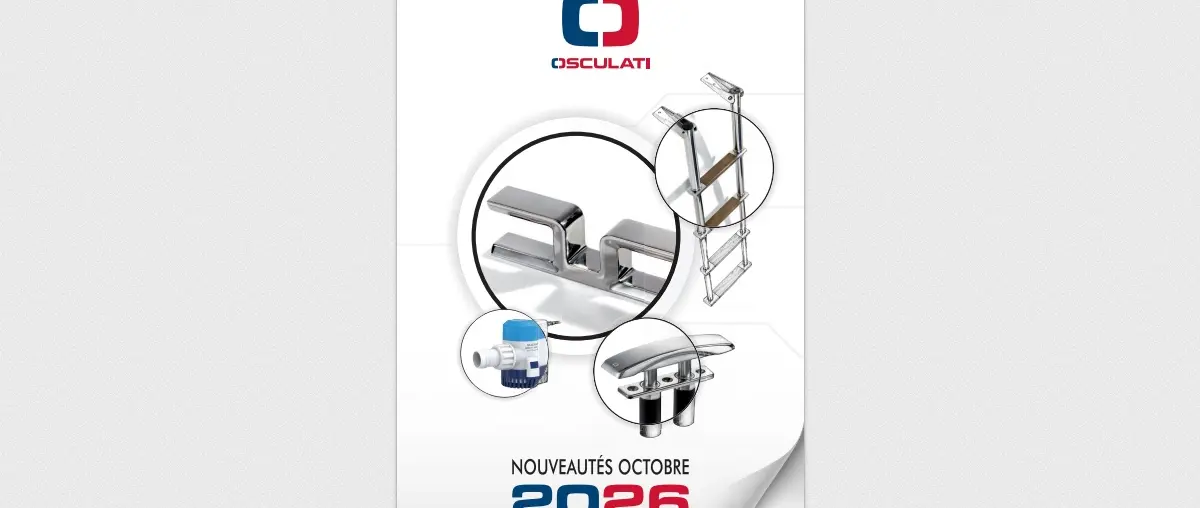
Osculati has introduced a new collection of yacht hardware led by the Halo range of AISI 316L stainless-steel cleats and fairleads. The products were developed by Osculati's Design and Engineering department with yacht designer Marco Casali and are intended to combine mooring strength with a more sculpted deck appearance.
The wider new-products programme also includes boarding ladders, stanchions and additional deck equipment. Although these are relatively small components, they influence how a yacht looks, how safely it is handled and how easily owners move between the deck and the water.
Halo reworks a basic mooring component
The Halo cleats use a deliberately simple geometry with a hollow section that gives the fitting a distinctive profile while reducing visual bulk. Osculati is offering several cleat and fairlead sizes so yards can match the hardware to different deck loads and yacht dimensions.
Mooring fittings are highly functional components, so styling cannot come at the expense of load capacity or installation quality. The use of AISI 316L stainless steel reflects the need for corrosion resistance in exposed deck hardware.
Marco Casali brings yacht-design language to hardware
Casali has worked across production and custom yachts and has collaborated with Osculati on the visual language of the Halo range. Applying yacht-design thinking to individual fittings can help builders maintain a consistent appearance across an otherwise fragmented list of deck components.
That is particularly relevant on premium production yachts, where owners increasingly notice the details around cleats, fairleads, hinges and boarding equipment. Hardware that looks integrated with the yacht can contribute to perceived build quality even when the component itself is small.
Access equipment is also being updated
Osculati's new-products catalogue includes swim ladders and related deck-access equipment alongside the mooring range. Boarding hardware needs to balance compact stowage with secure handholds and predictable deployment, especially when owners are using the yacht without professional crew.
Materials and detailing matter because ladders and stanchions remain exposed to saltwater and repeated handling. Well-designed hardware can reduce rattles, corrosion and maintenance over the yacht's life.
Small components can shape the ownership experience
Major systems such as engines and electronics attract more attention, but owners interact constantly with cleats, ladders, rails and deck fittings. Poorly designed hardware can make everyday jobs awkward even on an otherwise sophisticated yacht.
Osculati's latest collection shows suppliers putting more design work into those routine touchpoints. For builders in the 12-to-23.99-metre segment, that gives another way to differentiate deck quality without changing the underlying yacht platform.