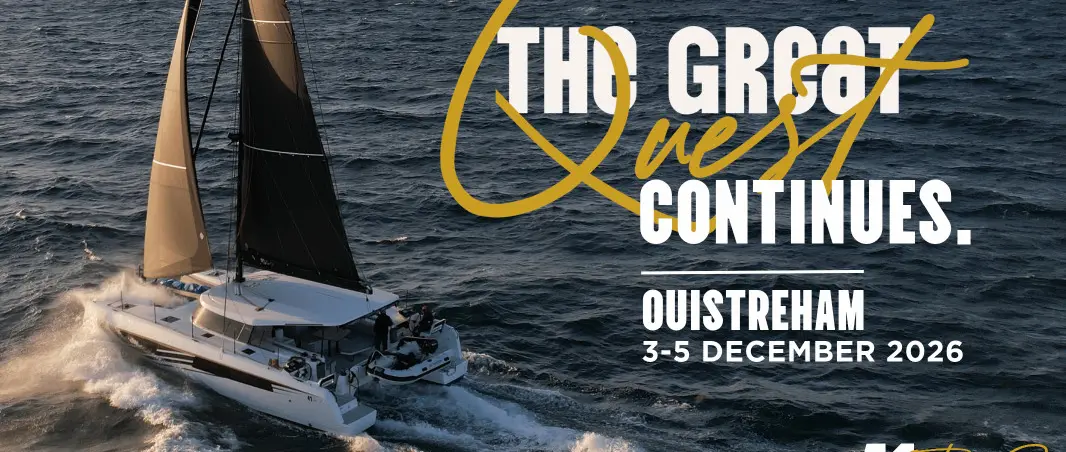
Nautitech Catamarans is inviting prospective owners and sailing enthusiasts to Ouistreham, Normandy, for a three-day presentation of its Nautitech 41 Type S from 3 to 5 December 2026. The visit forms part of the French builder’s Great Quest series, which takes the compact sailing catamaran to different coastal locations so that sailors can examine its layout and discuss their cruising plans with the team. In the manufacturer’s official announcement, the event is presented as an opportunity to understand a design that prioritises sailing feel, agility and the requirements of longer-distance cruising. It is a forthcoming event rather than a claim that the December appointments or sea trials have already been completed. The 41 Type S is especially relevant to the smaller luxury-yacht market because an owner at this size may be closely involved in every aspect of handling and maintenance.
Why Ouistreham is a useful setting
Ouistreham sits on the Normandy coast, near the mouth of the Orne and the approach to the Caen canal. It is a place associated with working maritime activity as well as recreational sailing. The surrounding waters can provide a more meaningful context for discussing passage planning and sail handling than a static indoor display. Yet no advance announcement can guarantee the weather or the exact conditions that will be encountered. A prospective participant should establish whether the planned visit involves a berthside viewing, a scheduled sail, or both. The manufacturer’s invitation describes a programme for three days, not unrestricted access to the yacht at every hour.
The Great Quest continues
Nautitech describes the Ouistreham call as another stage of the Great Quest, an owner-facing journey intended to bring the 41 Type S closer to people interested in its approach to cruising. Such a touring format can help buyers who would otherwise need to travel to one fixed showroom or shipyard location. It can also provide an opportunity to meet other sailors whose plans and experiences differ. The value of a visit lies less in promotional excitement than in the questions that can be answered by examining a real boat. Buyers should prepare a list of technical and practical concerns rather than judging a catamaran solely by the first impression of its lines.
Understanding what Type S means
The name suggests a particular focus on the experience of sailing rather than merely maximum accommodation. Nautitech says that the model’s sleek lines, optimised naval architecture and lightweight approach reflect the goal of bringing back instinctive sailing sensations. Those are useful statements of intent, but they do not establish independent comparative performance against other catamarans. Wind strength, sail inventory, crew experience, loading and sea state all affect the behaviour of a multihull. The appropriate way to assess the design is to connect the manufacturer's philosophy with model-specific technical information and, where possible, a properly conducted sail.
A catamaran within the smaller-yacht market
At approximately 41 feet, the boat belongs to the part of the sailing market in which owner involvement is often high. The dimensions can make some marina and maintenance choices more accessible than those of a much larger yacht, while still providing the breadth and accommodation associated with a cruising catamaran. Overall beam remains an important consideration, since a multihull may need a wider berth than a monohull of similar length. A buyer should verify the current beam, displacement, draft and mast height from the official specification sheet rather than assume that the model name supplies exact dimensions. Those figures influence the destinations that can be visited safely and economically.
Sailing response and practical seamanship
A yacht that feels responsive can make passages more engaging, but responsiveness is only one part of good design. Predictable steering, effective sail controls and clearly arranged deck equipment matter when a couple or small crew is handling the vessel. The builder's emphasis on agility suggests that helm feedback is a central part of the design brief. It does not mean the catamaran can be operated safely without training. Buyers should consider manoeuvring in confined water, reefing procedures and the practical demands of sailing at night. An event where these subjects can be discussed candidly may be more valuable than a short demonstration of the boat at its most flattering speed.
Weight as an engineering decision
Nautitech highlights the lightweight character of the 41 Type S. In multihull design, displacement can affect sailing behaviour, but achieving an appropriate weight is a complex task. The structure still needs to withstand expected loads and provide adequate strength for offshore use. Equipment, stores, water and cruising possessions also add weight after delivery. A catamaran that performs well when lightly equipped can behave differently during a long voyage. Owners should request the builder's loading assumptions and understand how additional gear affects trim and performance. The manufacturer’s general description is not a substitute for a detailed loading and stability assessment.
Comfort without abandoning the sailing brief
The official announcement places bluewater comfort alongside sailing pleasure. These objectives can coexist, but their interaction needs careful attention. Accommodation for extended cruising involves storage, ventilation, galley function, water supply and safe movement between cabins and living spaces. A cockpit that feels spacious at anchor may be more exposed in poor weather. Similarly, a bright interior should still provide handholds and secure stowage for a passage. Prospective owners should inspect the yacht with both uses in mind rather than treating the brochure's leisure photographs as a complete account of onboard life.
Examining the helm and sightlines
The position of the helm affects communication between crew, awareness of sails and visibility when entering a marina. At a smaller size, a couple may wish to share responsibilities without the physical separation of a large flybridge yacht. The best arrangement depends on the specific cockpit geometry, seat positions and where lines are led. A visit provides an opportunity to examine these details with the boat present, including whether one crew member can reach controls comfortably. The source does not publish a new helm specification in this event invitation, so owners should use the current technical documentation when comparing it with competing models.
The importance of deck movement
A catamaran’s broad platform creates space but can also introduce long routes between particular working areas. Moving safely from cockpit to foredeck, inspecting anchoring equipment and reaching sail controls all matter. It is useful to examine nonslip surfaces, handholds, lifelines and access to technical compartments when the vessel is stationary. During a sea trial, owners can then consider how that arrangement functions while moving. A beautiful deck photograph cannot demonstrate every aspect of safety. A careful owner looks at the whole operational sequence, including the way people move when tired, at night or in difficult weather.
A route to more informed specifications
Many buyers begin with a preferred number of cabins or a favourite interior finish. Those choices are important, but they should come after understanding how the yacht will be used. A boat planned for extended offshore sailing has different requirements from one intended for seasonal weekends near a home marina. Equipment choices can include power generation, navigation electronics, communications, refrigeration and ground tackle. Each addition brings cost, maintenance and potential weight. Conversations with Nautitech's team during the Ouistreham visit may help identify suitable options, but the event announcement itself does not establish availability or pricing for every configuration.
Energy consumption on an extended cruise
Electrical autonomy is an important question on any smaller cruising catamaran. Owners may rely on batteries, alternators, shore power, solar generation and occasionally a generator, depending on the boat’s configuration. An attractive solar installation does not automatically deliver sufficient power for every appliance or destination. Consumption from refrigeration, navigation and communications can vary considerably. The relevant assessment is an energy budget based on actual equipment and expected conditions. Buyers should request clear technical specifications for whichever version of the 41 Type S they are considering rather than infer energy performance from generic claims about efficient yacht design.
The role of local representatives
Touring events often rely on cooperation between the shipyard and regional sales or service partners. For a buyer in northern France, face-to-face contact can be helpful because long-term ownership depends on access to parts, skilled technicians and advice. A dealer's knowledge of local marinas and sailing conditions is also valuable. The Ouistreham announcement provides a meeting opportunity, not a guarantee of immediate delivery or future maintenance capacity. Prospective customers should establish who will handle commissioning, warranty communication and routine support after a purchase. Those operational details matter just as much as the yacht’s interior arrangement.
Questions about offshore ambitions
Nautitech's marketing places the 41 Type S within a bluewater cruising conversation. Owners who intend ocean passages should review the boat's certification, operating limitations and required safety equipment with qualified specialists. They should also investigate how the vessel behaves when heavily loaded and under reduced sail. A manufacturer invitation can explain the concept, but safe passage-making requires seamanship, route planning and ongoing maintenance. The boat's size does not eliminate the need for weather judgement or a properly prepared crew. This is an important distinction for buyers approaching their first long-distance multihull.
A three-day event with practical limitations
The official dates are 3, 4 and 5 December 2026. A prospective visitor should contact the organiser to confirm the programme, any appointment requirement and whether there is capacity for a viewing or sail. Weather, tides and operational circumstances may change the activities available during the visit. The published invitation should not be treated as real-time reservation confirmation. It also does not disclose a universal list of included services or costs. Clear expectations are essential when someone is travelling from another region specifically to inspect a yacht.
Why direct inspection remains valuable
Modern photographs and interactive drawings can communicate the shape of a yacht, but they cannot reproduce the practical feeling of its spaces. Sitting at the helm, moving through the saloon and examining an engine compartment reveal details that can be overlooked in a specification sheet. A direct visit may confirm a buyer’s initial enthusiasm or expose questions that need further research. It is better to discover those matters before ordering than during the first season of ownership. The Ouistreham event offers a setting for this process without requiring the manufacturer to claim that every question can be answered in one day.
The source and what remains to verify
Nautitech's official event announcement confirms the Ouistreham location, the 3–5 December schedule, the Great Quest programme and the builder's stated focus on responsive sailing and bluewater versatility. It does not document completed sea trials for those dates, available berths, pricing or an independent comparison with other 41-foot catamarans. This article explains the published invitation and the questions prospective owners should consider. Technical and commercial details should be confirmed with Nautitech and its authorised partners.
An opportunity to put sailing first
The Nautitech 41 Type S visit is notable because it asks buyers to consider how they want to sail, not simply how much interior volume they can acquire. The balance between handling, comfort, weight and useful accommodation defines the smaller cruising-catamaran market. A well-organised encounter with the actual boat can help prospective owners decide whether that balance suits their plans. The forthcoming three days in Normandy are an opportunity for informed questions and careful inspection, with the eventual judgement resting on the yacht's documented capabilities and the needs of those who will operate it.
Sources and image credits
Reporting based on Nautitech Catamarans 5 November 2026 official Great Quest Ouistreham event announcement.
Lead photograph: Nautitech 41 Type S Great Quest Ouistreham event — original shipyard promotional image. © Nautitech Catamarans Original official image source.