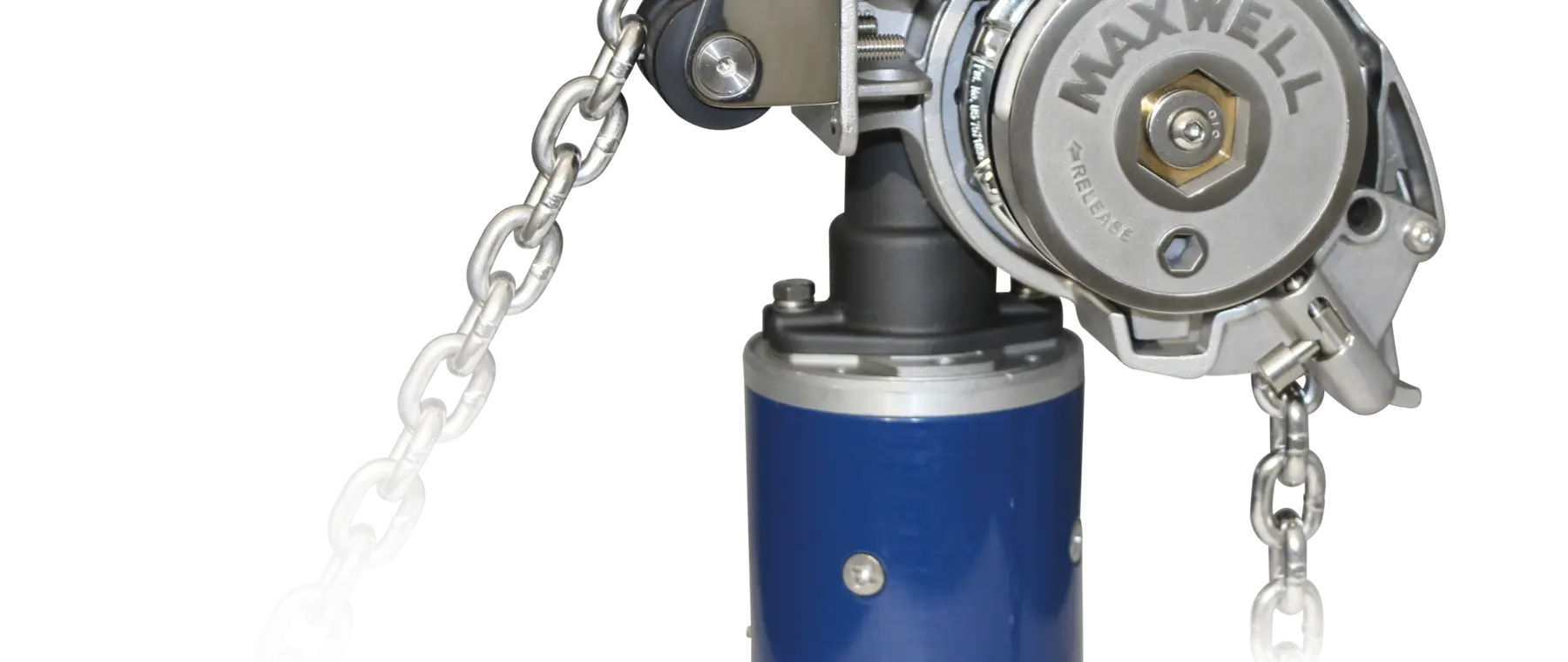
Maxwell Marine has launched the BH8 as a compact concealed anchoring system intended particularly for stern-anchor installations while retaining the flexibility to support bow configurations. The product responds to a design trend in which builders want the anchor and recovery hardware hidden from view without making the equipment difficult to install or service.
Concealed systems are increasingly relevant on luxury yachts because clean exterior lines and uninterrupted bathing platforms can conflict with the practical need for robust anchoring gear. Maxwell’s approach is to package the core mechanism around an adjustable bracket concept rather than requiring one fixed installation orientation.
A reversible bracket broadens installation options
The BH8 uses a bracket that can be flipped to suit different installation directions, helping builders adapt the system to bow or stern spaces without redesigning the entire anchoring arrangement. Maxwell says the concept was developed specifically to support the growing number of stern-anchor layouts found on contemporary yachts.
That flexibility can be valuable in semi-custom production because tankage, tender storage, beach-club equipment and structural members vary between models. A system that can accommodate several orientations gives naval architects and production engineers more freedom to preserve the intended deck layout.
Concealment has to coexist with reliable deployment
Hiding an anchor improves appearance, but the mechanism still needs a clear path for deployment and recovery under load. Rollers, chain or rope routing and the anchor pocket all have to work consistently despite movement, salt contamination and the changing angles that occur when the boat is not aligned perfectly with the rode.
A concealed unit therefore needs to be evaluated as a complete geometry rather than as an isolated winch. Owners considering such systems should pay attention to drainage, inspection access and the ability to clear a jam without dismantling large areas of finished joinery or deck structure.
Stern anchoring is becoming more common in some cruising areas
In parts of the Mediterranean and Nordic markets, stern anchoring can be a practical part of mooring technique, particularly where boats secure the bow to a quay or use tight shoreline arrangements. A compact stern system can make that process easier while keeping the aft deck clear when the equipment is not in use.
The use case is less universal in other cruising regions, so the value of a BH8 installation will depend on how and where the yacht is operated. Builders can nevertheless use the same hardware concept to support a wider range of layouts rather than committing the platform to one regional anchoring style.
Installation quality remains more important than concealment
Maxwell has spent decades supplying windlasses and anchoring equipment, and the BH8 applies that experience to a more design-sensitive package. The product is aimed at OEMs as much as individual owners, reflecting the fact that concealed anchoring works best when it is engineered into the yacht from the beginning.
For buyers, the key question is not simply whether the anchor disappears from sight. A good installation should deploy cleanly, drain properly, remain accessible for maintenance and use appropriately sized rode and structural attachment points, because the anchoring system is still safety equipment even when it is hidden behind a polished exterior.