A family-cruising finalist at a decisive moment
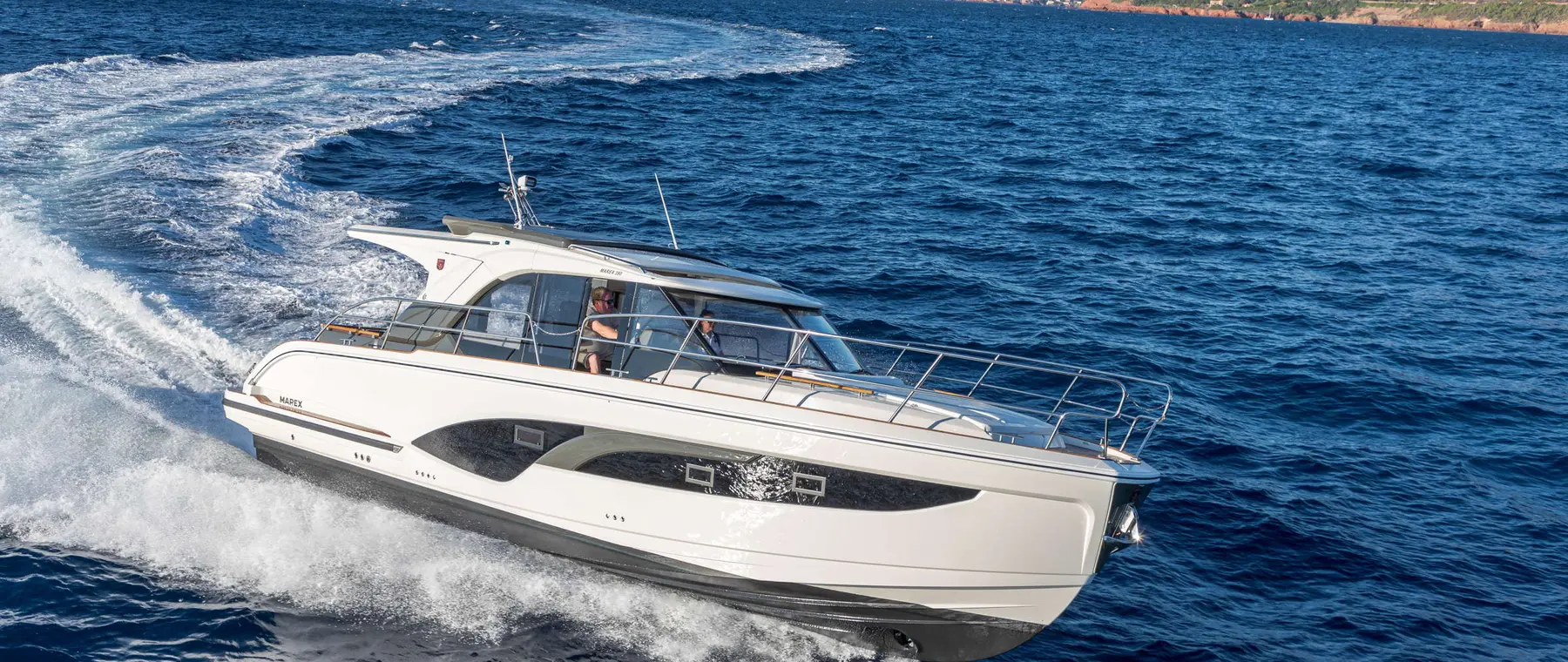
The Marex 390 is among the Best for Family finalists at the Best of Boats Award 2026, with the announcement scheduled for the evening of 26 November at OutVenture Berlin. The Norwegian builder's 12.00-metre cruiser has reached the shortlist alongside the Greenline 42, Viknes S40 Panorama, Grandezza 34 Outboard and Jeanneau Merry Fisher 1095 Fly Series 2. It is important to describe this as a nomination, not an award win: the result of the Berlin ceremony had not been announced at the time of writing. The Marex name has an established association with practical family cruising, and the 390, introduced with a world premiere in 2025, develops that proposition in an unusually competitive category. What makes the nomination worthwhile for Luxury Yacht Guide readers is not the possibility of a trophy alone. It is a reminder that a twelve-metre boat can provide a meaningful holiday experience if the builder has considered weather protection, sleeping arrangements, movement around the deck and owner operation with the same care as exterior styling.
The dimensions behind the idea
Marex publishes a length overall of 12.00 metres for the 390, with a beam of approximately 3.72 metres. These dimensions place it at the lower boundary of Luxury Yacht Guide's yacht coverage, yet it can serve an ambitious programme of family coastal cruising. Overall length alone does not communicate the volume inside a boat. The relationship between beam, freeboard, cabin layout and cockpit arrangement helps determine whether several people can cook, eat, relax and sleep without continually moving equipment from one place to another. Buyers should assess the physical boat rather than rely on a broad model category such as “thirty-nine foot cruiser.” Marina berth availability and costs can depend on precise overall dimensions and any projections from the hull. Likewise, handling in a tight harbour depends on windage, draft, propulsion configuration and the skipper's confidence rather than a brochure length. A careful inspection should begin with a current builder specification sheet and a realistic list of the destinations the family expects to use.
Why its enclosed and open spaces both matter
Scandinavian family cruisers have often sought a practical compromise between protected living spaces and the pleasure of sitting outside. The Marex 390's design draws on that tradition, creating an important buying question: can one boat feel comfortable on a cool, windy passage and genuinely enjoyable at anchor when the sun appears? Effective solutions require more than a roof over the saloon. Windows must provide useful visibility and ventilation. Doors and openings need to resist spray and rain when closed, while allowing convenient movement in dry weather. Families should inspect seat heights, table access, circulation routes and any step between deck areas. They should also examine how the boat stores covers and cushions when the weather changes unexpectedly. The best measure is not the breadth of a sales photograph but the ease with which the occupants can switch from a meal inside to swimming or relaxing outside, then secure the craft for the return passage without a complicated procedure.
The cockpit as a working family room
A cockpit often acts as the most-used room aboard a family cruiser, particularly in the Mediterranean. It needs to accommodate refreshments, conversation and views of the water without creating obstacles to the skipper's work. On an owner-operated twelve-metre yacht, the cockpit is also part of the mooring process. Lines, fenders and access to the stern must be managed while guests are present, which makes clear divisions between guest seating and working surfaces especially useful. Buyers should check whether any table can be used safely without blocking circulation, whether drinks can be secured during movement and whether storage is available for wet shoes, towels and water toys. Consider the route to the swimming platform and the safety of children moving between levels. The relationship between a seating plan and real deck operation is rarely captured in a specification table, yet it can be a decisive aspect of daily satisfaction. The Marex 390's finalist status is a reason to examine these practical details, not a substitute for doing so.
Cabins and genuine sleeping comfort
Manufacturer and dealer material for the Marex 390 describes a two-cabin arrangement capable of accommodating four people in dedicated sleeping spaces, with further occasional berths depending on the chosen layout. Buyers should confirm the exact arrangement and options of any individual hull. Numbers alone can make two different boats appear equivalent, even if one has noticeably more natural light, better ventilation or more usable locker volume. Couples with young children may value proximity between berths, while families travelling with teenagers can place a higher priority on doors, privacy and separation from the main saloon. Check mattress lengths, access to the sides of berths, blackout arrangements and the convenience of accessing a washroom at night. It is also worth testing interior noise and temperature with the boat's engines and hotel systems operating. A realistic seven-day packing exercise will reveal whether there is sufficient space for clothes, provisions and safety gear once the initial boat-show cleanliness has disappeared.
The propulsion decision is a long-term commitment
The Marex 390 has been offered with different propulsion packages, including twin Volvo Penta sterndrive configurations in published dealer information. Buyers should always verify the exact engines, drives, service intervals and equipment fitted to the hull they intend to acquire. There is no universal propulsion choice that works best for every family. An installation that provides crisp manoeuvring or strong performance in one operating profile might incur different maintenance costs from another arrangement. Access to engines, sterndrives and ancillary systems can be as important as headline horsepower. Inspect the space available around filters, belts, electrical systems and cooling circuits. Ask the dealer to show how normal servicing would be completed and whether local technicians are trained on the installed drive package. On a sea trial, record the response at low speeds, steering behaviour, noise and fuel use at the cruising speeds the family expects to maintain. The quality of the service network should carry real weight in the purchase decision.
Comparing five family finalists fairly
The official Berlin shortlist brings the Marex 390 into comparison with very different competitors. Greenline 42 emphasises its distinctive energy-management philosophy; Viknes S40 Panorama presents a strongly weather-protected Northern European cruising approach; Grandezza 34 Outboard brings another interpretation of a compact family boat; and Jeanneau Merry Fisher 1095 Fly Series 2 combines familiar family-cabin styling with elevated outdoor space. The names and national origins do not determine which is the right yacht for an individual household. A buyer should instead define a repeatable set of tasks and compare how each finalist meets them. Can parents berth the boat without requiring inexperienced passengers to take risks? Can a family remain comfortable if rain continues for an afternoon? Are storage and sanitation practical for three or four nights away from shore? Is there a protected place to supervise children? Does the local marina have suitable lifting and maintenance facilities? These questions are more useful than a simplistic ranking based on speed or the number of photographs featuring a sunlit cockpit.
A Northern European design in wider waters
A Norwegian-developed family cruiser is naturally interesting to owners who expect mixed weather in the North Sea, Baltic or Atlantic approaches. The same qualities can also benefit Mediterranean owners during spring and autumn, when temperatures may be pleasant but winds and showers can change a coastal plan. That does not mean the Marex 390 should automatically be treated as suitable for any sea conditions. The appropriate operating limits are established by the vessel's certification, loading, equipment, forecast and the master's competence. Buyers should examine the design category, stability documentation and safety equipment supplied with the particular boat. Ventilation also deserves attention across climates. A protected saloon that performs well on a cool day can become unpleasantly warm without effective shade and cooling in summer. A serious demonstration should include both enclosed and open configurations and, if possible, a passage in representative local weather. The strongest cruiser is one whose practical strengths remain useful across the owner's ordinary seasons.
Handling the boat with a small crew
Many buyers at twelve metres expect to operate with one experienced skipper and another family member who helps with fenders or lines. That makes side-deck access, helm visibility and communications vital. During an inspection, walk the route from the main helm to a cleat and check whether handholds are available where needed. Consider the height of the gunwale alongside an ordinary pontoon and whether a single person can handle a spring line without crossing a guest seating area. A thruster or joystick, where specified, should be demonstrated in a sensible breeze while the skipper learns its limitations. Equipment reduces workload but does not remove the need to understand wind, current, propeller effects and mooring plans. Owners should also ask for a demonstration of ground-tackle operation and basic emergency procedures. These requirements are common to all family cruisers, but a shortlisted boat is a timely opportunity to see whether the design has made the skipper's ordinary tasks less stressful.
Ownership costs and an honest budget
The total cost of owning a Marex 390 will depend on home berth, engine package, annual use, insurance terms and local service pricing. It is not possible to derive a reliable figure merely from the model's length. Prospective buyers should seek itemised quotes covering marina fees, haul-out, winter storage, antifouling, propulsion service, batteries, refrigeration, upholstery care and safety-equipment inspection. Owners who cruise frequently should budget for higher engine hours and wear, while those who leave the boat idle for long periods may face different costs associated with maintenance and recommissioning. Insurance providers may ask for skipper experience, cruising area, security provisions and whether the vessel will be used privately or commercially. A spare reserve for unplanned defects is sensible, as even a relatively small failure can spoil a carefully organised family holiday. The right budget should reflect the programme the boat will actually follow, not an optimistic best-case schedule invented to make a purchase seem more affordable.
What to do before signing
An informed buyer should obtain the official Marex 390 specification for the exact boat, review the warranty and clarify which equipment is standard and optional. A competent marine surveyor can assess hull and machinery condition and flag concerns that are invisible during a short viewing. The sea trial should include steering, visibility, low-speed manoeuvring, representative cruising and domestic systems under realistic loading. Families should participate rather than allow a dealer demonstration to substitute for their impressions. Bring overnight luggage, at least mentally, and evaluate whether lockers, berths and food preparation spaces remain usable when occupied. Ask how common faults are diagnosed, whether a local workshop can obtain spare parts, and what procedures protect the boat during winter. If a boat is intended for charter, the required licensing and passenger-safety standards must be separately verified. Award recognition is valuable background, but it can never replace these steps.
What the Berlin announcement can and cannot decide
The Best of Boats Award 2026 winners are due to be revealed at OutVenture Berlin at 18:00 on 26 November. Until the official result appears, the Marex 390 should be described only as a Best for Family finalist. The nomination places it among five recognised approaches to small-family motor-yacht cruising, each with strengths that depend on the owner's priorities. The Marex 390's particular interest lies in how a twelve-metre design attempts to make practical, weather-adaptable family life feel natural. Whether it wins or not, purchasers should treat the shortlist as an invitation to compare real boats on everyday tasks, technical support and overall affordability. A family yacht earns its value over repeated passages, evenings at anchor and uneventful returns to the marina. Those are harder to compress into a trophy headline than styling or top speed, but they remain the strongest reasons to choose one vessel over another.
Manufacturer sources and editorial photo credit
The Best of Boats Award 2026 organiser and OutVenture Berlin finalist announcement provide the shortlist and ceremony schedule. Technical context, model features and the 2025 model premiere are documented by Marex Boats' official 390 page and the official Marex 390 model presentation. The lead photograph is a shipyard-supplied Marex 390 finalist image from the Best of Boats Award 2026 press-photo archive. The organiser expressly permits free use for editorial coverage and prohibits promotional use. Photo credit: Marex Boats / Best of Boats Award 2026 press material. This report does not claim a winner has been announced.