Knysna Yacht Company has selected Integrel E-Drive as a hybrid option across its luxury sailing-catamaran range. The partnership gives buyers a factory-supported route to electric propulsion and high-output onboard power generation alongside conventional diesel engines.
The option is relevant to models including the Knysna 500SE and Knysna 550, both of which are aimed at long-distance cruising. Knysna says the system is intended to combine quieter electric running with efficient energy production for the broader hotel load.
E-Drive combines propulsion and generation
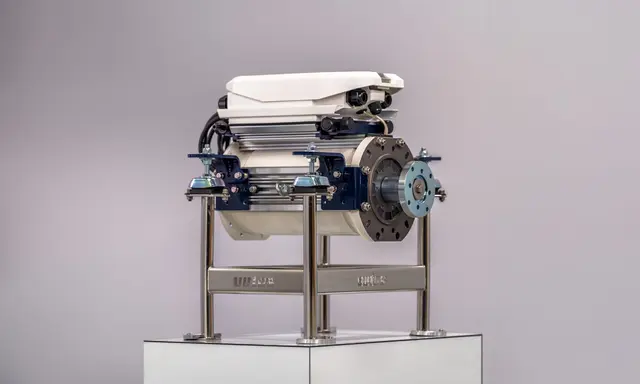
Integrel E-Drive integrates a motor-generator with the yacht’s conventional propulsion installation rather than replacing the diesel engine outright. The company says the system can generate up to 15kW of electrical power and provide up to 20hp of electric drive per unit, depending on configuration.
That architecture gives a cruising catamaran several operating modes instead of forcing every passage into an all-electric profile. Owners can use diesel propulsion when range and power are required, generate energy while motoring, or use electric drive for quieter low-speed operation when battery state allows.
Catamarans suit hybrid operating strategies
Twin-hull yachts already have separate propulsion installations, creating opportunities to combine electric and diesel power in ways that are harder to reproduce on a single-shaft monohull. Integrel specifically supports hybrid operation where one engine can propel one hull while also generating enough power to drive the opposite hull electrically.
The value of that arrangement depends on route, speed and battery capacity, but it gives designers more flexibility when balancing efficiency against redundancy. It may also reduce the need to run a separate generator for some hotel loads, which can improve noise and fuel use at anchor.
The partnership makes the system a factory option
Factory integration is important because hybrid propulsion affects engine spacing, cooling, controls, batteries, charging and service access. By selecting E-Drive as an approved option, Knysna can engineer those interfaces during construction instead of leaving owners to solve them later as a retrofit.
That should also make commissioning and documentation more consistent across future boats. Buyers should still ask how battery capacity is sized for their cruising profile and what shore-power, solar and generator arrangements are included, because hybrid capability is only one part of the complete onboard energy system.
A practical step rather than an all-electric claim
The Knysna-Integrel partnership is notable because it does not depend on claiming that long-range cruising catamarans can immediately abandon combustion engines. Instead, it uses electric drive where it provides a practical benefit while retaining diesel range and adding more efficient electrical generation.
For owners of larger sailing catamarans, that mixed approach may currently offer a more useful transition path than a battery-only solution. The new factory option also gives the market another real-world platform on which hybrid performance, fuel use and maintenance can be measured over extended cruising.