Nine months reveal a mixed market
The latest Groupe Beneteau figures offer a more useful reading of the recreational yacht market than a single headline growth percentage. For the nine months to 30 September 2026, the French builder reported €595.8 million in revenue, compared with €574.4 million for the comparable period in 2025. That represents a reported increase of 3.7%, or 4.7% when currency movements are removed. The distinction matters when judging demand across an international product portfolio, because exchange rates can alter the value of overseas sales without a corresponding change in how many boats customers order.
At the same time, third-quarter revenue fell from €170.6 million to €146.6 million, a decline of 14.1% on a reported basis. That quarterly contraction deserves as much attention as the nine-month improvement. It describes a year in which deliveries, dealer decisions and customer confidence have not moved in a straight line. An apparently positive annual trajectory can coexist with pressure in one selling period, and observers should avoid treating either number as the definitive verdict on the entire leisure-yacht sector.
A third quarter shaped by purchasing delays
Beneteau attributes the difficult third quarter partly to a cautious purchasing environment linked to geopolitical uncertainty in the Middle East. Dealers and prospective buyers postponed commitments even as the company continued to introduce new boats. This is important because a yacht purchase is both a substantial financial decision and a complex delivery proposition. The timing of an order can depend on financing, specification, expected cruising plans and the confidence of a dealer to hold inventory. These forces can delay revenue recognition without implying the permanent disappearance of interest in a particular vessel.
The company also notes that the effect of discontinued American activities reduced growth by around two percentage points over the nine months. Separating businesses being exited from the continuing portfolio prevents a misleading comparison. For owners considering a new 40- to 80-foot vessel, the figures are best viewed as a signal of market conditions rather than a guide to the price or availability of any specific boat. Individual model demand and local dealership stock can differ markedly from group-wide averages.
Sailing remains a relative strength
The Sailing business generated €243.2 million during the first nine months, up 7.3% on a reported basis and 7.5% at constant currency. Management credits continuing demand for monohull designs launched in 2025, which has helped offset weaker demand for multihulls. That divergence is particularly relevant in the 12- to 24-metre leisure-yacht bracket, where owners often compare cruising monohulls, sailing catamarans and powerboats while deciding how much interior volume they need and what kind of passage-making they intend to undertake.
The results do not establish that monohulls are inherently better purchases or that catamaran demand is weak in every market. They show that the company's product mix has helped sustain its sailing turnover. Designers and dealers will be watching whether the latest generation of cockpit arrangements, accommodation plans and handling systems continues to attract customers who want practical cruising capability. It would also be premature to infer a model-by-model order ranking from aggregate sales, since Beneteau has not published that detailed breakdown in this release.
Motor yachting and dayboating move differently
The Motor business reported €323.6 million of nine-month revenue, down 0.9% on a reported basis but up 0.6% at constant currency. The third quarter was markedly weaker, falling 22.6%. Beneteau says dayboating is gradually recovering, whereas dealers in motor-yachting segments have remained cautious. The distinction is significant: a dayboat bought for immediate coastal use can involve a very different purchasing cycle from a larger trawler or family cruising motor yacht requiring multiple cabins, systems and an extended build or delivery timetable.
Excluding the discontinued American operations, motorboat sales increased by 2.9% over the nine months. Beneteau also reports stable retail sales in the motor-yachting segments, even as group deliveries to dealers were affected by caution. Retail demand and wholesale deliveries are different measurements, and comparing them can help explain apparent contradictions. A retailer may first sell an existing vessel before ordering a replacement, which can create a temporary lag between customer interest and the manufacturer's revenue.
Cannes model response is the crucial forward signal
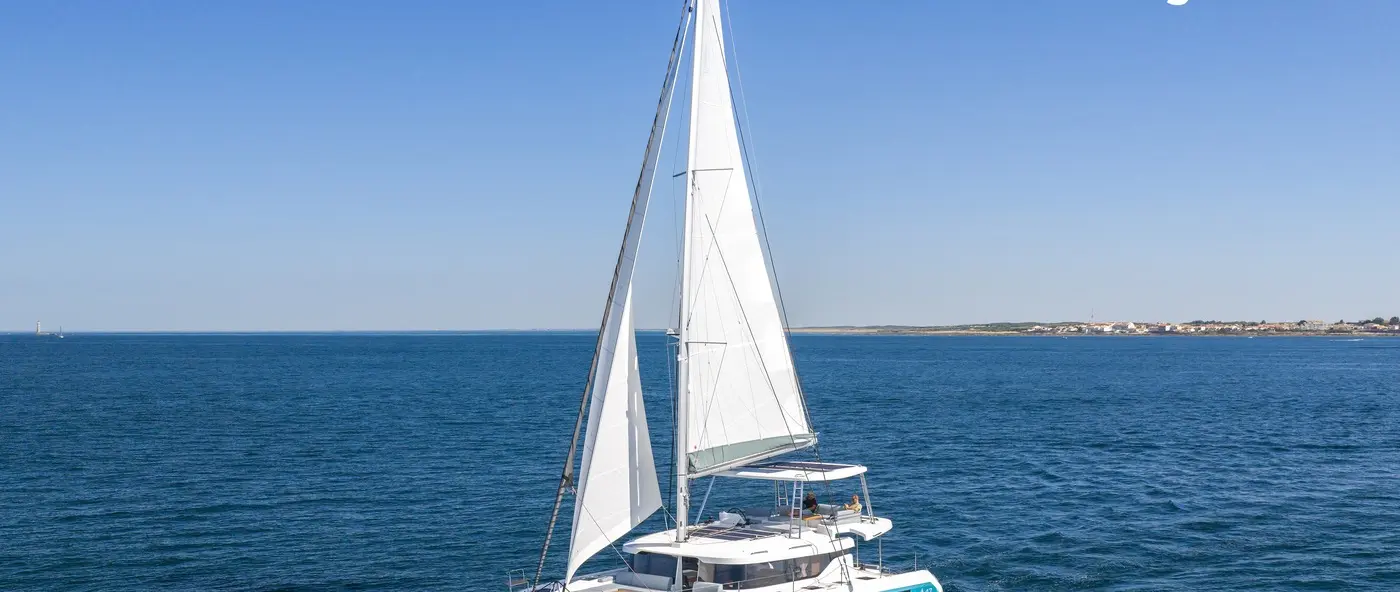
The builder says order intake began to recover in September following the public presentation of new models at the Cannes Yachting Festival. Management cited a favourable response to its recent launches, including the Lagoon 47, Oceanis 42, Swift Trawler 43 and Jeanneau EX 34. Together these examples span sailing, multihull, long-range motor cruising and dayboating, showing why the group considers product renewal central to its commercial strategy. They also give customers a fresh set of choices at a moment when established models may have been in the market for several seasons.
A boat-show reception, however, is not identical to a completed delivery. Enquiries and orders must pass through specification decisions, production scheduling and final handover before all associated revenue is recognised. Prospective buyers should use the announcement as a prompt to compare actual build slots, support arrangements and written equipment specifications with their dealer. The company has not published a universal waiting time for the newly presented models, and it would be misleading to extrapolate one from the rise in September orders.
Europe and North America in the figures
Europe contributed €362.2 million to nine-month revenue, an increase of 9% on the prior-year period. North and Central America generated €173.7 million, up 10.5% as reported and 14.1% at constant currency. Other regions contributed €35.4 million, down 37.3%, while fleet sales of €24.4 million were 13.5% lower. These results underline the geographic differences within the business. A strengthening European distribution channel cannot automatically compensate for every weaker destination, especially where customer needs and product preferences are different.
The company says North American comparisons include nearly €20 million of deliveries deferred from late 2025, partly offset by an €11 million impact from discontinued American activities. That timing element matters when interpreting the regional headline. It is not proof of a sudden uniform rise in boat demand across North America. For the leisure-yacht industry, the more useful question is whether the growth can be sustained as deferred deliveries work through the system and the new 2026–2027 models reach buyers.
Guidance and the coming delivery period
Beneteau has reiterated its forecast of 4% to 9% full-year sales growth on a basis that excludes the discontinued American businesses. Including those activities, the group expects consolidated 2026 revenue of €860 million to €900 million, against approximately €848 million in 2025. The outlook is a company forecast, not a guaranteed result. It depends on the continuing improvement in orders and on deliveries scheduled for the final quarter reaching customers as expected. These conditions should be kept separate from the nine-month figures, which report completed business.
The company says its order book for delivery during the current year has strengthened and is above 2025 sales levels, with larger vessels scheduled for the fourth quarter. In the market for substantial cruising yachts, the timing of these handovers can have an outsized influence on quarterly results because the value per delivery is higher than for smaller boats. The expected return to a positive result from ordinary operations, excluding the activities being discontinued, remains another management target rather than an achieved outcome.
Financing and industrial resilience
Alongside the trading update, Beneteau disclosed a renewed five-year syndicated credit facility of €250 million, with options to extend twice by one year. Seven financial institutions participate in the arrangement. Financing capacity does not make demand certain, but it can support working capital and strategic investment while the builder undertakes a rapid product-renewal programme. Production planning, component procurement and dealer support all require a degree of financial flexibility, especially when the sequence of customer payments and supplier costs differs across boat models.
The interest margin for this facility is linked to environmental, social and governance measures, including occupational injury frequency and greenhouse-gas emissions intensity. Beneteau also says it has adopted the ACT Step-by-Step approach to structure its decarbonisation strategy. For yacht owners this is not an immediate change to a vessel specification, but it reveals how sustainability considerations increasingly enter industrial finance. The durability of these commitments will depend on measurable progress and disclosures rather than on the existence of the financing terms alone.
What prospective yacht owners should take away
For someone assessing a sailing cruiser or motor yacht in the luxury leisure range, this financial announcement is useful context rather than a shopping recommendation. It indicates that Beneteau's sailing business has held up comparatively well, that motor-yachting dealers have remained cautious and that demand may be improving for newly introduced models. Buyers should still compare boat-specific performance, survey access, installation quality, warranty coverage, service networks and berth compatibility. Those practical issues are not settled by group revenue figures and may matter much more over years of ownership.
The wider lesson is that an established manufacturer can show growth over nine months while experiencing a difficult quarter. Headlines that highlight only the increase or only the decline miss the shape of the year. The clearest next evidence will be the conversion of autumn orders into completed deliveries, the experience of dealers carrying the new range and the confirmed year-end results. Beneteau has scheduled a fourth-quarter revenue update for February 2027 and its full-year earnings presentation for March 2027.
A careful reading of the industry's direction
Yacht manufacturers are responding to slower decision-making by refreshing designs, diversifying ranges and investing in services around the boat. Beneteau's figures show the potential advantage of offering multiple categories rather than relying on one narrow segment. Nevertheless, no single manufacturer's results can measure the whole global yacht industry. Builders with different geographic exposure, dealer arrangements or product sizes may experience another pattern. The fair conclusion is that the company has reported resilience alongside volatility, with important evidence still to come.
This update is based on Groupe Beneteau's primary corporate release dated 4 November 2026. Percentages are presented as the company reported them; reported growth and constant-currency growth are not interchangeable. Analysis of dealer behaviour and buyer considerations is editorial context, not a statement that every dealer or purchaser has acted in the same way. Luxury Yacht Guide will continue to distinguish confirmed revenue, order indications and forward guidance when covering the market for privately owned cruising yachts.