
Spanish leisure-boat market still ahead in 2026
Spain recorded 4,873 new recreational-vessel registrations between January and October 2026, up 5.5% from 4,617 over the corresponding period last year, according to the Spanish marine trade association ANEN. The accumulated growth conceals a weaker October, when 231 registrations represented a 16.9% decline from the same month in 2025. The contrast makes the latest report more interesting than a simple positive or negative headline.
For Luxury Yacht Guide readers, the most relevant finding lies in the larger size bands. ANEN reports strong growth in registrations of craft between 12 and 16 metres and those above 16 metres. The figures concern the Spanish registration market and should not be confused with worldwide yacht deliveries or a measure of prices. They nevertheless provide a useful view of demand for larger leisure craft in a significant Mediterranean country.
The 12–16-metre segment stands out
ANEN's October year-to-date release records 175 registrations in the 12–16-metre segment, a 38.9% increase from the comparable 2025 period. This is directly relevant to the smaller end of the private luxury-yacht market, where many owner-operated motor yachts, sailing yachts and cruising catamarans sit. The percentage suggests that this segment has been growing more rapidly than the market as a whole.
However, the absolute base remains small beside the thousands of craft under six metres. A percentage rise from a smaller starting point can look dramatic without representing a huge addition to the fleet. Owners, builders and brokers should read the 175 registrations alongside the larger national total. The data indicate stronger relative activity, not proof that every model in this length class is selling equally well.
Above sixteen metres grows even faster
The association reports 71 registrations of recreational vessels above 16 metres during the ten-month period, an increase of 54.3% year on year. That is the fastest growth rate among the length categories highlighted in the report. It is also the category most closely aligned with the upper half of Luxury Yacht Guide's 12–24-metre audience, although ANEN's group extends beyond that upper editorial boundary.
This caveat matters. A statistic covering all craft longer than sixteen metres must not be described as an exact count of 16–24-metre yachts. It may include larger vessels, depending on the registration definitions used. The data are still instructive because they show momentum towards more substantial recreational boats. But any precise assessment of the 16–24-metre class would require a more detailed length breakdown.
A difficult October after stronger months
The month of October produced 231 recreational registrations, down from 278 a year earlier. ANEN calculates the fall at 16.9%. Seasonal patterns often affect boating markets, but the report does not establish whether this month's decline will continue. It would be premature to treat a single month's figures as proof that Spanish yacht demand has reversed after a year of growth.
The more careful reading compares different time frames. Ten months remain positive, while the latest month is negative. Both facts can be true at once. Dealers managing inventory, marinas planning for new owners and yacht builders evaluating local demand may draw different practical conclusions. A responsible market analysis reports the direction and the size of the change without turning the October figure into a prediction about next year's prices or availability.
The scale of smaller boats remains dominant
ANEN says boats of up to six metres account for 3,316 registrations in the January–October period and around 68% of the overall market. Their increase is just 2.6%, well below the growth rates in the larger bands. The figures show how national boating statistics are shaped by small craft even when luxury yachts command most of the public attention.
That is why market headlines require context. A 5.5% overall growth rate is not necessarily the best guide to a company specialising in fifteen-metre cruisers. Equally, the rapid growth of larger boats cannot describe the experience of a small-outboard dealer. Different products depend on different customers, financing conditions and usage patterns. The ANEN report becomes most useful when its size categories are preserved rather than collapsed into a single average.
What happened between six and twelve metres
The association records 920 registrations in the six-to-eight-metre category, up 9.8%, and 388 in the eight-to-twelve-metre category, up 4.3%. Those figures add detail to the broader picture. Growth is visible across all published length groups, but it is uneven. The transition into the 12–16-metre category appears especially marked, raising questions about the appeal of boats capable of more substantial overnight cruising.
That is an interpretation rather than a conclusion drawn directly by the association. Buyers may be responding to comfort, family needs, available models or other factors that registration counts alone cannot identify. A more complete explanation would need transaction data, buyer research and information about new versus imported stock. The registration report is a reliable starting point for the size distribution, but it cannot reveal motivations.
Motorboats lead among major types
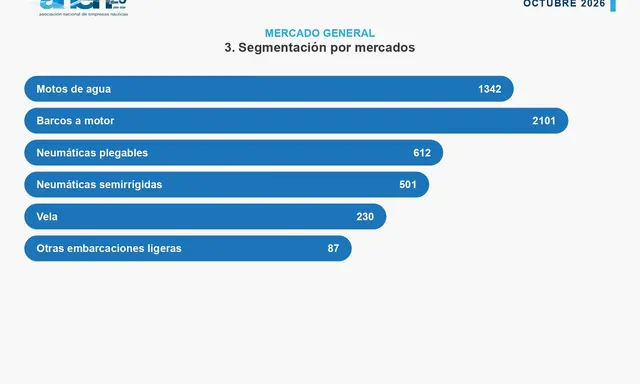
Motorboats account for 2,101 registrations, a rise of 14.5% and a 43.1% share of the national total, according to ANEN. The association also records 230 sailing-boat registrations, up 3.6%. These figures suggest that powered leisure craft continue to form a major part of Spanish boating activity, though the report combines a wide range of boat dimensions within those broad propulsion categories.
For a luxury-yacht readership, the motorboat result is notable but cannot be read as a figure solely for motor yachts. Many registered craft are far smaller than twelve metres. Manufacturers of larger cruising boats should therefore examine both propulsion and length simultaneously before drawing conclusions. The report does not provide a complete cross-tabulation in its public summary, so claims about specific 15-metre motor-yacht sales would go beyond the published evidence.
Charter registrations have their own pattern
ANEN reports 1,471 registrations associated with rental or charter use between January and October, a 7.5% increase year on year. The October figure for this category is 31 registrations, down 13.9% on the comparable month. This broadly mirrors the tension between positive accumulated results and a weaker recent month in the overall recreational market.
The report also highlights growth among charter craft in the larger length classes. However, a registration for rental use is not the same as a completed charter booking or a measured number of guest nights. Fleet investment and customer demand are connected, but not identical. A charter operator may register a vessel ahead of a season, while actual utilisation depends on marketing, pricing and local travel patterns. The association's figures are supply-side indicators.
The Balearics remain a registration centre
The Balearic Islands lead the provincial breakdown with 760 registrations and a 15.6% national share over the ten months. Barcelona follows with 563, or 11.6%, and Madrid with 378, or 7.8%. In charter-related registrations, the Balearics are again first with 364 and a 24.8% share of that category, ahead of Barcelona and Girona in the published figures.
Care is needed when translating registrations into physical yacht activity. A registered address does not prove the vessel will remain in that province or use a marina there throughout the year. Madrid's position in a boating ranking illustrates why registration location should not be mistaken for a map of moorings. The numbers are valuable for assessing administrative and commercial patterns, but they are not a direct tally of yachts cruising off each coast.
What the report does not measure
Registration data are not a survey of every boat afloat in Spain. They do not count the entire existing fleet, all foreign-flagged yachts visiting its marinas or every second-hand transaction. Nor do they directly show charter utilisation, sales prices or owner wealth. ANEN builds its market report from records supplied by Spain's Directorate General of the Merchant Marine, a defined administrative source with its own scope.
These boundaries make the data more, not less, useful. When a statistic has a clear definition, readers can compare it over time without treating it as evidence for unrelated claims. A yacht buyer considering Spain as a home base should combine these figures with berth availability, operating costs and local rules. A builder evaluating a dealership opportunity needs separate information about model demand and aftersales provision.
Possible implications for the luxury segment
The faster growth in larger length bands suggests that premium-sized recreational craft are an important part of Spain's current market story. If the pattern continues, dealers and service providers may need to pay close attention to berthing dimensions, power capacity and maintenance support for more substantial boats. But the ANEN figures do not establish a future shortage of marina space or quantify demand for any one facility.
Those are questions for local marina operators and harbour authorities. Owners should seek specific berth offers rather than assume a national trend guarantees or prevents availability. Similarly, a broker should evaluate comparable vessels and real asking-to-sale outcomes rather than infer resale value from registration growth. Market statistics provide context; actual yacht decisions still depend on individual specifications, condition and the operating environment.
Why the month-by-month distinction matters
Anyone presenting the latest Spanish data should retain both sides of the report: overall growth to October and the monthly decline. Selecting only the positive larger-yacht percentages would conceal a softer recent period, while focusing solely on October would ignore the accumulated year. The balance is particularly important when discussing a market in which purchase decisions and delivery dates can span many months.
The data have another limitation: percentage changes in small length bands can shift markedly with a modest number of registrations. That makes consistent reporting essential. Compare the same months in successive years, state the numerator clearly and avoid making a single chart carry more meaning than it supports. A careful approach gives owners and industry professionals a clearer basis for following the Spanish market through the rest of 2026.
A positive year with a late warning
Spain's recreational registration market remains ahead of 2025 on the January–October measure, with 4,873 vessels and 5.5% growth. Within that result, the 12–16-metre group rose 38.9% to 175 registrations, while boats above sixteen metres climbed 54.3% to 71. October alone fell 16.9%, highlighting a change in the recent pace. These are the central, verifiable findings in ANEN's latest release.
For owners and businesses serving the luxury-yacht segment, the report offers useful scale and direction without settling the outlook. The final two months of 2026, future registrations and actual customer behaviour will determine whether the larger-boat momentum persists. Until then the most accurate headline is one of uneven growth: solid accumulated gains, notable strength in longer craft and a weaker October that deserves monitoring.