Spain's boating market reaches 4,873 registrations
Spain recorded 4,873 recreational-boat registrations between January and October 2026, up 5.5 percent from 4,617 in the equivalent period of 2025. The figures were released on 4 November by the Spanish boating-industry association ANEN, using records provided by the Dirección General de la Marina Mercante. The latest report reveals a market still ahead of last year in cumulative terms, even though the pace of activity has become less consistent.
It is important to distinguish registration data from a manufacturer's revenue or the number of boats sold at an individual dealership. Registrations provide an official measure of boats entering the Spanish administrative system during the reporting period. They may reflect different types of craft and customer use, including charter operations. The report therefore indicates the scale and direction of market activity, but it does not directly establish changes in yacht prices or the profitability of builders.
October brings a sharp year-on-year fall
The October total was 231 registrations, compared with 278 in the same month of 2025, a decline of 16.9 percent. This was the main reason ANEN described the accumulated market's growth as moderating. September had brought the nine-month total to 4,642 registrations, seven percent ahead of the previous year. Adding a weaker October reduced the cumulative percentage gain to 5.5 percent without reversing the overall year-to-date increase.
Monthly comparisons can be sensitive to delivery timing, seasonal activity and the relatively small number of transactions during a quieter period. A fall in one month should not automatically be interpreted as evidence that the annual market will contract. Equally, a positive cumulative total does not guarantee that the final months will be strong. The most accurate description is a mixed picture: growth over ten months, accompanied by a measurable decline in October alone.
Boats over sixteen metres show the fastest percentage increase
The largest percentage gain by length category came from craft longer than 16 metres. ANEN records 71 registrations in that group, up 54.3 percent from the corresponding 2025 period. Boats between 12 and 16 metres recorded 175 registrations, a rise of 38.9 percent. These two segments are especially relevant to buyers considering larger private cruising yachts, although the over-16-metre category can include vessels well beyond the size range normally covered by a compact-yacht market.
Percentages must be interpreted alongside the underlying number of boats. Seventy-one registrations represent a much smaller volume than the thousands of sub-six-metre craft, so relatively modest changes in unit counts can generate dramatic percentage movements. The figures do not show that every builder of larger yachts in Spain enjoyed a comparable increase. Brand, model, market location and the date when a vessel was registered can all influence the result.
Smaller boats still dominate overall activity
Boats of up to six metres accounted for 3,316 registrations during the first ten months, up 2.6 percent and representing approximately 68 percent of the market. The six-to-eight-metre category reached 920 registrations, an increase of 9.8 percent, while the eight-to-twelve-metre segment recorded 388 units, up 4.3 percent. Every length band identified in the ANEN report remained above its comparable 2025 total despite the slowdown in October.
This distribution is significant because the recreational boating economy relies on a large base of relatively small craft for much of its unit volume. Marinas, equipment shops, repair businesses and training providers often serve customers across many sizes and activities. A new dayboat and a large motor yacht generate very different expenditure, however, so the number of registrations should not be confused with the value of the market. Unit growth alone is not a measure of revenue.
Motorboats lead the classification by vessel type
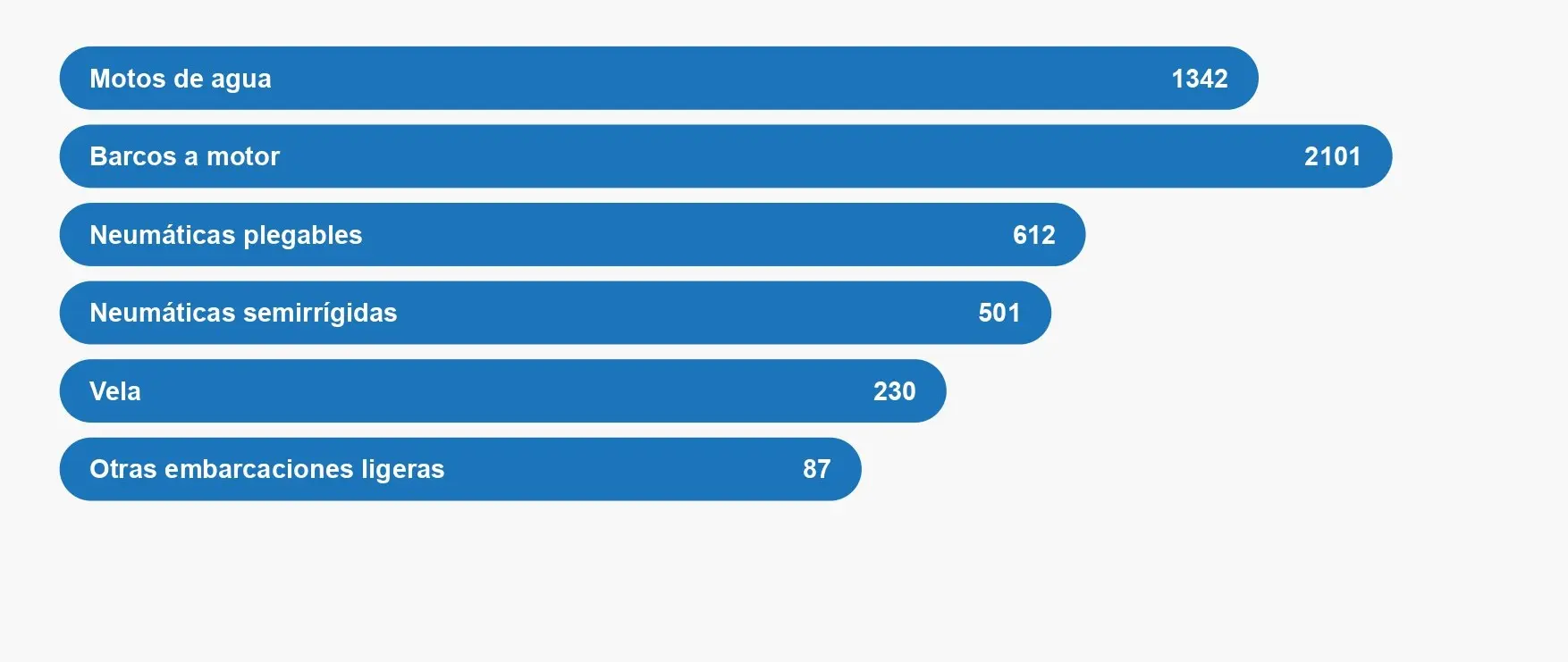
Motor-powered boats remained the largest individual propulsion and craft category in ANEN's figures, with 2,101 registrations, a gain of 14.5 percent from the equivalent period last year. They accounted for 43.1 percent of all recreational-boat registrations. This performance suggests continuing demand for a wide range of powered boating activities, from short coastal trips to larger leisure cruising, although the source does not provide a single breakdown of individual motor-yacht models.
Sailing craft recorded 230 registrations, an increase of 3.6 percent. Inflatable craft and personal watercraft followed different trends: folding inflatables reached 612 registrations, up 4.6 percent, while personal watercraft totalled 1,342, down 0.6 percent. Another inflatable-boat category recorded 501 registrations, a fall of 4.8 percent. These differing results show why a single market percentage can conceal substantial variations in customer preferences and vessel types.
Charter registrations rise despite a weaker October
The charter segment recorded 1,471 registrations between January and October, 7.5 percent more than a year earlier. October itself saw 31 recreational craft registered for rental use, down 13.9 percent from the same month in 2025. This mirrors the distinction seen in the overall market: cumulative progress, but a weaker latest month. Charter registrations are a useful measure of fleet activity, not an estimate of how many days the boats were actually chartered.
Among charter boats longer than 16 metres, ANEN reports 33 registrations against 19 a year earlier. The 12-to-16-metre charter category also improved, with an increase of 38.6 percent. Such numbers may interest yacht operators and brokers because they indicate additions to the registered rental fleet. They do not by themselves demonstrate higher occupancy, stronger charter rates or profitability. Those outcomes depend on bookings, operating costs and the individual service proposition.
Personal watercraft represent a large charter share
Personal watercraft accounted for 44.3 percent of registrations for rental use, with the category rising 13.4 percent year on year. Motorboats represented 36.1 percent of the rental market and grew 8.8 percent, while sailing registrations for charter were up 10.4 percent. The variety of craft matters because a holidaymaker renting a personal watercraft for a short session is participating in a fundamentally different activity from a family booking a crewed yacht.
An aggregate charter statistic can therefore be misleading if it is interpreted only through the lens of luxury travel. Commercial operators face varying requirements concerning licensing, safety, maintenance, insurance and customer instruction. The mix also changes by region and season. Readers assessing yacht-charter opportunities should investigate the specific segment and location rather than assume that strong growth in the full rental register implies the same trend in luxury-yacht holidays.
Balearic Islands remain Spain's largest regional market
The Balearic Islands recorded 760 recreational-boat registrations through October, accounting for 15.6 percent of Spain's national total. Barcelona followed with 563, equivalent to 11.6 percent, and Madrid with 378 or 7.8 percent. Other major provincial counts included Murcia with 290, Alicante with 283, Girona with 278, Málaga with 264 and Cádiz with 223. These figures demonstrate a geographically diverse market rather than a single concentration around one famous cruising destination.
The presence of Madrid among the leading provinces is a reminder that administrative registrations do not necessarily tell a simple story about where every vessel spends its time on the water. Location of registration, ownership and boating activity may differ. Marina demand and cruising traffic require their own evidence. Nevertheless, the coastal provinces in the list illustrate the breadth of infrastructure and services supporting recreational boating around the country.
The Balearics also lead in the charter segment
In the rental market, the Balearic Islands recorded 364 registrations and represented 24.8 percent of the national charter total. Barcelona contributed 186 charter registrations and Girona 130. The figures show the islands' particular significance as a base for commercial recreational boating, although the category covers a mix of smaller rental craft and larger vessels rather than only private luxury charters.
A charter operator considering the Balearics would still need to examine berth availability, local requirements, seasonality, maintenance capacity and the practical demand for a particular type of boat. The number of registrations alone does not identify how many operators are competing for the same customers or what revenue they generate. For yacht buyers contemplating charter use, the sensible approach is to obtain location-specific professional advice and a realistic operating budget.
What the final two months will reveal
ANEN's October release leaves the Spanish market in positive territory overall, with stronger percentage growth in boats longer than twelve metres and in motor-powered craft. It also signals that activity is not advancing at the same pace throughout the year. The final two months will help clarify whether October's decline was an isolated fluctuation or part of a sustained cooling trend. No November or December registrations are included in the figures reported so far.
For builders, distributors, brokers and marina operators, the data is a useful benchmark when planning rather than a substitute for their own transaction records. It identifies where registrations are concentrated and how different categories are performing. The clearest conclusion is that the ten-month market has grown by 5.5 percent while October itself fell 16.9 percent. Future reporting should keep those measures distinct and avoid treating partial-year registration figures as a complete annual outcome.
Source: ANEN — Spain Recreational Boat Market, 4 November 2026.