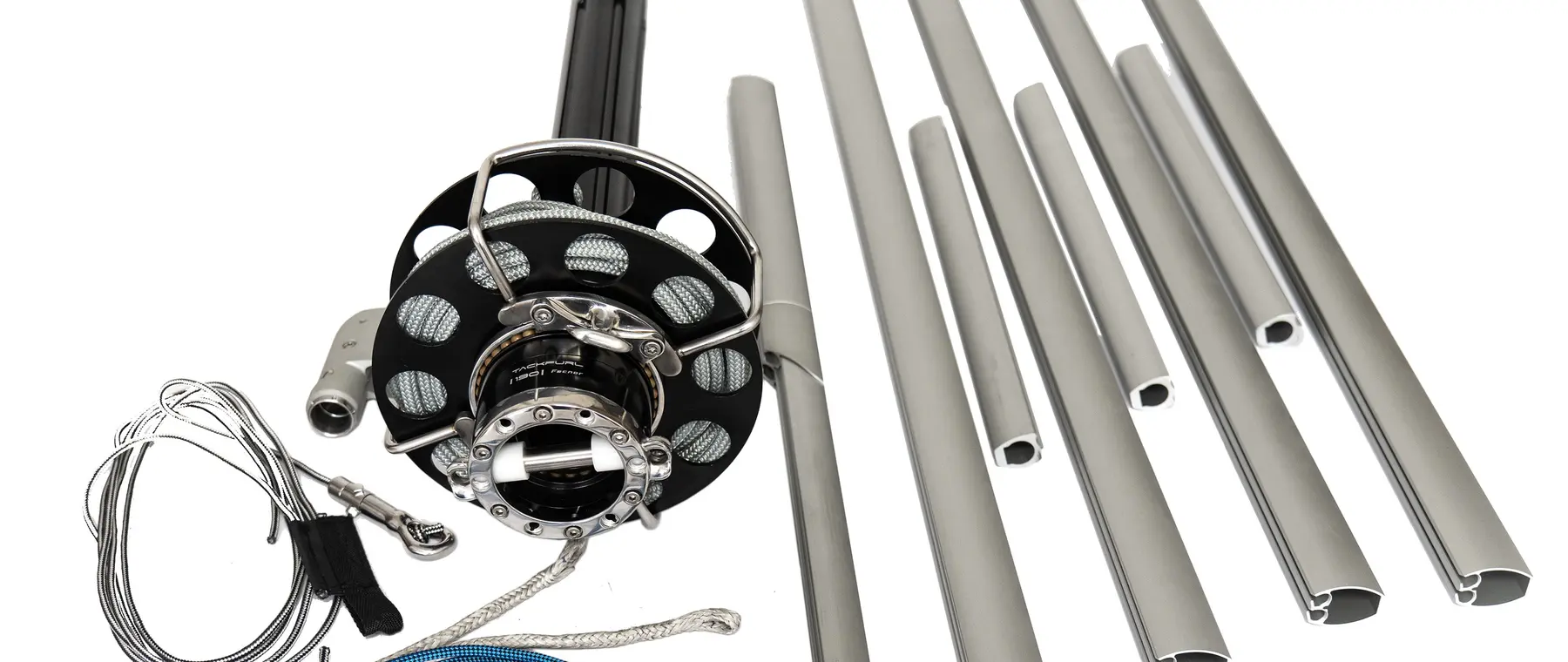
Award recognition for a different approach to headsail furling
Facnor has won the Deck Equipment category of the 2026 DAME Design Awards at METSTRADE with TackFurl, its manual headsail furling system. The French manufacturer confirmed the award in its own announcement following the opening of the exhibition in Amsterdam on 17 November. The result draws attention to a rearrangement of two familiar functions on a sailing yacht: securing a headsail at the upper end of its luff and controlling its tension at the lower end.
The product is not a newly announced design created specially for the awards ceremony. Facnor described the system in its September exhibitor press release, and its technical material sets out the concept in further detail. The new development is the recognition given by the 2026 DAME jury. For the luxury sailing-yacht sector, that distinction matters because the product can be considered in terms of a documented architecture rather than a vague promise of future innovation.
A headsail furler is sometimes perceived as a relatively ordinary item of deck equipment. In reality, it sits within a network of components which transmit substantial forces and influence how the sail is raised, adjusted and handled.
Moving the sail adjustment away from the masthead
Facnor describes TackFurl as combining a lock at the top of the foil assembly with an adjustable drum at its lower end. A conventional arrangement commonly uses a halyard and upper swivel as part of the means of raising the headsail, maintaining its luff tension and permitting the sail to rotate during furling. The configuration depends on the design of the individual system, so this comparison does not describe every existing furler.
The new architecture changes the way the sail is secured after hoisting. The integrated upper locking mechanism is intended to retain the sail without the continuous conventional halyard and separate upper swivel arrangement. At the lower end, the drum can move vertically to provide a means of controlling the luff tension through a cunningham. The latter is a line used to adjust tension at the lower portion of the sail rather than pulling on a continuously loaded halyard from above.
This is a meaningful distinction to designers and riggers because the positioning of fittings affects both the geometry of the available sail area and the arrangement of forces within the installed system. Facnor states that eliminating the separate upper swivel and using a compact drum can increase the length available for the sail's luff. The precise amount that can be gained depends on the existing boat, its rig and the sail dimensions.
Why the shape of a furled sail is worth considering
Headsail handling is not just a question of the ability to rotate a drum. As a sail is rolled around its supporting foil, the way the cloth and its reinforcements accumulate can affect the resulting shape. The sailing programme, sail construction and any arrangements for partial furling also matter to the yacht owner. Different sails have different requirements, and an equipment award does not determine which combination will be appropriate for a particular yacht.
Facnor's documentation emphasises the low-profile drum and the ability to adjust the tack point. The company also identifies Torlon ball bearings as part of the drum's rotating assembly. These are specific features of the manufacturer's stated design rather than independent measurements of its resistance to turning. The documentation available for this report does not establish a universal reduction in operating effort compared with every other furling system on the market.
Owners of cruising yachts can benefit from examining the complete relationship between the furler, sail and operating lines. A sailmaker needs to know the finished dimensions and arrangement of the tack and head before specifying a replacement sail. A rigger may need to establish how the equipment aligns with the stay and its associated fittings. The crew needs to understand how the sail is operated and what maintenance the system requires.
What a prospective retrofit would involve
A headsail furling system forms part of a boat with an established structure. The mast, forestay, deck attachment and available space cannot be assumed to suit a different furler simply because the advertised purpose is the same. Facnor's product information describes a ready-to-install kit with the furling equipment and relevant lines, but this does not amount to a statement that the kit replaces every existing arrangement without adaptation.
A refit on a premium yacht should therefore begin with an examination of the installed rig and the manufacturer's model selection information. Important questions include the sail geometry, dimensions and permitted loads; the condition and configuration of the existing stay; the space available around the bow; and the intended line leads. Any required structural changes or modifications to the sail should be established before the owner commits to an equipment order.
The handling of the yacht by its regular crew also belongs in that assessment. The new architecture introduces a different division of functions between hoisting, securing and adjusting the headsail. This may require familiarisation even for people who have operated other manual furling equipment for years. The installer and sailmaker should be involved in explaining and demonstrating the relevant procedures, including inspection and maintenance. This article is not an installation guide and does not specify a safe configuration for any individual vessel.
A manual system in an increasingly powered equipment market
The DAME award is particularly interesting in a sector where major hardware developments often attract attention because they add a motor, hydraulic drive or electronic control. TackFurl instead changes the configuration of a manually operated mechanism. In some sailing programmes there is a strong case for keeping an operation manual, provided it remains suitable for the expected loads and the capability of the crew. In other circumstances, a correctly engineered powered arrangement may be more appropriate.
Neither decision can be made solely by looking at yacht length. Two sailing yachts of similar dimensions may carry different sail plans, have different deck arrangements and be operated by crews with very different experience. The choice of equipment should consider those differences, as well as the model ranges and limitations stated by suppliers. Efficiency and simplicity in one context need not be synonymous with ease of use in another.
The award helps illustrate how a mechanical design can still yield meaningful changes to established equipment without requiring the introduction of an entirely new source of onboard power. For designers of luxury performance cruisers, this is an example of the value of reconsidering an entire mechanical arrangement rather than simply improving an individual component. For the owner, the potential benefit must ultimately be judged on the installed system.
Recognition and the next purchasing decisions
Facnor's announcement confirms the Deck Equipment category win. It should not be confused with an overall DAME award or treated as a certification of suitability for every sailing yacht. The manufacturer presented the product at METSTRADE under stand 05.441, and its published material identifies the design principles, but pricing for a complete yacht-specific installation is not established by the award.
A buyer considering TackFurl can use the exhibition recognition as a reason to examine the equipment in greater depth. The appropriate discussion is with the manufacturer, its distributor, the yacht's rigger and the sailmaker, where the dimensions, compatibility and service implications can be assessed against the actual vessel.
For Luxury Yacht Guide's 12 to 23.99 metre sailing yacht audience, the result is a useful reminder that innovation in yachting can occur at the point where the sail meets the rig. The award recognises a new arrangement of familiar tasks. Its practical value for a particular owner will depend on the compatibility of the system, its handling under the intended sailing conditions and the quality of installation and continuing support available to the crew.
Sources and lead image
Source documentation: https://www.metstrade.com/exhibitors/facnor/news/tackfurl, https://www.facnor.com/523629-2/, https://www.facnor.com/headsail-furlers/fd-webbing-headsail-furler/tackfurl-range/, https://www.metstrade.com/exhibitors/facnor/products/tackfurl. Lead image: Facnor TackFurl full manual headsail furling kit — Facnor official product photograph in the METSTRADE exhibitor catalogue for TackFurl, showing the kit rather than the award ceremony.. Issuer-supplied media asset published with the relevant official exhibitor release or product catalogue made available through the official virtual press room for coverage of the announcement; copyright remains with the rights holder.