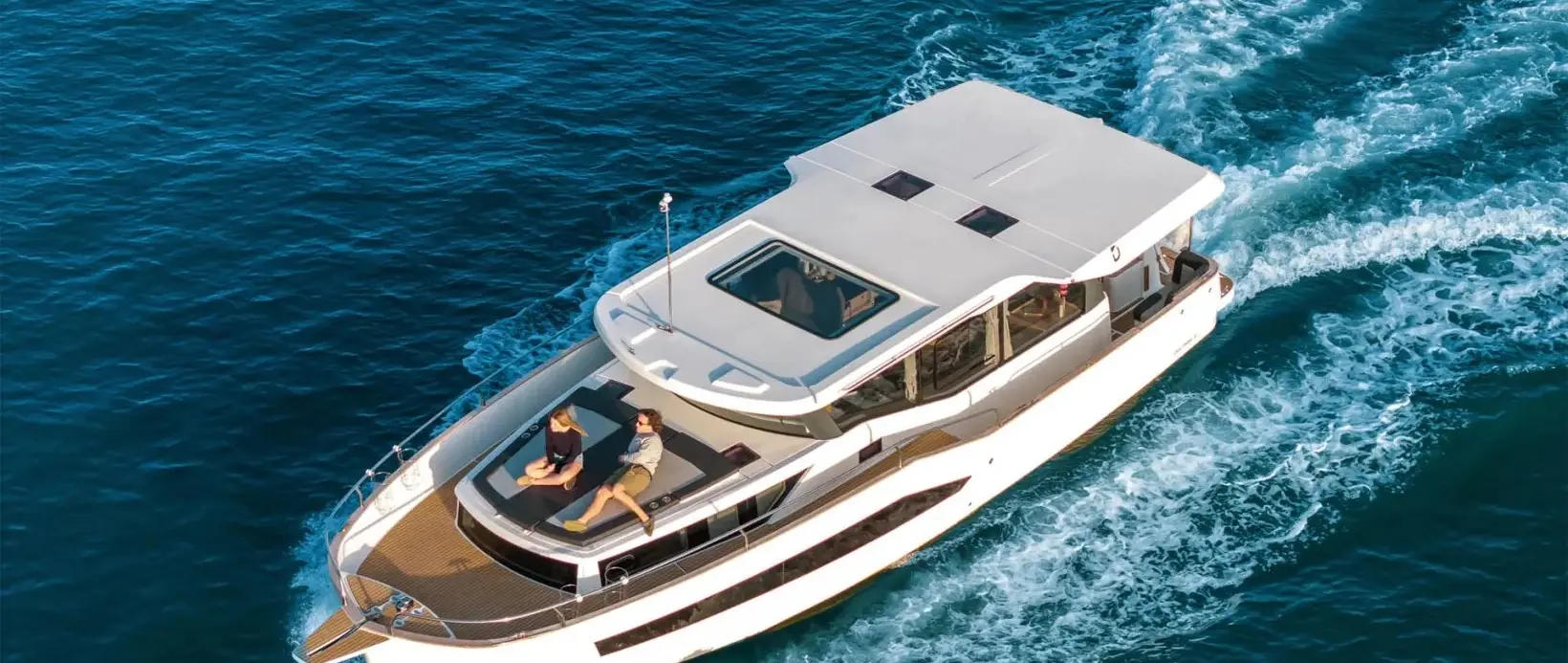
A different answer to the cruising brief
The Delphia 12 Sedan is designed for an owner who values time on the water more than a dramatic sprint between ports. At 13.40 metres overall and 4.26 metres in beam, it presents a generous interior within the size of vessel commonly handled by a couple. The emphasis falls on controlled movement, clear circulation and the ability to move between sheltered rivers and open coastal stretches. The boat's current manufacturer specification makes that underlying philosophy unusually clear.
Delphia describes the Sedan as a vessel for coastal and inland exploration, supported by an air draft of approximately 2.65 metres in its published configuration. The relatively low profile can make waterways with bridges more accessible, although every owner still needs to verify actual clearance with antennas and equipment. Bridge height also changes with loading and water level, so the advertised number should be treated as a planning reference, not a guarantee. An itinerary still requires the ordinary checks for navigation restrictions and tides.
The exterior places strong visual emphasis on large areas of glazing and comparatively straightforward movement around the accommodation. Four access points to the cockpit and a door adjacent to the wheelhouse are among the practical features described by the builder. They help a skipper reach lines or a side deck without repeatedly passing through guest seating. For short-handed owners, the quality of those movements can influence whether a boat is enjoyable to handle on a busy day.
The design credits Andrzej Skrzat and Tony Castro Yacht Design in Delphia's current presentation. Their work is most persuasive where styling and function coincide, particularly around the windows, walkway widths and cabinhouse proportions. It is easy to make a boat attractive in a photograph, but harder to combine natural light with secure movement and genuinely useful storage. The 12 Sedan deserves to be evaluated on those everyday standards.
One main level for the way people actually live
The most important interior decision is the continuity between saloon, galley, helm area and cockpit. Delphia places the principal shared living spaces on one level, reducing the need to negotiate steps every time guests move between conversation, dining and the wheelhouse. That can make a major difference when cruising with children or older friends, while still requiring sensible care in wet conditions. There is nothing glamorous about routine movement until a layout gets it wrong.
Large saloon windows bring light into the central living area and keep the surrounding scenery visible. For a slow-cruising vessel, this is more than a design flourish because the experience is built around watching the water and landscape pass by. The fully equipped galley sits within that same shared space, rather than being pushed into a remote compartment. Owners can prepare a meal and remain part of the conversation during extended passages.
Below, the builder specifies an owner's suite and a separate guest cabin, with two bathrooms and dedicated facilities for laundry. This is a more realistic accommodation plan for two couples or a family undertaking a longer voyage than a large number of nominal berths achieved by constantly converting seating. Private sleeping areas and independent washing facilities make daily life less dependent on everyone keeping the same schedule. The layout nevertheless warrants an in-person assessment of headroom and usable storage.
Cabinetry and tank space matter particularly on a vessel designed for long stays. A prospective owner should consider where wet jackets, spare linens, maintenance supplies and bulky provisions can be kept without occupying guest areas. Check access to the laundry space and whether galley drawers remain usable when someone is walking past. A bright saloon can impress at a glance while the real liveaboard value is concealed in these smaller choices.
Range, power and the slow-cruising calculation
Delphia publishes a diesel power range from 110 horsepower upwards, with different engine specifications shown across its current material. Its broader presentation refers to a semi-displacement hull and to the appeal of economical travel at considered speeds. Buyers should confirm the installed engine, gearbox and performance chart for a particular boat rather than assuming every advertised figure applies to every variant. A displacement-oriented cruising brief demands a different kind of sea-trial conversation.
The manufacturer also cites a fuel capacity of 770 litres and a claimed range of as much as 1,500 kilometres. That distance should be understood as a manufacturer figure dependent on operating conditions, not as a universal guaranteed range for a loaded boat in poor weather. Speed selection can dramatically change fuel use, and currents or extended manoeuvring periods can alter voyage calculations. A responsible passage plan builds in reserves, daylight considerations and alternate stopping points.
Freshwater autonomy receives similar attention, with Delphia listing two tanks providing 500 litres in total. That capacity can support longer stays away from marina facilities, but the practical number of days depends on showers, laundry, galley habits and crew size. Solar power is also described as part of the vessel's approach to onboard autonomy, especially when resting at anchor. Owners should ask which hotel loads the fitted panels and batteries are designed to cover and whether air conditioning is included.
Thrusters at bow and stern are highlighted as manoeuvring aids, a sensible provision for close-quarter operation in marinas or inland basins. Such equipment may reduce the workload but does not erase the effects of wind, current or an awkward berth. Short-handed crews should establish how controls work from the helm and what visibility exists during the final approach. The most confidence-inspiring boat is one whose systems are understandable and accessible under pressure.
Practical limits and a more relaxed ownership model
The official specification lists CE categories B for eight people and C for twelve, which reflects different operating environments rather than one unrestricted passenger allowance. Owners need to understand the certified conditions applicable to their planned cruising area and the equipment carried on board. A route involving exposed coastal waters may require different preparation from a protected river cruise. A comfortable interior cannot substitute for operational judgement.
At 4.26 metres beam, the Delphia remains more conventional to berth than a wide power catamaran of comparable length, though berth dimensions must still be confirmed. Hull shape and beam should be considered alongside available depth, manoeuvring room and shore-power provision. Frequent inland operation brings additional questions about locks, mooring rings, wash limits and local speed restrictions. These factors affect whether the boat's intended flexibility becomes a practical advantage.
Before committing to the design, buyers should examine access to the engine and service points, the location of water and fuel filters, and the maintenance requirements of solar and thruster equipment. A quiet, deliberate cruising style is appealing partly because it reduces stress, but avoidable service difficulties can quickly undermine that benefit. Ask the dealer to demonstrate access to each major system rather than relying entirely on a glossy layout drawing. The aim is an ownership routine that supports travel instead of interrupting it.
The 12 Sedan's most convincing selling point is therefore the coherence of its priorities. Delphia has combined a low air draft, one-level living space, practical deck access and overnight accommodation in a hull intended for unhurried exploration. For a buyer whose holidays revolve around relaxed passages and longer stopovers, that package may be more useful than impressive maximum-speed statistics. Its suitability comes down to matching the actual configuration with real routes, crew habits and berthing arrangements.