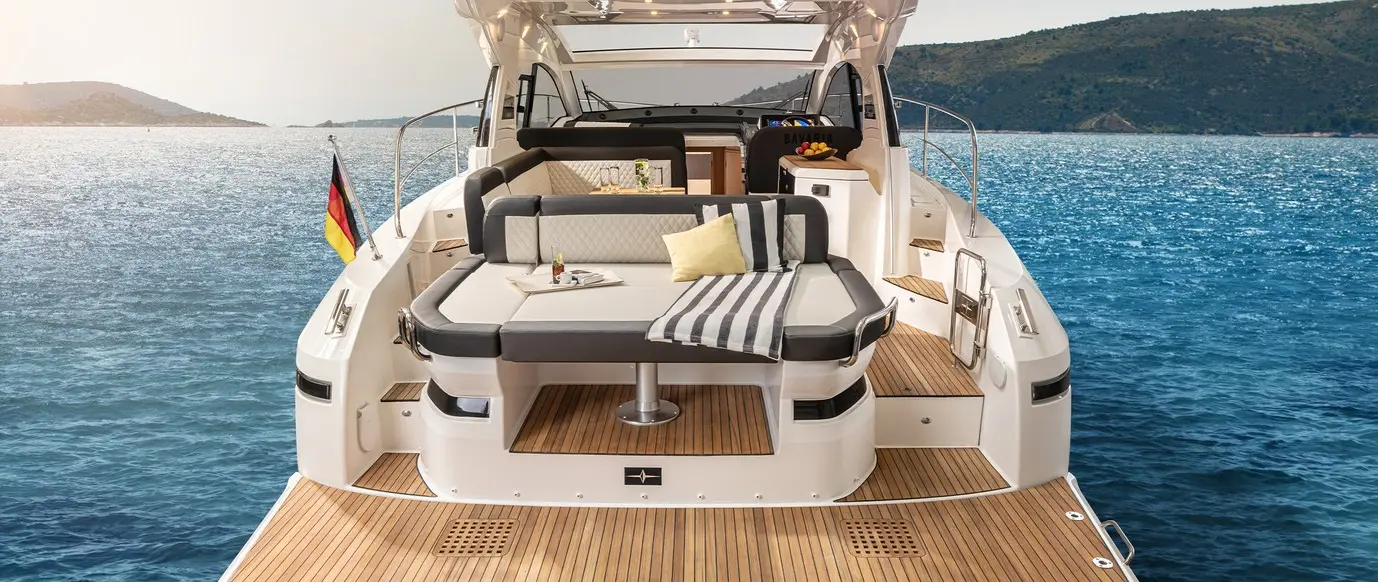
Making the stern earn its place
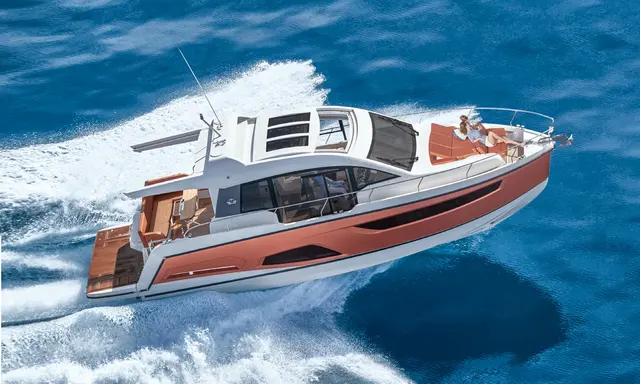
The Bavaria SR41 is a reminder that a motor cruiser's layout can be improved without demanding another metre of length. Its signature feature is a broad sunbed at the stern that changes into a seated waterside lounge when a cushion is removed and a table is lowered into position. In one configuration it serves swimmers and sunbathers; in another, it becomes a quiet place for a meal close to the sea. This is established product design rather than an announcement of a new model launch.
At first glance the distinction might seem minor, but it changes how the rear of the boat functions throughout a day. A conventional fixed sunpad can be comfortable yet inactive once the sun goes down or guests move indoors. Bavaria's arrangement introduces another practical place for conversation while the bathing platform remains the connection with the water. The resulting experience is closer to a flexible outdoor room than a simple boarding area.
The SR41 was conceived by Bavaria's own development team in cooperation with Marco Casali of Italy's Too Design. It combines elements of the company's sporty S and larger R ranges, but the useful test is whether the individual decisions make sense together. A convertible stern, sliding roof and sociable cockpit need to support one another rather than compete for scarce space. The manufacturer's exterior description provides enough detail to examine that balance carefully.
Backrests at the stern can fold to turn the same furniture into a bench facing the cockpit. That gives owners a second seating orientation for time spent underway or alongside, when facing out to sea may be less useful than participating in the main group. A boat that changes with the hour often feels larger than one with rigid furniture. The mechanism should nevertheless be tried repeatedly during an inspection to judge how quickly one person can convert it.
A compact hull with generous day spaces
Bavaria lists the SR41 at 12.24 metres overall without the bathing platform and 13.23 metres including it. The hull itself measures 11.86 metres and has a beam of 3.99 metres, so the generous stern arrangement operates within ordinary marina-scale dimensions. Prospective owners comparing boats should check which length is quoted by each builder, as adding or excluding a bathing platform changes the headline substantially. Berth charges and manoeuvring clearances will usually depend on the vessel as presented, not only its hull.
The cockpit has a wet bar and lounge areas intended to support relaxed outdoor use. A sliding roof can let in sunlight on a clear day and provide shade when conditions turn hotter, helping the same seating remain useful across more of the season. These features are particularly relevant in Mediterranean cruising, where the area beneath the hardtop may be occupied for long periods. In real conditions, buyers should also assess how effectively the roof and side openings ventilate the space.
Circulation around the cockpit requires attention because its furniture serves several different roles. Check where a guest can stand while others operate the stern table, and whether the passage to the bathing platform remains safe when the lounge is configured for dining. The most persuasive flexible layout is one that still allows movement without asking everyone to get up. Foot space, handholds and the positions of fittings are therefore as important as cushion width.
A bathing platform adds an inviting connection with the water but brings operational responsibilities. Families carrying children need to think about how the platform is managed while swimming and how guests return aboard when wet or tired. Owners may also want a tender or watersports equipment, which can make the stern more crowded than the brochure photography suggests. The right layout leaves enough practical room for the equipment its occupants will actually bring.
Accommodation and machinery for two-cabin cruising
Below deck, the SR41 adopts a two-cabin plan with a midships owner's cabin and a forward guest cabin. The manufacturer lists two bathrooms, providing a level of separation that can make weekends with another couple more comfortable. Large hull windows bring natural light into sleeping spaces, countering the enclosed feeling some compact sports cruisers create. As always, photographs do not replace checking the usable height and wardrobe capacity of the individual cabins.
The midships cabin is especially important because it occupies space beneath part of the main living deck. Owners should verify how the arrangement feels with doors closed, whether ventilation reaches all sleeping areas and what noise levels result from machinery or deck activity. These details can make a beautiful cabin difficult to enjoy on a long trip. A careful inspection with the onboard systems operating reveals more than a silent marina viewing.
The builder quotes an approximate dry weight of 10,438 kilograms and fuel capacity of 750 litres. Freshwater tankage is approximately 240 litres, a figure worth relating to the number of people expected to spend several nights aboard. A comfortable two-cabin layout can encourage longer stays, but water use and available storage set practical limits. Buyers should assess tank access, gauge reliability and how easily the vessel can be replenished during a passage.
Engine choices involve established Mercruiser and Volvo Penta powerplants, according to the current official product information. Those alternatives should be evaluated for local service capability, operating cost and the particular sterndrive configuration supplied. A raised-drive draught of roughly 0.77 metres and a lowered-drive draught of about 1.02 metres are among Bavaria's published dimensions, but neither removes the need for proper depth checks. The drive position also matters when approaching shallow water or planning maintenance.
What buyers should inspect before the sea trial
The helm is presented as a newly arranged working area with prominent instrumentation and broad visibility. A skipper should confirm that important gauges remain visible when standing and seated, and that the forward view is not compromised by guests or reflections. The location of a co-pilot relative to the helm can influence both comfort and communication at speed. Any demonstration should cover low-speed handling as well as open-water running.
Bavaria publishes CE Category B passenger allowances that depend on the engine specification. The builder lists B6 with one Volvo D4 arrangement and B10 in another configuration, so the certification plate for the actual boat must govern expectations. An attractive cockpit with many places to sit is not necessarily an invitation to carry any number of people offshore. Properly matching crew numbers to the certified operating category is a basic part of ownership.
Owners should spend as much time testing the convertible stern seating as they do studying the performance figures. Move the cushions, lower the table and walk the route to the platform with friends in place, then reverse the process before heading out. Assess the stability of the table and how the sunpad surfaces drain after rain or bathing. Furniture that works smoothly in a real environment will create more enjoyment than a feature that rarely gets converted.
The SR41's enduring appeal is its willingness to use a modest length creatively. A two-cabin cruiser with an adaptable cockpit and a separate waterfront lounge suits owners whose boating includes long lunches, short cruises and repeated stops for swimming. It is not a universal solution, and some buyers will prefer a fixed cockpit or a different propulsion system. Its value lies in showing how thoughtful multifunctional design can expand the uses of the same square metres.