An early agenda for the next European boat-show season
boot Düsseldorf has confirmed that its blue innovation dock will return for the 23–31 January 2027 exhibition, with an emphasis on practical technology, industry policy and collaboration. The programme, announced by Messe Düsseldorf on 19 November 2026, is developed with European Boating Industry and will be based in Hall 10. Its stated topics range from low-emission boating and alternative fuels to connected systems, artificial intelligence, marinas, circular manufacturing and workforce development. Group Beneteau is identified as main sponsor, the Ferretti Group as a new project partner and Brunswick Corporation as an established partner. For the Luxury Yacht Guide audience, this news matters because many of the operational decisions facing owners of 12–24-metre yachts are shaped by these technologies and the rules that govern them. A boat show discussion does not make a proposed product reliable, but it can create a useful forum for asking whether solutions are ready for routine cruising rather than existing only as laboratory demonstrations. The meeting is future-dated; it has not already taken place.
The emphasis shifts from aspiration to use
The organiser says the 2027 forum will concentrate more closely on innovations already available for the market and on the practical requirements facing companies and boat owners. That distinction is important. A novel propulsion system or digital service can sound persuasive when demonstrated for a few minutes, yet the yacht's owner needs to understand the equipment's behaviour over a season of real use. A battery charger must work with the electrical supply at the home marina, not merely with the factory test bench. A navigation system must remain understandable when visibility is poor, and a marina-management service must be reliable when guests arrive after office hours. Buyers need written specifications, appropriate approvals and a credible maintenance plan. The forum's value will be greatest if speakers and exhibitors provide these details rather than broad predictions about what boating may become. Owners should distinguish between confirmed production products, pilot deployments and ideas still requiring regulatory or engineering work.
Electric and alternative-fuel discussions
Decarbonisation will remain a central topic, but the owner of a small luxury yacht must assess different approaches according to their intended routes. A short-range electric day cruiser used near a reliable home berth has a different mission from a 20-metre motor yacht planning long offshore passages. Battery capacity, shore power, recharge duration, installed weight and emergency reserve affect whether an installation is practical. Hybrid solutions can offer useful flexibility but may also combine the service needs of combustion machinery with those of electrical equipment. Alternative fuels bring questions about storage, handling, local availability and compatibility with certified engines. No single technology should be declared a universal replacement before its operating limits are demonstrated. A discussion involving marine manufacturers and policymakers could help clarify which innovations have moved beyond promotional descriptions and into repeatable service. Buyers will benefit from case studies that quantify energy use under comparable loads and sea conditions rather than simply reporting theoretical maximum range.
Connected boating and artificial intelligence
The organiser includes artificial intelligence, digital solutions and connected boating among the 2027 themes. These areas offer practical opportunities, particularly in fault monitoring, maintenance planning and the management of complex electrical systems. Yet introducing more software does not automatically improve safety. Owners should know which systems continue operating without mobile data, how software updates are installed and what happens if a supplier ceases providing a subscription service. Fault alerts must be understandable to the skipper, and automated recommendations must be checked against the actual situation. Cybersecurity, account access and protection of location data are also important concerns when a yacht is connected to cloud services. A well-designed monitoring system should make essential information easier to understand, not create an opaque dependency on remote support. The forum can help distinguish genuinely useful applications from marketing claims. Purchasers should still insist on technical documentation, independent testing where relevant and a clear responsibility for troubleshooting.
Why marina infrastructure belongs in the conversation
Marina and nautical tourism issues have a direct effect on the feasibility of modern propulsion and ownership models. A yacht may have an advanced electrical system, but its full benefit depends on the availability and quality of shore power, water, waste facilities and competent technical support. Operators also face competing demands for berths, environmental management and seasonal staffing. Owners planning to move between several marinas should establish which facilities are available at each stop rather than assume that infrastructure is consistent across countries. The 2027 programme's attention to marinas offers a chance for shipyards, equipment suppliers and port operators to discuss these dependencies together. Practical progress might involve clearer information about charging provision, more reliable digital reservation systems, standardised connections or improvements in repair services. None should be assumed to be implemented merely because it appears on a conference agenda. Buyers should treat announced initiatives as subjects for due diligence until the relevant marina confirms what it can actually provide.
The circular economy in a working yacht
The forum also plans to address repair, reuse and circular manufacturing. These themes can seem distant from the pleasure of boating, but they influence the long-term cost and value of a yacht. A piece of domestic or navigation equipment that is difficult to repair may need to be replaced entirely after a relatively minor failure. Materials that are hard to separate can complicate refurbishment or eventual disposal. Owners who buy with a ten-year horizon should ask manufacturers whether major systems are modular, whether parts can be replaced independently and how long important components are likely to remain supported. A boat's service history and the availability of diagrams may have as much value at resale as a fashionable interior finish. Real circularity involves maintenance practices, spare-part supply and the ability to extend the useful life of equipment. An industry forum can encourage common approaches, but the practical test will be whether owners can obtain affordable repairs when their particular yacht needs them.
The significance of industry partners
Group Beneteau, Ferretti Group and Brunswick Corporation represent substantial parts of the international recreational marine industry, with interests spanning hull construction, equipment and global customer networks. Their involvement gives the blue innovation dock access to different technical and commercial perspectives. Buyers should nevertheless regard the programme as an industry discussion rather than evidence that any specific company endorses every technology presented. Manufacturers may have legitimate differences about propulsion, materials and digital integration. Smaller suppliers and research organisations can also bring useful expertise, particularly where a new solution addresses an everyday difficulty overlooked by larger product ranges. The most valuable outcome would be open, technically specific discussion in which claims can be compared and limitations acknowledged. Owners benefit when industry leaders describe not only expected performance gains but also the service requirements, cost and operational conditions under which those gains are achieved.
How the programme will run in Düsseldorf
Messe Düsseldorf says the blue innovation dock begins with a Business meets Politics event at 11:00 on Saturday 23 January 2027. The regular stage programme is scheduled from 13:00 to 16:00 on the following exhibition days, primarily in English. The wider boot Düsseldorf show runs until Sunday 31 January and includes boats, equipment, marine services and associated leisure activities. These details are useful to people planning meetings or research during the show. An owner wishing to explore hybrid systems may want to attend a relevant discussion and then meet the actual equipment supplier on its stand. A yacht-management business could use the event to compare marina services or maintenance platforms with people who will support their products after installation. However, programme schedules, speakers and exhibition arrangements can change. Visitors should confirm the final agenda and ticketing conditions directly with the organiser before making travel plans.
Buyers should bring technical questions
A visitor interested in future equipment can benefit from a short, disciplined checklist. For an energy system, request installed capacity, peak and continuous ratings, operating temperature limits, service intervals and a complete description of emergency behaviour. For connected software, ask about local control when internet access fails, data ownership, cybersecurity and expected update support. For materials, obtain information about repair processes, compatibility with existing construction and end-of-life handling. For marinas, establish actual shore-power supply, access arrangements and the cost of necessary upgrades. These questions can quickly separate a compelling presentation from a product that is ready for a real yacht. It is also worthwhile to identify who is legally and commercially responsible if equipment supplied by several companies fails to work together. Smooth integration is central to the ownership experience, and a conference focused on practical innovation should make that responsibility visible rather than obscure it.
Implications for yacht refits
The 12–24-metre fleet includes many well-maintained existing vessels that owners may wish to upgrade instead of replacing. Innovation is therefore not only a new-build issue. Navigation software, electrical management, refrigeration, communications and monitoring systems can sometimes be modernised, but a successful refit requires compatibility with the hull's existing layout and capacities. New batteries can affect weight distribution and ventilation requirements; additional electronics can demand wiring changes or greater electrical capacity. An owner should establish whether the benefits justify the cost and whether the work can be completed during a planned maintenance period. The blue innovation dock's topics could provide a useful starting point for conversations about refit solutions, provided suppliers describe installations already tested in representative boats. Buyers should obtain drawings, quotations and a statement of limitations before approving significant changes. A promising product seen in an exhibition hall should never be assumed to fit automatically.
What should count as success in January
The announcement positions blue innovation dock as a forum for practical developments, not simply futuristic speculation. By the close of the 2027 event, the most meaningful results would be tangible: clearer technical information, collaborative standards discussions, documented case studies and connections between those designing boats and those maintaining them. Changes to European regulation or market demand will take longer and should not be described as accomplished merely because stakeholders meet. For owners of smaller luxury yachts, the essential outcome is increased confidence that new technologies can be installed, used safely and supported for years afterward. Industry partners may benefit from improved communication, while buyers gain a clearer understanding of risks and trade-offs. The November announcement is therefore a useful marker for the next boat-show season, even before the event opens. Its importance will be tested by the quality of the evidence presented, not by the number of fashionable terms in the programme.
Official source and contextual press photograph
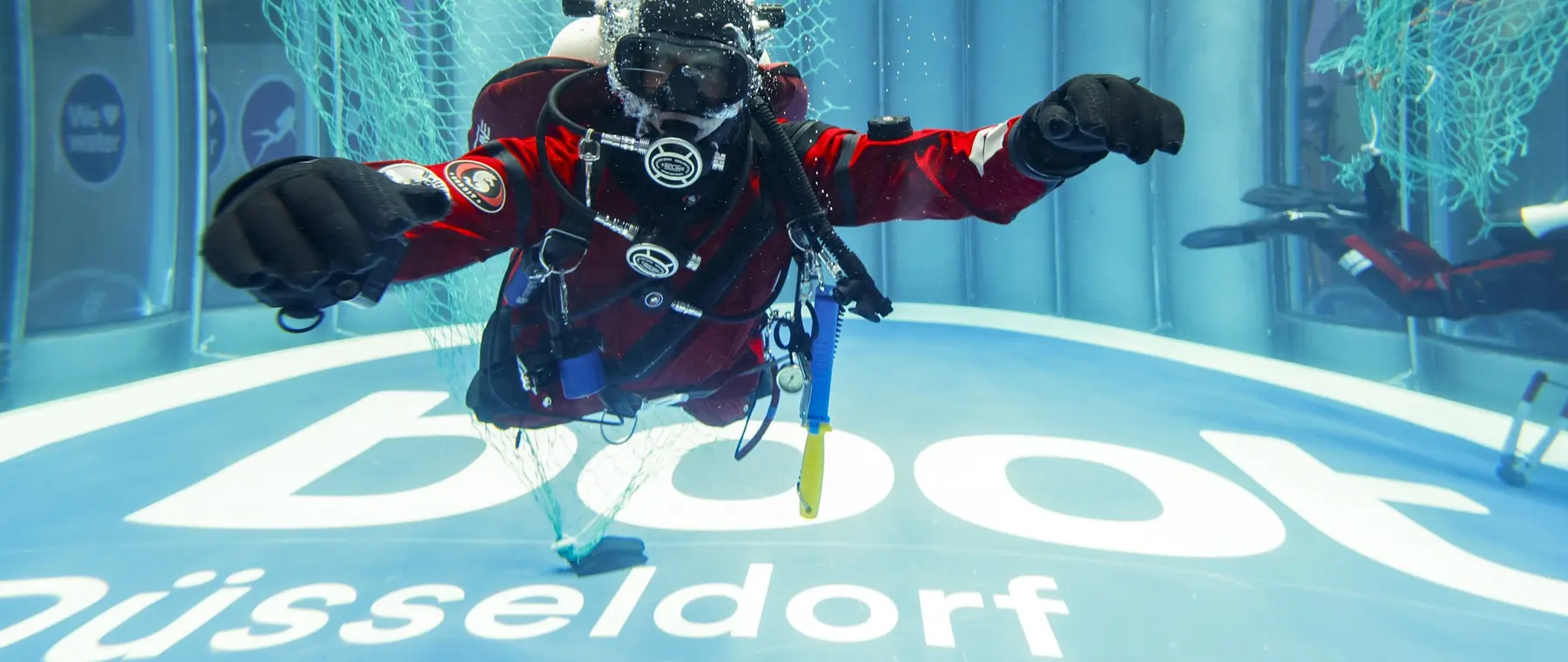
The 2027 schedule, sponsors and subject areas are stated in the official boot Düsseldorf release of 19 November 2026 and in the organiser's boot 2027 exhibition overview. The lead photograph is an official Messe Düsseldorf image issued with the organiser's press materials for an earlier boot event; it illustrates the fair context and is not a photograph of the future January 2027 innovation-dock proceedings. The image is reproduced solely for editorial coverage with its publisher credit retained. Photo credit: Messe Düsseldorf / CTillmann. No unannounced event result or future attendance figure is asserted.