A private portrait at the scale of a jewel
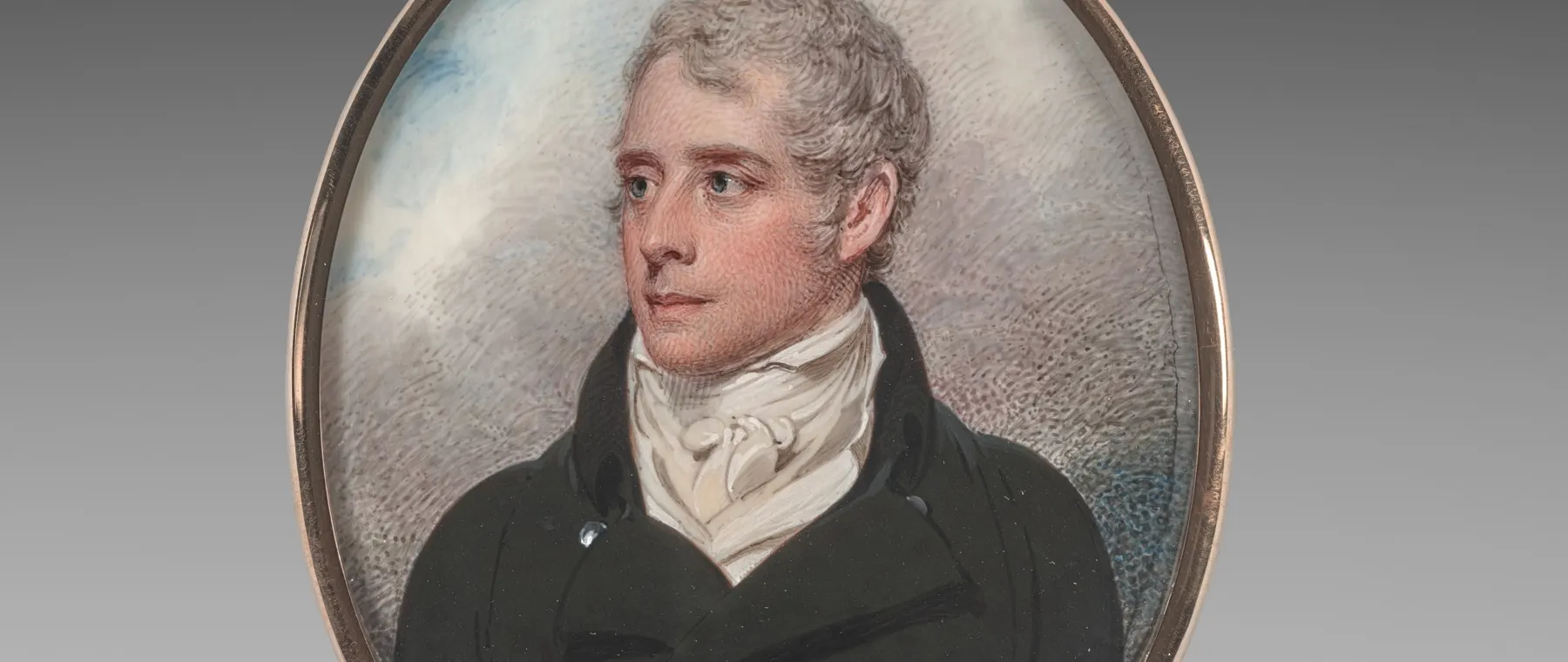
Among the British decorative arts presently on view at the Cleveland Museum of Art is an elegant portrait of Sandford Peacocke painted by William Wood in 1801. The image occupies an oval within a gold frame measuring only 8.6 by 7.3 centimetres. Dating from the period immediately before the widespread adoption of photography, this individual object offers a particularly revealing example of a luxury associated with intimacy rather than display on an imposing scale. Wood painted in watercolour on ivory, and the reverse of the frame is glazed. The museum's Hidden Insights gallery rotation, continuing through 14 February 2027, draws attention to the often neglected backs of thirteen British miniatures. For anyone commissioning a bespoke portrait or designing a small private collection, the relationship between the image and the object that contains it is an unusually rewarding subject.
The historical example requires responsible treatment. Its ivory support belongs to a past artistic practice and is not a recommendation to acquire or commission new ivory objects. Present-day commissions can employ other materials, and any proposed transaction involving an existing antique must comply with applicable wildlife, import and export rules.
The commission recorded in the artist's ledger
The Cleveland museum's catalogue relates the Peacocke portrait to a surviving set of four volumes in the National Art Library at the Victoria and Albert Museum. The records cover 1,211 miniatures by Wood made between 1790 and 1808. In the case of Peacocke, the entries specify that work began on 25 March 1801 and was completed on 11 April. Delivery did not occur until 29 July, and the recorded recipient was a General Stuart. The precise relationship between that person and the sitter has not been established.
The survival of such documentation alters the way a collector can consider the portrait. Rather than simply assign an approximate date from clothing or painting style, one can relate the object to a recorded period of work. The ledger also establishes that the delivery date was distinct from the date of completion. Those dates reveal a history that the finished image does not disclose on its own. A particularly interesting question remains open: why the miniature spent such a lengthy period with the artist after it had been completed. Its documentation establishes the interval without establishing a reason.
What the back can reveal about the artist
Wood often marked the paper behind his paintings instead of signing the visible surface. This practice may leave significant information inaccessible to an ordinary viewer. The museum also notes that the artist was capable of working in styles associated with other established miniature painters. A superficial comparison of visible images is therefore unlikely to settle every question of attribution.
A privately owned portrait of this kind deserves examination as a composite historical object. Its mount, frame and any inscriptions can hold evidence that is not apparent from the image. Opening a delicate frame merely to search for an inscription can, however, risk damaging both the portrait and its setting. An appropriately qualified conservator should determine whether further examination can be carried out safely. Documentary research, photography and examination of existing records may provide useful information before any intervention is considered.
For the owner of a contemporary commission, the lesson is more straightforward. A signed record kept independently of the work, including its date, materials, artist and commissioner, can help future generations understand an object without having to dismantle it.
Why the small format changes the experience of portraiture
A painting intended for a large wall can address a substantial room and an audience situated at a considerable distance. A miniature instead invites the viewer into close proximity. Its outlines, colour transitions and subtle variations become legible when the object is examined from a relatively short distance. The face is therefore not merely a scaled-down version of the face in a larger formal portrait; the artist has to make different decisions about the information communicated through its surfaces.
Wood's fine application of marks allowed him to build the image through numerous small decisions. An owner examining the miniature today can consider how the different areas of painting support the likeness without requiring every detail to be rendered at the same intensity. The artist's treatment of the visible surroundings is part of that achievement. If the eye is directed everywhere with equal insistence, the distinctive presence of the sitter may be diluted.
Contemporary portrait commissions can use the same principle without imitating the old technique. An illustrator, painter or photographic artist may develop an individual image intended to be experienced privately rather than projected across an interior.
Personal objects and the history of travel
The scale of a miniature made it possible for its owner to carry it between places. For a person leaving home on a lengthy journey, an image associated with a spouse or another member of the family could have an importance different from a painting that remained at the principal residence. Museum records indicate that Peacocke married in 1801 and subsequently served in Jamaica. Either event may have provided an occasion for the commission, although the evidence does not establish which one actually did.
This possibility gives the portrait a particular resonance for households that spend extended periods travelling. Many objects carried between residences or brought on board a yacht are selected for their personal associations, rather than their value to other collectors. A small original work may be particularly meaningful if it can be accommodated comfortably within the owner's private surroundings.
The modern owner has considerably more options for preserving a likeness. Commissioned paintings and carefully produced photographic prints can coexist with digital records. The choice between them need not be governed by which form of representation is most expensive. What matters is whether the selected object has a relationship with the person or episode it is intended to recall.
Display within a compact yacht interior
Owners of yachts between twelve and twenty-four metres have to make sensitive decisions about the objects occupying their limited private spaces. A small portrait can be more suited to such surroundings than a work conceived for the walls of a large residence. Its modest dimensions permit a position within a cabin where it can be seen clearly without requiring a large uninterrupted wall.
That characteristic does not remove the environmental requirements of the artwork. A fragile historical miniature can be affected by light, moisture and changes in its surroundings. The physical movement of a yacht also creates a risk for items installed without proper restraint. The decision to introduce an original should be made with suitable conservation and marine-design advice rather than based solely on an available area of wall or furniture. A commissioned modern image or an authorised reproduction may offer the desired personal connection without exposing irreplaceable historical material to unnecessary risk.
The display can be considered at the beginning of the interior design process. Establishing the actual position, viewing distance and relationship to nearby surfaces may help the artist develop a composition at a scale suitable for the intended setting.
Commissioning a contemporary keepsake
A client considering a small portrait has the opportunity to discuss more than the likeness to be represented. A contemporary artist can help determine the material, format and degree of detail that will suit the image. A specialist maker can develop an appropriate surround or case. Where the object is intended to accompany someone travelling, the construction and practical arrangements for its protection deserve consideration alongside the appearance of the portrait.
The intended circumstances of use can also affect the artist's approach. A depiction associated with a particular journey may include a small reference to its location. A piece intended for a family collection may instead place emphasis on the individual sitter. Personal significance can be expressed through the choice of pose or colour without requiring an obvious written explanation on the visible surface.
A record kept with the commission can establish the meaning of those decisions for future owners. It can also identify the people involved in the object's manufacture and provide guidance for its continuing care. Those arrangements offer a modern counterpart to the unusually informative records that William Wood maintained throughout his working life.
Looking beyond the public face of the portrait
The Hidden Insights display is located in gallery 203B at Cleveland and is presently listed as free to visit. Its unusual focus on the backs of the objects makes it a useful destination for people interested in the physical history of personal adornment and portrait painting. Visitors should confirm the museum's opening arrangements independently before making a shore excursion.
Wood's portrait of Peacocke can be appreciated as a likeness, an instance of artistic technique and a documented object with a history of commissioning and delivery. Each of these aspects has a different significance. Together they demonstrate why the value of a carefully selected private possession may be only partially visible. For the contemporary yacht owner, the enduring lesson is that personal luxury can be shaped through attention to individual meaning and careful craftsmanship without dependence upon substantial size.
Sources and photograph
Source documentation: https://www.clevelandart.org/art/1942.1159, https://www.clevelandart.org/exhibitions/hidden-insights-looking-backs-portrait-miniatures. Photograph: Portrait of Sandford Peacocke, 1801 — Cleveland Museum of Art, Portrait of Sandford Peacocke, 1801, The Edward B. Greene Collection 1942.1159; CC0 Open Access.. Resized for web display under CC0 1.0.