A collection of small forms with a profound history
The Cleveland Museum of Art's Silver, Gold, and Gems rotation brings together jewellery from several regions of Africa, including a group of five Ethiopian necklaces gifted in 2025 by Raymond A. Silverman. The display continues until 6 December 2026 in gallery 108C. One object in the group, accession 2025.154, is a necklace known as an ashän ketab, with amulet pendants called tälsäm and a bead. Its date is given as the late nineteenth or early twentieth century. The museum's technical catalogue identifies mercury-gilded copper alloy, although its descriptive account refers to gold-washed silver. That discrepancy is worth recording rather than resolving through an assumption about the object. Neither description warrants treating the piece as solid gold. Its artistic significance can be appreciated independently of the precious-metal content that might otherwise dominate an ordinary jewellery appraisal.
The necklace illustrates a tradition in which personal adornment serves purposes extending beyond decoration. Its carefully worked shapes relate to practices and beliefs that deserve attention in their own cultural context.
Pendants with a purpose beyond visible ornament
The museum associates the amulet containers with protective beliefs, including protection from the evil eye. Their relation to Islamic amuletic traditions provides an important explanation of why their shapes and enclosed spaces matter. The account indicates that some amulet containers might hold writings while others remain empty.
The jewellery is not evidence of the objective effectiveness of the protection sought by its wearer. It is evidence of the way material objects can acquire meanings through their relation to a person's beliefs and social surroundings. A purchaser attracted to an old necklace should be attentive to that distinction. Historical objects created for particular cultural practices should not simply be reclassified as fashionable accessories without considering what they represented to their original users.
The individual pendants offer an interesting visual contrast between an enclosed object and the detailed work appearing on its surface. The space within a pendant may be comparatively small, but the recognition that it has a particular function changes the viewer's understanding of its construction. It is a container as well as a piece of ornament.
Filigree and granulation as different forms of surface design
The museum draws attention to intricate filigree and granulation techniques associated with work from Harar and Aksum. Filigree takes advantage of slender metal forms to develop decorative arrangements. Granulation instead introduces small rounded elements whose disposition contributes to the appearance of the surface. Although both methods can produce complex patterns, the parts from which the pattern is built have different physical characteristics.
The appearance of an object made through these techniques changes considerably with lighting and viewing distance. The viewer can recognise the overall outline at a distance, but closer examination reveals the relationship between the numerous components. An experienced maker must control the connections between those elements while preserving the intended character of the design. Individual irregularities are not necessarily failures of workmanship, although a jewellery specialist can assess whether a particular variation is original or relates to later damage.
A contemporary client interested in commissioning jewellery can learn much from the economy with which these means of decoration are employed. A relatively small number of repeated forms can give a surface substantial interest without requiring an expensive assortment of large gemstones.
What a material description actually establishes
The differing wording in the museum record for 2025.154 raises an issue that applies to collecting in general. A warm gold colour does not establish the composition of an object beneath its surface. Even the word gilded does not establish a uniform process or the thickness of the applied material. Where the composition has commercial or conservation significance, documentary evidence and appropriately qualified examination are necessary.
The metallic substrate, the applied surface and any later restoration may each have different implications for the treatment of the necklace. A cleaning method selected on the assumption that the whole object is solid gold could be unsuitable. The collector should not attempt to determine the composition through destructive experiments or home methods. Where a qualified specialist considers further assessment appropriate, it should be carried out in a manner suitable for the object's age and condition.
The museum's two descriptions can be read as an invitation to ask for clarification, not an indication that an exact material analysis has been published. The technical field is the basis used here to identify the photograph and object; the differing descriptive text is explicitly acknowledged.
Comparing two Ethiopian necklace forms
The same group includes a necklace made from silver alloy, accession 2025.152, and a separate muriya necklace, accession 2025.155, which the museum associates with Muslim women's bridal dress in Harar. The latter combines gilt silver with a yellow resin identified tentatively as copal. Its spherical elements and warm coloured components create a notably different visual relationship from the small amulet containers of the ashän ketab.
Considering these items together allows the visitor to recognise that the category Ethiopian jewellery encompasses distinct forms with different associations. The country of origin by itself gives too little information to understand the intended use or significance of a particular piece. The identification of a bridal ornament does not mean that every necklace from the region was worn under the same circumstances.
For collectors choosing jewellery from cultures other than their own, the particular history of a piece can be more instructive than the general label under which it is offered commercially. Examining documented examples provides a foundation for distinguishing forms and materials without assuming that every similar looking object shares the same history.
The importance of provenance and respectful acquisition
The museum records the objects as gifts from Silverman. Its collection records identify important stages in their documented histories but do not identify every person who owned or wore them over the preceding century. That difference between a recorded modern collection and a complete historical chain of possession should be understood clearly.
A buyer considering a historical cultural object should seek evidence of legitimate ownership and lawful acquisition and export, rather than regard a dealer's general identification of the region of origin as sufficient. Where questions remain concerning the circumstances in which a piece left its original community, further investigation may be appropriate before any purchase. Cultural significance deserves attention even where an object has a modest financial value.
Alternatively, a commission from a contemporary jeweller working within a living tradition can provide an opportunity to sustain the practice itself. A discussion with the actual maker allows the purchaser to understand the intended meaning and circumstances of use, and to compensate the people whose skill creates the finished work.
Considering jewellery for life aboard a yacht
A collector whose travel includes time aboard a luxury yacht may have a particular interest in pieces that are comparatively compact. The necklace's size and visual detail demonstrate how a small personal possession can provide scope for an individual aesthetic without requiring a large space for display. Its historical construction, however, is not necessarily appropriate to the conditions associated with swimming, exercise or informal activity on deck.
Fine interconnected components, delicate metal surfaces and old fittings may require careful assessment before the object is worn. A responsible owner can seek advice from a conservator or experienced jewellery specialist about display, storage and protection from damage. Insuring an item and arranging secure storage do not eliminate the need to consider its physical suitability for the proposed use.
A contemporary necklace inspired by the principle of geometric repetition can be developed specifically for the circumstances in which it will be worn. The designer should not simply copy meaningful cultural motifs without permission or understanding. The commission can instead concentrate on qualities such as the structure, scale and tactile character of the individual elements, developed independently with the maker.
An opportunity to study the objects directly
The museum lists the African jewellery display through 6 December 2026. Alongside the Ethiopian pieces are works associated with the Akan states, the Maghreb and ancient Egypt. The presentation is free according to the museum's current information. As with any gallery rotation, a visitor should verify the availability of an individual item before making a journey specifically to see it.
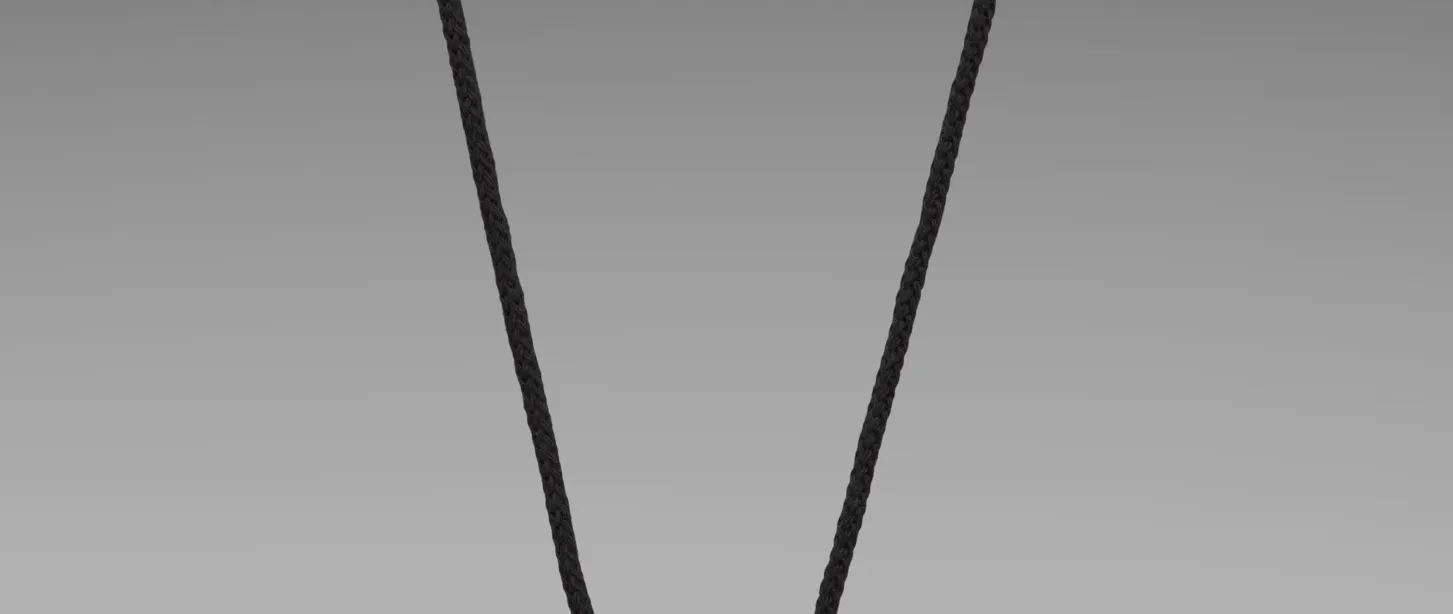
The image reproduced with this feature shows accession 2025.154, not the silver-alloy necklace or the separate bridal ornament. These distinctions matter because the three works invite different questions about material, religious and social significance. They also reward close inspection of the artistic decisions embodied in their construction. The exhibition offers a valuable opportunity to appreciate jewellery as a source of individual and cultural meaning rather than merely an expression of the market value of its metal.
Sources and photograph
Source documentation: https://www.clevelandart.org/art/2025.154, https://www.clevelandart.org/art/2025.152, https://www.clevelandart.org/art/2025.155, https://www.clevelandart.org/exhibitions/silver-gold-and-gems-spotlight-jewelry-across-africa. Photograph: Necklace (ashän ketab) with amulet pendants (tälsäm) and bead, late 1800s or early 1900s — Cleveland Museum of Art, Necklace (ashän ketab) with amulet pendants (tälsäm) and bead, late 1800s or early 1900s, Gift of Raymond A. Silverman 2025.154; CC0 Open Access.. Resized for web display under CC0 1.0.