A small drawing within a tradition of royal painting
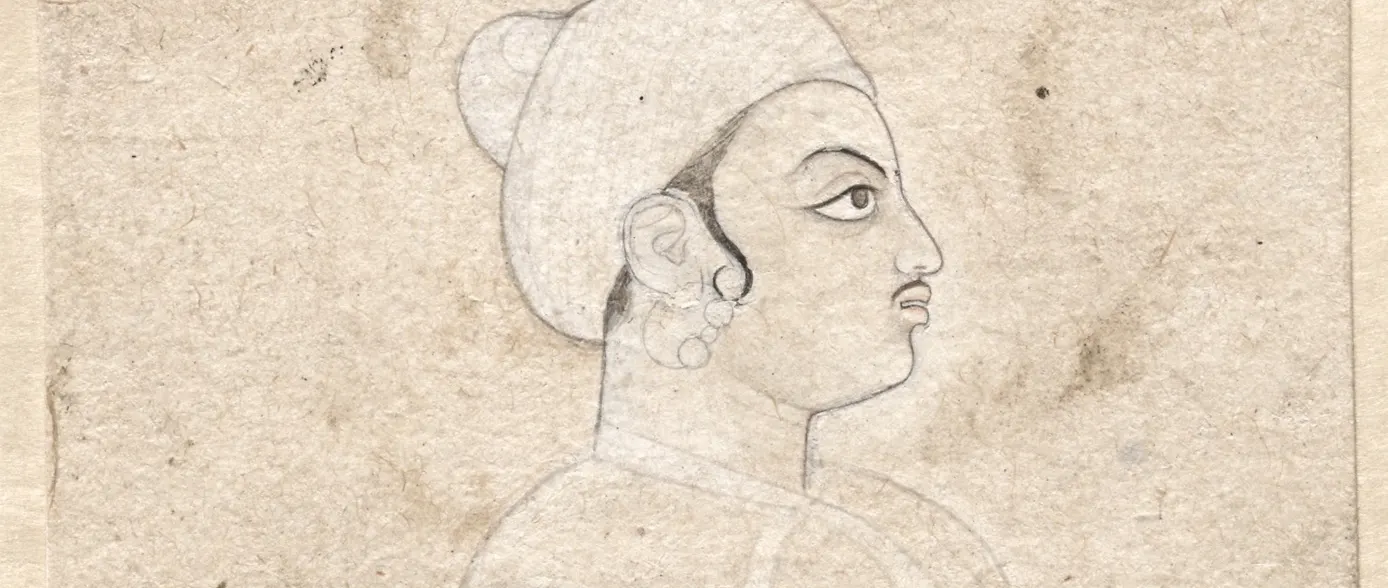
An unfinished portrait of a man in the Cleveland Museum of Art offers an unusually intimate encounter with the working methods of artists associated with the Pahari kingdoms of northern India. Dating from the late eighteenth century, the unidentified artist's sheet measures just 7.3 by 5.5 centimetres and is recorded as gum tempera on paper. It forms part of the museum's Art of Pahari India gallery rotation, which runs from 30 August 2026 to 21 February 2027. Unlike a highly finished painting commissioned for a royal collection, this modest sheet preserves evidence of a preparatory process. Its importance to a collector lies in the observation of an artist's decisions rather than an elaborate display of materials.
Pahari painting grew within the northern Himalayan foothills. The terrain, the historical networks of patronage and the individual workshops that supplied works to those patrons provide a context considerably more specific than a general classification of the art as Indian miniature painting. The museum's current presentation invites an exploration of that context through both completed images and the work involved in creating them.
Reading the portrait through its visible marks
The tiny drawing presents a man in profile, with his face turned to the right. The artist has defined the eye, moustache and head covering through notably economical marks. The modelling of the face appears much more definite than the lower portion of the sheet. Its restrained treatment leaves the underlying paper visible and permits the viewer to examine the relation between a developing outline and the features already established by the painter.
In an image of this scale, a small adjustment can alter the character of the likeness considerably. An extended line may change the direction of the gaze, while a slight variation in the position of a feature can change the apparent attitude of the sitter. The sparing treatment of the clothing is especially useful to the observer because it prevents the portrait from becoming primarily a study of fabric and ornament.
The name of the sitter is not established. The drawing's appearance should not therefore be interpreted as a means of identifying a historical monarch or a particular courtier. The museum suggests that he may belong to a series depicting members of the nobility. That is an assessment of a possible purpose for the sheet rather than a definitive identification of its subject.
Preparatory studies as records of artistic choices
The museum identifies several stages of work preceding the completion of Pahari paintings. Drawings and preliminary studies could be retained in family workshops, providing artists with a body of material available for subsequent compositions. These are an important aspect of the production of highly developed decorative and narrative works because they demonstrate that their final appearance emerged from selected elements rather than a single spontaneous gesture.
For the contemporary collector, a preparatory drawing can have a different appeal from the finished painting. It may expose a degree of uncertainty, concentration or adjustment that is less apparent in the completed commission. Its purpose should nevertheless be examined before it is described as the first stage of a particular painting. Without documentary evidence connecting the drawing to a finished work, there may be no basis for assigning it to a known commission.
An owner commissioning original artworks can ask an artist whether selected preliminary studies might be retained alongside the final piece. Their importance need not be commercial. They can provide a record of the conversation that shaped the work, including decisions that were explored and subsequently abandoned.
Networks of patronage and the mobility of artists
The Cleveland presentation explains that artists working within hereditary communities provided paintings for patrons across several of the Pahari kingdoms. A painter was not necessarily confined to the particular locality in which the family workshop was established. The circulation of commissions and gifts among members of the ruling classes contributed to the movement of paintings and artistic ideas.
This background complicates an attempt to understand the objects only through modern geographical categories. A work associated with a particular subject or visual tradition may have acquired its character through relationships among patrons and artists in several places. Where the original commission and workshop are not securely documented, a careful description of the object may be preferable to a precise attribution that its evidence cannot sustain.
Patronage also influenced the subjects of paintings. The museum's broader display encompasses devotional imagery, literary themes and references to musical traditions. In each case the visual representation might be understood in relation to knowledge that the original audience brought to the work. A collector encountering the image today may need to learn something of that background to appreciate the significance of its individual details.
When music becomes the subject of an image
Another small work shown in the same gallery, Surmananda Ragaputra of Hindol, from a Ragamala, dates to around 1750. Its museum record, accession 2002.116, describes a painting in gum tempera, ink and gold showing two men equipped for a contest. Their similar positions create a visual balance, while the circumstances of the scene anticipate action. The museum connects the tension of the composition with the musical character associated with its title.
This is a useful contrast with the relatively unfinished portrait illustrated here. A portrait can investigate the particular characteristics of a sitter. A musical or literary image may organise its forms around the experience associated with a theme. In the latter case, the people, landscape and ornamental elements have roles within the entire visual arrangement.
An interested viewer does not need to play the relevant music in order to examine the composition. Learning about the association can, however, reveal why certain aspects of the painting are significant beyond their decorative appearance. The two objects provide distinct points of entry into the wider tradition of painting collected by the museum.
A provenance connected to museum design
The unfinished portrait entered Cleveland's collection in 2005 as a gift from Pamela Elizabeth Ward commemorating her parents, William E. Ward and Evelyn Svec Ward. The museum notes that William Ward served as its chief designer from 1957 to 1993 and taught calligraphy and watercolour at the Cleveland Institute of Art. This association does not establish the original purpose of the eighteenth-century sheet, but provides an interesting element of its later collecting history.
A study of an artwork's provenance may disclose several kinds of interest among its successive owners. One individual may have acquired it because of its historical subject; another may have appreciated its technique or wished to understand the visual organisation of a work. The history of the Ward collection is particularly pertinent to the appreciation of a modest drawing whose quality is connected to its economical use of line.
For a prospective collector, documentation of the acquisition should be retained independently of any mounting or frame. Records of legitimate provenance are especially important where works have passed through markets in several jurisdictions and where the circumstances of their earlier movement are not fully established.
Collecting at the scale of a private cabin
The tiny Pahari drawing challenges the assumption that an artwork must physically dominate a space to have a significant role within it. Within a well-designed cabin on a 12-to-23.99-metre yacht, a small carefully chosen work can establish a focal point at a comfortable viewing distance. Its size may also allow other aspects of the interior to remain deliberately understated.
The suitability of an original historic drawing for that environment requires a separate assessment. Paper and delicate media may be vulnerable to changes in light and humidity. Secure mounting, glazing where appropriate and the location of the display should be considered with a qualified conservator and the yacht's design team. For a valued original, a location ashore may be more suitable, while a correctly licensed reproduction can provide a meaningful representation of the image aboard.
In commissioning a contemporary work inspired by the discipline of the miniature format, the owner can discuss the actual dimensions and intended viewing conditions with the artist, rather than request a copy of historic cultural imagery.
An exhibition to reward close observation
Art of Pahari India is currently listed in gallery 242B and admission is free. The illustrated portrait is identified in the museum catalogue as being in that gallery. Individual displays may change, so visitors intending to see a particular drawing should confirm its availability.
For a visitor accustomed to appreciating polished design objects, the attraction of this small sheet lies in the visible process preceding completion. The difference between its finely described face and the relatively open surroundings offers a lesson in how an artist can direct attention without resolving every part of an image to the same degree. It is also an opportunity to appreciate a distinct historical artistic tradition through the original decisions of its makers. A well-chosen private collection can reward that kind of close observation even within the relatively limited spaces available aboard a yacht.
Sources and photograph
Source documentation: https://www.clevelandart.org/art/2005.69, https://www.clevelandart.org/art/2002.116, https://www.clevelandart.org/exhibitions/art-pahari-india. Photograph: Portrait of a man, late 1700s — Cleveland Museum of Art, Portrait of a man, late 1700s, Gift of Pamela Elizabeth Ward in loving memory of her parents, William E. and Evelyn Svec Ward 2005.69; CC0 Open Access.. Resized for web display under CC0 1.0.