A monumental textile preserved across two millennia
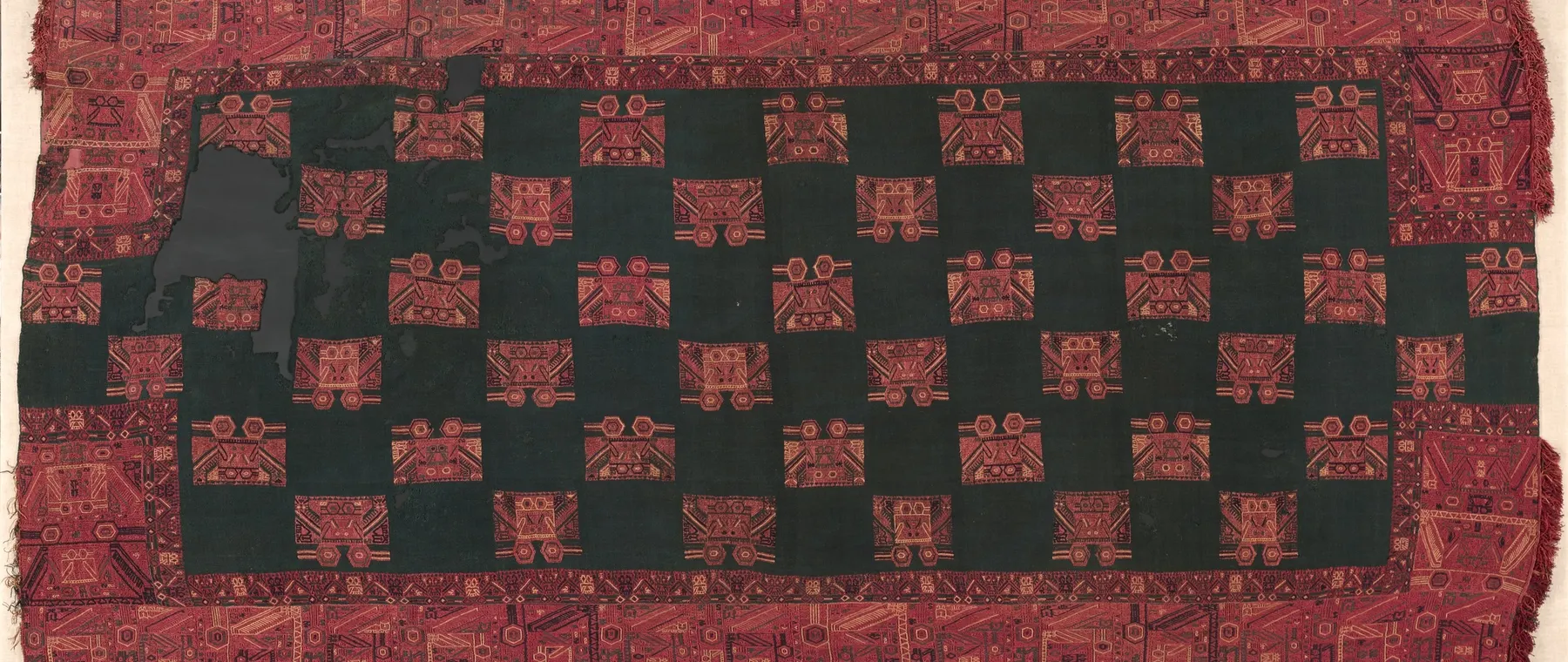
Among the Cleveland Museum of Art's Andean holdings is an embroidered mantle attributed to the Paracas Cavernas style of Peru's southern coast. Dated broadly to about 300 BCE–200 CE, it measures 154.9 by 292.1 centimetres before mounting and is made from camelid fibre. Its plain-woven ground carries embroidery with brightly coloured, double-headed bird forms. The museum identifies it as part of the Norweb Collection and currently places it in gallery 232. The object is an exceptionally instructive example of the way a textile can carry visual information over a comparatively extensive surface without losing the significance of the individual elements from which it is constructed.
The original historical context is essential. This mantle is associated with the burial traditions of the Paracas people, rather than with modern interior furnishings. Its preservation and museum presentation allow the visitor to appreciate an important textile tradition through evidence surviving from antiquity. An owner considering contemporary textile commissions can learn from its organisation of colour and rhythm while respecting its cultural and funerary meaning.
The different work performed by weaving and embroidery
The collection record distinguishes the plain-weave structure from the embroidery. The weave establishes a connected textile ground; embroidery introduces a further series of threads through or over that ground to create the visual arrangement. Consequently the designer can exploit two levels of organisation. The first gives the material its underlying properties as cloth, while the second permits shapes to be developed that need not be restricted to an identical repetition of the weave.
Understanding the distinction helps the viewer appreciate the complexity of the mantle. The large surface is not simply a pattern printed onto modern fabric. Its imagery is materially integrated into the textile through the work of the embroiderer. Variations in the disposition of coloured yarns, directions of stitches and the relation between individual components influence the appearance of the motifs.
In an original modern commission for a residence or yacht, a textile designer can similarly consider the ground and its ornament separately. A fabric selected because of its construction or tactile character may require a different approach to embellishment from one chosen chiefly for its visual appearance. The technical properties of the two elements must remain compatible.
Repeating a figure without reducing it to a mechanical pattern
The mantle's double-headed bird motifs give the composition a distinctive identity. The museum considers that imagery likely to have had symbolic importance, while explicitly acknowledging that its precise meaning is unknown. It would therefore be inappropriate to attach a confidently asserted modern interpretation to each element of the design.
Even without attempting to decipher the imagery, a viewer can appreciate the visual effects of the repeated forms. The recurrence of a recognisable shape helps establish unity across the surface. Different colours and the placement of adjacent motifs introduce variation within that unity. The result can be experienced as a large connected field or examined closely as a succession of separate embroidered forms.
This ability to manipulate the relationship between the whole and the detail is particularly relevant to textile design in a compact interior. A large pattern can appear very different from the position of a seated occupant than it does in a photograph of an entire room. When developing an original textile, the designer should consider the actual areas that will remain visible after the material has been placed over a seat, panel or other appropriately constructed support.
A palette that survives because of exceptional circumstances
The museum describes red, blue, yellow and green yarns in the mantle's embroidery. Their appearance today is connected to the particular conditions in which ancient textiles survived. The dry coastal environment in Peru permitted the preservation of fibre objects that would often deteriorate in other circumstances.
That survival should not be mistaken for evidence that the textile is inherently resistant to every environmental condition. Its condition today reflects its long history and the measures taken to preserve it. The same material introduced into a continually changing environment could have a very different future. It is important to distinguish the colour visible in the current photograph from a complete reconstruction of how the mantle might have looked when originally completed.
For a client commissioning a decorative textile, the contrast between brilliant colours can be explored independently of any attempt to recreate the historic palette exactly. The selection of yarns, their individual finishes and the underlying fabric influence how colours are perceived. Examining samples under the lighting of the intended room may reveal differences that are not apparent in a photograph or digital simulation.
Related garments and the significance of a complete ensemble
The Cleveland catalogue relates this mantle to a tunic and long headband held in the same collection under accession numbers 1946.227 and 1946.228. Similar imagery is one reason for considering the three objects in relation to one another. Viewing an individual textile within that wider ensemble can help explain why its visual organisation was important.
A ceremonial arrangement of clothing may include several surfaces experienced simultaneously or in sequence. The design of one garment can complement another without making all the individual parts identical. A textile may also behave differently when wrapped around a body from when it is laid out flat on a display surface. The museum's mounted presentation offers a valuable means of examining the surviving material but does not reproduce all the circumstances of its original occupation.
In the contemporary decorative arts, the principle of related objects offering distinct individual treatments is worth consideration. A client may commission several coordinated textiles for different parts of an interior. Rather than repeat precisely the same pattern on every cushion and furnishing, the designer can establish a relationship between the sizes, colours and visual rhythms appropriate to each use.
Respecting the circumstances of an ancient burial object
Paracas burial practices involved wrapping the dead in layers of textiles and including associated offerings. The museum's account connects richly embroidered garments like the illustrated mantle with the funerary treatment of important individuals. This context is particularly significant when considering the ethics of acquiring ancient textiles.
A documented museum object is not an invitation to purchase comparable items whose provenance is unclear. The movement of archaeological material away from its original context can remove evidence important to understanding its history and may involve unlawful export or collection. A purchaser should seek qualified advice and clear documentation of legitimate provenance and the applicable legal requirements before contemplating any acquisition of antiquities.
There are other ways to appreciate textile craftsmanship without entering the market for ancient material. Museums provide opportunities to examine historic works and make authorised images available for study. The work of contemporary textile artists can be acquired directly with an understanding of the maker's own practice. A thoughtful commission can recognise the distinction between studying a surviving cultural object and reproducing imagery whose original significance is not fully understood.
Textile design for a yacht's changing environment
The visual complexity of the Paracas mantle offers ideas about colour and composition, but the technical requirements of yacht fabrics are very different from those of the preserved historic work. A luxury yacht between twelve and twenty-four metres often experiences changes in light, humidity and temperature as it moves between destinations. Textiles may also need to withstand relatively intensive use in restricted spaces.
A fabric for upholstery should be selected in conjunction with the actual construction of the seating and the intended maintenance arrangements. A decorative hanging presents different considerations, including how it will be secured and whether it can be inspected and removed without damage. Any installation must satisfy the yacht's applicable safety requirements. These questions should be considered before a design is committed to a lengthy manufacturing process.
For owners who appreciate the tactile qualities of embroidery, specially commissioned smaller pieces may offer a more practical arrangement than introducing a large historic textile on board. A maker can develop the scale and character of the work in response to the actual conditions of its intended display, alongside the advice of the vessel's interior specialists.
Experiencing the scale of the museum object
The mantle's length of nearly three metres is an important part of its character. A visitor who sees the original can appreciate the distance across which its motifs are distributed and the amount of individual work represented by the entire surface. The web reproduction is useful for examining its arrangement but cannot fully reproduce the textile's physical dimensions and construction.
Cleveland's collection record identifies the mantle as on view in gallery 232. Its Andean textiles programme is currently advertised through 13 December 2026, but visitors should confirm the display of the individual object before making a journey. The collection record, rather than an earlier archived exhibition page bearing the same general title, is the principal reference for the object discussed here.
The mantle provides a distinctive example of the ability of textile artists to develop an extensive visual language through the interaction of ground, colour and repeated form. For contemporary collectors, the most valuable response is an informed appreciation of those artistic decisions and respect for the cultural circumstances in which the object was created.
Sources and photograph
Source documentation: https://www.clevelandart.org/art/1946.226, https://www.clevelandart.org/art/1946.227, https://www.clevelandart.org/art/1946.228, https://www.clevelandart.org/about/press/november-exhibitions-and-event-listings-cleveland-museum-art-2. Photograph: Mantle, c. 300 BCE–200 CE — Cleveland Museum of Art, Mantle, c. 300 BCE–200 CE, The Norweb Collection 1946.226; CC0 Open Access.. Resized for web display under CC0 1.0.