A garment whose form became a collector's textile
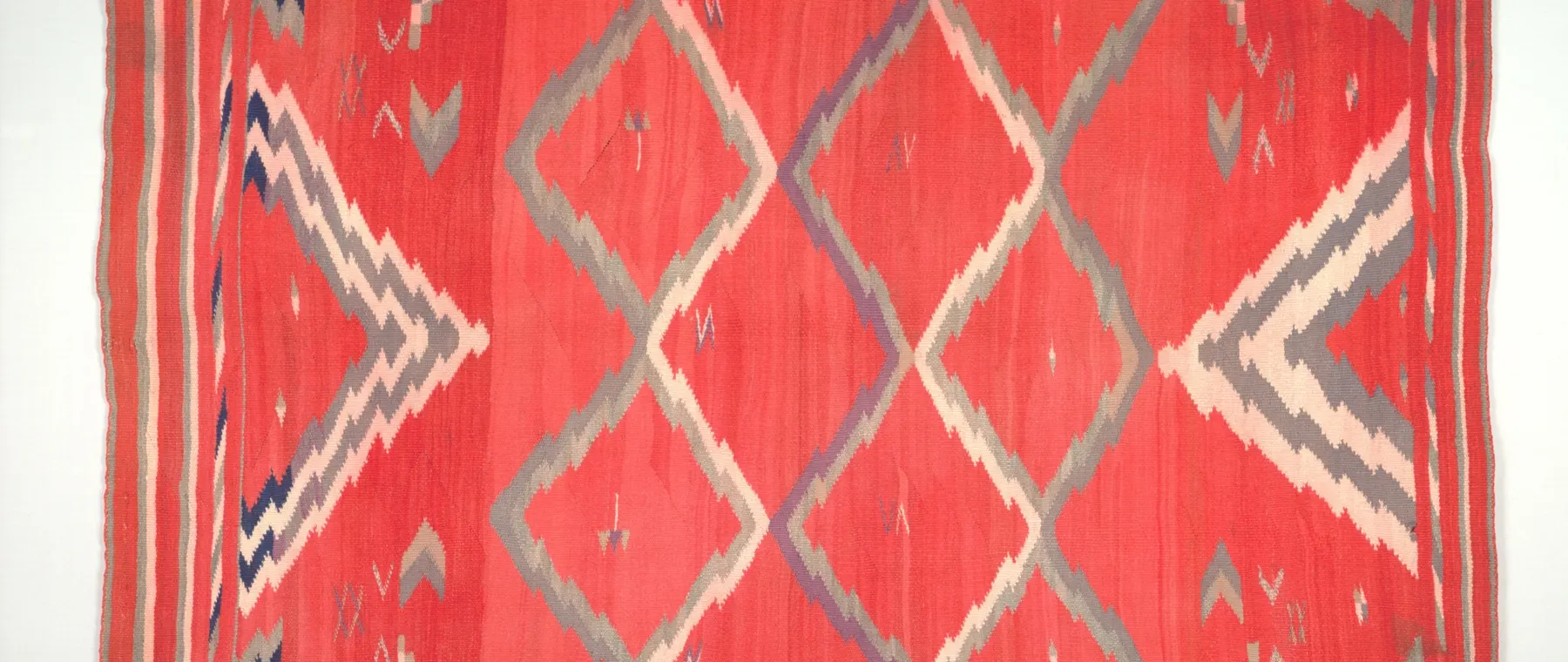
The Cleveland Museum of Art is presenting two late nineteenth-century Diné, or Navajo, textiles in its Native North American galleries through 13 December 2026. The museum identifies the historically important change of function embodied by the two pieces: they drew upon the form of shoulder blankets but were made for sale to collectors outside the original Indigenous market. Another comparable textile from Cleveland's collection, reproduced with this feature, is its Wearing Blanket, accession 1921.560. Dated to approximately 1875–80 and measuring 208 by 120 centimetres, it is woven in wool, using materials identified in the catalogue as handspun, Germantown and bayeta. It is not listed as currently on display. The object nevertheless provides an instructive comparison for visitors considering the current rotation and for collectors interested in how the intended function of a textile can change over time.
The difference between a wearable blanket and a decorative rug matters because it affects the relationship of the work to the person using it. Materials chosen for one purpose may later be appreciated in a substantially different context.
The relationship between the body and the dimensions of cloth
A textile conceived to be wrapped around the shoulders participates in the movement of the body. A large portion of its design may become visible or concealed depending on how the material is arranged. Its length and width affect the way it hangs and the areas in which the wearer experiences its weight.
A rug displayed flat is encountered differently. The complete design may be visible at a glance, and the position of the viewer in relation to it can change as the viewer moves through a room. If the textile is placed on the floor, direct physical contact and the demands of cleaning become part of its use. A historical wearing blanket need not be treated as a floor covering simply because it resembles a modern rug. Its actual construction, condition and significance should guide any decision about display.
For designers working aboard a yacht, this distinction is valuable. A piece conceived as a loose throw can be much more flexible in its use than a textile fixed to a particular piece of furniture, but it may also produce different practical problems when the vessel moves. The intended circumstances of use should be considered before choosing the material or its dimensions.
Weaving colour into the structure of the surface
The catalogue for the illustrated blanket describes tapestry weave. Its coloured elements are an integral part of the woven structure rather than a printed representation of colour applied to a uniform fabric after manufacture. The way in which the coloured areas meet and continue across the material is therefore closely connected to the work of the weaver.
The distinction is useful when examining geometric textile designs. A simple rectangular shape may appear unremarkable when viewed on a screen, but making it part of the textile's construction involves the control of the yarns through an extended series of individual operations. Variations in the characteristics of the yarn can add further differences to the finished surface. The overall design is the result of both the visual choices of the artist and the physical arrangement of the threads.
A client commissioning a new textile can discuss that relationship with an experienced maker. A design formed through weaving or embroidery is not interchangeable with a design reproduced digitally on a piece of fabric. Each approach offers particular possibilities and trade-offs, and the appropriate choice depends on what the client values about the object.
Materials that reflect changing commercial relationships
The museum's technical record identifies several types of wool associated with the blanket, including Germantown and bayeta alongside handspun material. Those terms provide a starting point for investigating the relationship between the weaver's own work and materials obtained through wider exchanges. They should not be understood as a complete reconstruction of the origin and production history of every thread.
The inclusion of different materials is relevant because an artistic tradition can respond to changes in supply without ceasing to be a living practice. The availability of particular yarns may influence the colours and textures a maker can achieve. Conversely, the decisions of the maker determine how those materials are brought into relation with the design and intended function of the textile.
Collectors sometimes make assumptions about traditional craftsmanship according to whether every material appears to have been produced in the same region. A documented historical textile can offer a more nuanced account of manufacture. Knowledge of its sources and materials may reveal relationships that are not visible in the pattern itself. In a contemporary commission, the client can ask the artist to explain the choice of fibres and their significance to the particular work.
A change of market and its historical circumstances
Cleveland's records describe a shift in Diné textile production during the late nineteenth century. Weavers continued to develop their practice while responding to new demands from non-Indigenous purchasers. This was not merely an abstract change in fashion. Other records in the museum's collection place that development within a period of profound disruption, including the forced confinement of Diné people at Bosque Redondo in the 1860s and changes to established trading relationships.
The history should be understood as one involving people responding to difficult and rapidly changing circumstances, rather than a picturesque narrative about the discovery of a decorative style by outside collectors. The resulting objects can reveal considerable creative agency while also reflecting the conditions in which the work was made. Neither dimension should be ignored.
A purchaser interested in historic Diné textiles should seek reliable information about attribution, condition and the history of the particular piece. A contemporary design reproducing a general geometric appearance is not equivalent to an original Diné work, and it should not be represented as such.
Living artistic traditions and the importance of authorship
The museum records the makers of many older works by cultural association rather than individual name. That absence reflects limitations in the surviving documentation and does not diminish the achievement represented by the textile. It is particularly important not to invent an attribution or assume that the maker's intentions can be deduced solely from the visual appearance of the object.
For a contemporary collector, purchasing directly from identified Indigenous artists or reputable galleries representing their work offers a different relationship with the artistic tradition. The artist can explain the provenance and materials of the piece and indicate whether a proposed use is appropriate. The purchaser can also retain documentation relating to the person who made it, instead of relying exclusively on an anonymous dealer description.
When commissioning an artwork for a yacht or a private residence, a client should distinguish general design principles such as proportion, contrasting colour and rhythm from culturally specific imagery. Collaboration with a qualified artist, respect for the artist's decisions and accurate attribution are more appropriate than requesting an imitation that obscures the origin of the design.
Preserving historic woven objects near the water
For owners of yachts between twelve and twenty-four metres, the scale of a textile can have a substantial influence on its practical suitability. A handwoven work of more than two metres in length may occupy much of a cabin wall or seating area. Folding or altering it merely to fit an available position can obscure important elements of the design and may place physical stress on an older material.
A valuable original should be evaluated by a textile conservator before installation in a marine environment. The effect of direct sunlight, humidity, abrasion and the methods used to secure the object should be considered in relation to its condition. A permanent historical collection may be better accommodated ashore in suitable conditions, with the yacht furnished using contemporary works selected for their actual intended environment.
For a newly commissioned textile, the owner can discuss the intended use and cleaning requirements in advance with the maker and yacht interior specialist. The fabric, backing or mounting system must also be appropriate to the applicable vessel safety requirements. The goal is a design that can be appreciated in everyday life rather than an object that imposes impractical restrictions on its surroundings.
Looking at the current Cleveland display
The museum's current rotation is listed in gallery 231 and is free to visit through 13 December. A subsequent rotation is scheduled from 20 December 2026. The illustration here is of a different blanket in the collection, retained as comparative material rather than represented as one of the pieces in the current display.
For a visitor interested in textile arts, the exhibition is an opportunity to examine how a wearable form could be adapted to meet the expectations of a new market while retaining connections to established weaving practices. It is also an opportunity to consider the history behind an object whose designs may otherwise be encountered primarily through modern decorative products. The artistic quality of a woven textile cannot be separated from the individual decisions involved in making it, and responsible collecting begins with recognition of that work and the people whose traditions sustain it.
Sources and photograph
Source documentation: https://www.clevelandart.org/art/1921.560, https://www.clevelandart.org/art/1937.903, https://www.clevelandart.org/exhibitions/native-north-american-textiles-1, https://www.clevelandart.org/exhibitions/native-north-american-textiles-2. Photograph: Wearing Blanket, c. 1875–80 — Cleveland Museum of Art, Wearing Blanket, c. 1875–80, Gift of J. H. Wade 1921.560; CC0 Open Access.. Resized for web display under CC0 1.0.