The small scale of eighteenth-century porcelain
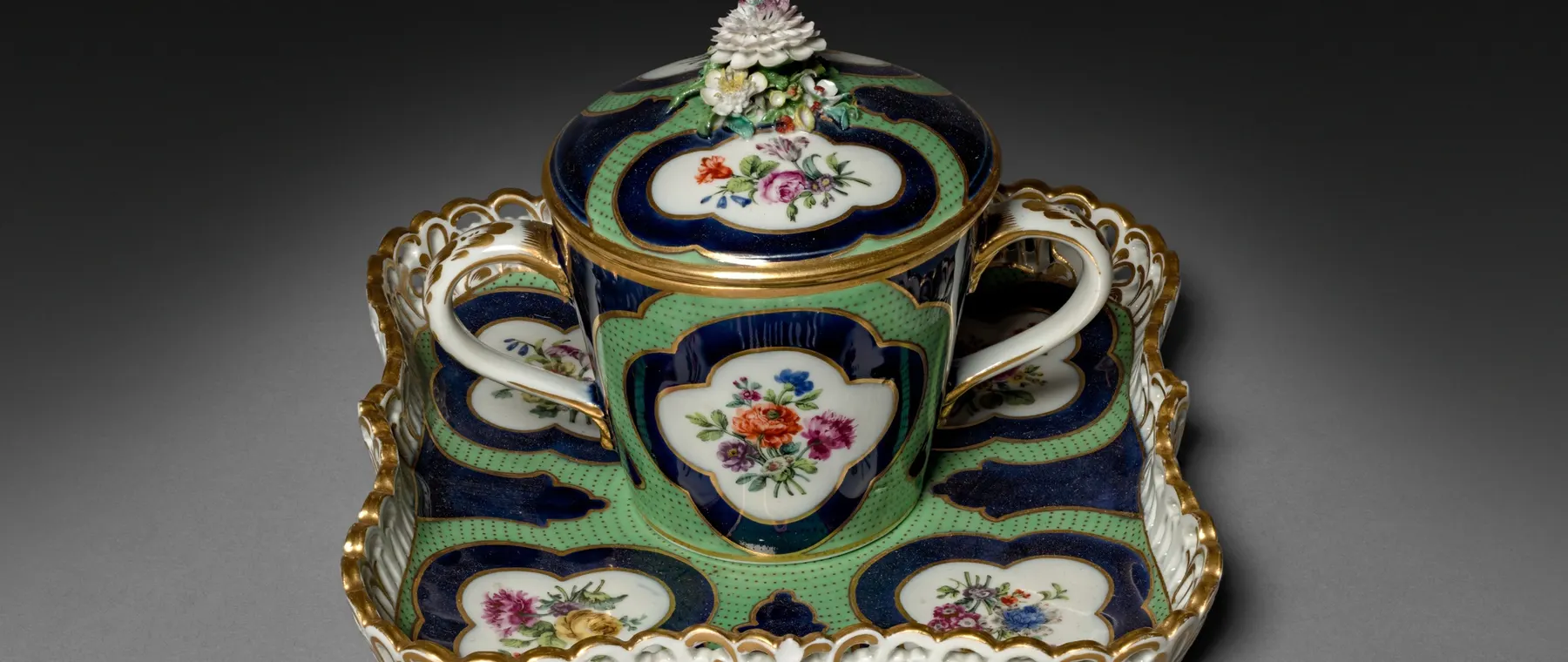
A covered, two-handled porcelain cup and its matching stand in the Cleveland Museum of Art provide a revealing example of the precision with which eighteenth-century European manufacturers addressed the experience of drinking from an individually designed vessel. The museum dates the ensemble to about 1780 and attributes it to the Viennese porcelain manufactory associated with Claudius Innocentius Du Paquier. Its recorded dimensions, eleven by 13.9 by 9.1 centimetres, establish its relatively intimate scale. The piece entered the museum through the bequest of Mrs. Severance A. Millikin and is catalogued under accession number 1989.187.
The object belongs to a world of dining and hospitality in which even a small vessel could be developed as an assembly of several carefully related forms. It is a useful precedent for anyone considering a bespoke porcelain service for a yacht or residence. The relationship between the handles, lid, cup and stand is a more interesting starting point than a simple preference for the most elaborately decorated piece of tableware.
The development of porcelain manufacture in Vienna
Du Paquier's establishment was an important early European producer of hard-paste porcelain, following the achievements at Meissen. Its origins lie in the early eighteenth century, when the expertise required to produce such material was being developed and guarded by competing manufacturers. The Cleveland Museum's biographical entry identifies Du Paquier as a court official of Dutch origin who established the enterprise in 1719 with assistance from craftsmen connected with Meissen.
The date assigned to the covered cup, however, is several decades later than the establishment of the enterprise. The identification of the object with the manufactory should not be understood to mean that Du Paquier personally made it. An institutional attribution can encompass the activity of several generations of designers, decorators and specialist workers.
For a contemporary collector, this distinction is useful. A manufacturer's name may identify a tradition of manufacture without establishing the identity of the particular hand responsible for every component. The historical period, the documented marks, the construction and the condition of an individual vessel can all contribute to an assessment of its significance. Reliable attribution should be based on the actual evidence accompanying the object rather than on an attractive general history of the factory.
Why porcelain vessels have several distinct components
A covered cup and stand perform several related functions. The cup holds the beverage, the lid closes its upper opening, and the stand provides a separate surface to receive it. The handles establish points of contact between the object and its user. Their relationship to the body can influence the way the vessel is lifted, and their size and placement contribute to the appearance of the whole.
The presence of a lid introduces another sequence of movements into the experience of using the object. It can be removed, held or placed separately before being returned to the cup. These actions require an appropriate relationship between the different components. The form of the stand may provide a convenient setting for the cup, but the actual historical function of an individual arrangement should be established through documentary evidence and specialist examination rather than assumed from its appearance alone.
A commission for contemporary tableware can begin with a similarly detailed understanding of the intended activity. The design of a cup intended for a particular kind of drink may benefit from analysis of its capacity, handling characteristics and accompanying objects. The purpose is not necessarily to reproduce an eighteenth-century service. It is to develop a set of objects whose parts relate to each other because they were conceived for a defined use.
The scale of an individual place setting
The Cleveland cup is an example of an object whose visual complexity fits within the dimensions of an individual place setting. It does not require the large area associated with a substantial centrepiece or serving vessel. A small grouping of related shapes may attract attention while allowing the surrounding space to remain relatively uncluttered.
This is an important consideration for dining aboard a luxury yacht between twelve and twenty-four metres. The principal dining surface may be required for several different kinds of meal, and the available space for the service may be limited. An owner can work with a designer or hospitality specialist to identify which pieces will be used frequently and which should be retained for particular occasions. Reducing unnecessary duplication of large serving objects can sometimes provide more opportunities to use a carefully selected collection.
The dimensions of the Cleveland piece are not a recommended specification for a modern yacht service. The actual dimensions should respond to the type of drink, the needs of the guests and the storage arrangements on the vessel. Samples and prototypes can help reveal whether an arrangement that appears appealing in a drawing is equally convenient when handled.
Surface decoration and the experience of handling
The surface of a porcelain vessel has several distinct relationships with its user. Its exterior may be seen from a distance across the table, while its rim, handles and interior become more important upon close examination. The stand introduces a further surface that is partially concealed when the cup is placed upon it. Removing one part can reveal an aspect of the decoration not apparent in the assembled object.
A maker can exploit these relationships deliberately. Ornament need not be distributed uniformly over every surface. A particularly significant detail may be placed where it becomes visible during use, allowing the experience of the object to develop gradually. Conversely, a visually striking external form can benefit from a comparatively restrained treatment of its other surfaces.
The choice of decorative method has practical implications. An elaborate surface intended for frequent contact with hands or utensils needs to be considered differently from a decorative object that remains in a display cabinet. The manufacturer of a contemporary service should establish the actual characteristics of the decoration, its food-contact suitability where applicable and the appropriate cleaning arrangements. These matters cannot be determined simply from whether a finished porcelain object appears smooth, glossy or richly coloured.
Collecting a matched ensemble rather than an isolated cup
The presence of several related components gives collectors a particular set of questions to investigate. A cup, lid and stand may have become separated over the course of their history. Parts that appear suitable when placed together are not necessarily original to the same ensemble. Differences in their dimensions, marks and decorative treatment may provide useful evidence, but specialist assessment is necessary when authenticity or condition has financial significance.
The Cleveland Museum records separate component identifiers within the group, making it possible to distinguish the individual parts from the collective accession. This kind of documentation can provide a useful reference for collectors maintaining a record of their own collections. Photographs of each item, its marks and its condition may be retained alongside acquisition documents. Where restoration has been undertaken, an account of that work can be important to the object's future care.
The available museum record does not establish an appraisal value for the piece or the transaction prices of comparable objects. A prospective purchaser should not use its association with an important manufactory as a substitute for investigating a particular object being offered on the market. The condition and history of that object remain important independently of how closely it resembles a documented museum piece.
A contemporary service for personal hospitality
The practical demands of a yacht can influence the design of contemporary porcelain in a number of ways. Where several related objects are intended to be used together, the people responsible for service should be able to arrange and clear them without excessive complexity. Storage should provide suitable protection from contact and movement, with particular attention to projecting elements and separately removable components.
A bespoke collection may be developed around the actual dimensions of drawers and storage compartments, rather than attempting to accommodate an existing extensive domestic service within the vessel. The crew's experience can be valuable during the design process. Arrangements that require several fragile objects to be moved before a commonly used item can be reached may prove unnecessarily demanding in regular operation.
Porcelain chosen for use on board should be appropriate to the intended circumstances and handled within the vessel's operating requirements. A historically important original may be better retained in a controlled collection ashore. The aesthetic principles embodied by the covered cup can instead inform an independently designed modern commission. The owner can develop the forms and decorative treatment with a qualified maker while preserving a clear distinction between newly manufactured tableware and historical porcelain.
The continuing appeal of a carefully considered object
The museum's collection record for accession 1989.187 currently identifies no gallery location. Visitors should therefore not assume that the original will be on display. The open-access catalogue and its images are valuable for studying the object, including its separate components, without making unsupported claims about current exhibition arrangements.
What makes the Viennese covered cup interesting today is the coordination of several small objects around a particular human activity. A well-considered service can transform that activity through the way the pieces fit together, the appearance of their materials and the relationships established at the table. Its quality is not reducible to the extent of its ornament. For a person commissioning tableware, the most useful lesson of the historical example may be that thoughtful hospitality begins with attention to the individual using the object.
Sources and photograph
Source documentation: https://www.clevelandart.org/art/1989.187. Photograph: Two-Handled Covered Cup and Stand, c. 1780 — Cleveland Museum of Art, Two-Handled Covered Cup and Stand, c. 1780, Bequest of Mrs. Severance A. Millikin 1989.187; CC0 Open Access.. Resized for web display under CC0 1.0.