A clock approaching the scale of architecture
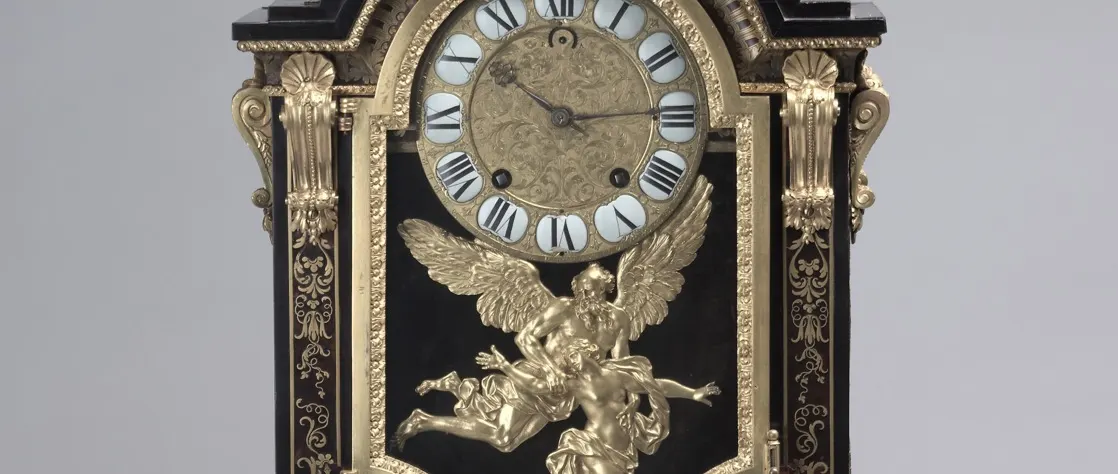
The Cleveland Museum of Art holds a French clock made around 1695 by André-Charles Boulle, with the timekeeping mechanism attributed to Balthazar Martinot II. More than a metre high, at 113.7 centimetres, the object combines a dark tortoiseshell ground, brass inlay and gilt bronze. Its decorated structure rises through several different levels towards an urn. Two sphinxes occupy projecting platforms beside the main composition. Clocks of this scale could make a substantial contribution to the appearance of a room rather than function merely as convenient instruments for telling the time.
The Cleveland example is especially interesting for owners of fine art and furniture because it brings several different kinds of specialist work into one object. The clockmaker's mechanism has been incorporated into a cabinetmaker's architectural composition. The decoration provides a means of experiencing the relationship between those elements. Its physical size and historical materials should also make clear that it is more relevant as a subject of collecting and design study than as an object to be introduced casually into a contemporary yacht interior.
Boulle’s position in late-seventeenth-century France
Boulle was appointed cabinetmaker to Louis XIV in 1672 and became one of the prominent specialists working in the French decorative arts of the period. His approach to furniture is particularly associated with marquetry incorporating brass and tortoiseshell. The effect could be highly distinctive because the contrasting materials allowed closely related ornamental shapes to be developed against a surface with a different visual character.
The Cleveland Museum identifies the clock with Boulle and Martinot rather than treating its decorative and mechanical work as the product of a single undifferentiated workshop. That distinction provides a useful starting point for examining the object. Developing a substantial case requires expertise in the organisation of materials and the structural arrangement of the furniture. Designing and making a clock mechanism requires another set of skills. Their integration is central to the completed work.
For an owner commissioning a modern object containing a mechanism, a similar division of responsibilities may be appropriate. An artist might develop the visual character of the instrument, while another specialist addresses its construction and operation. Their work needs to be coordinated from the beginning rather than attempt to fit a delicate technical component into a case designed without knowledge of the relevant requirements.
Marquetry and the contrast of materials
Marquetry involves the introduction of decorative patterns into or across a surface through the arrangement of different materials. Boulle's work is particularly associated with the use of patterns in dark shell and metal. The precise lines of the decorative composition can become more or less visible according to the light falling upon them. Reflections from the brass create a different experience from the appearance of the surrounding darker material.
The surface also has a relationship to the underlying object. A pattern developed for a broad flat panel may need to change as it approaches an edge or a narrower part of the construction. The design is not necessarily a single image repeated unchanged across every area. The maker can guide the viewer between the larger masses and the individual details by adjusting the density and direction of the ornament.
Historical tortoiseshell is material derived from protected wildlife. Appreciation of the original should not become a recommendation to obtain it for a new commission. Any proposed transaction or international movement of an existing object incorporating such material requires specialist examination of the law and applicable documentation. Modern makers can develop distinctive contrasts using lawful alternative materials, without treating the reproduction of the historic material combination as necessary to the achievement of a high-quality design.
Sculpture and the organisation of the case
The clock's gilt-bronze elements introduce a sculptural dimension to the relatively fine inlaid decoration. The figures and projecting platforms influence the outline of the object as well as its appearance when seen closely. The circular dial occupies a position within that broader arrangement. It is not simply set into an undecorated panel occupying the entire upper surface.
These relationships create several distinct scales of observation. At a distance, a person entering a room may recognise the outline and principal divisions of the case. Moving closer makes the smaller sculptural elements and patterns easier to examine. The object provides an example of how a complicated design can still retain a recognisable structure when viewed from different positions.
Contemporary designers sometimes face the problem of giving an instrument sufficient presence without overwhelming the room in which it is situated. Boulle's approach is a historical example of a particularly ambitious response to that problem. A modern commissioned clock need not have equally elaborate decoration. Its case can nevertheless be considered architecturally, with attention to the way the instrument is approached and the proportions of its surroundings.
Martinot and the scientific interest of timekeeping
The museum describes the clock as incorporating a pendulum mechanism and a barometer. At the date assigned to the object, the development of pendulum clocks had helped transform the possibilities of mechanical timekeeping in Europe. The inclusion of a barometer added another kind of observation to the instrument's intended functions.
The two components also give the sculpture and marquetry a particularly interesting context. They surround mechanisms designed to indicate physical phenomena. The clock's period of origin makes that relationship significant because the combination of scientific instruments and expensive cabinetmaking could express the intellectual as well as the commercial resources of an owner.
That historical importance should be distinguished from the present condition of the instrument. A collection record identifying the mechanism does not establish that it currently operates or that its components retain their original performance. Collectors should have antique timepieces examined by appropriately qualified horological specialists before attempting to wind, adjust or otherwise operate them. The museum's documentation is not a set of operating instructions and should not be used as such.
An inscription concerned with the passage of time
The lower part of the case carries the Latin words Dirigit atque movet. Cleveland offers an interpretation connecting the phrase with time's continuous movement. The placement of such an inscription adds another layer to the object: the owner is invited to consider time not only as information given by the dial but as a subject capable of reflection.
The effect differs from that of an ordinary manufacturer identification placed on a contemporary product. The words form part of a larger arrangement of instrument, case and sculptural ornament. They help establish an association with the purpose of the object without having to provide a literal written description of every feature.
An owner commissioning a personal clock today might find a different way of introducing such an association. A discreet dedication or reference to an important event can acquire significance over a long period. The placement and scale of an inscription can influence the manner in which it is encountered. A maker can consider whether the words should be visible throughout ordinary use or reserved for people examining the object closely. The purpose is to create an appropriate relationship with the intended owner rather than imitate the language of the historical clock without understanding its context.
Why a historical pendulum clock belongs ashore
A mechanical pendulum clock depends on conditions distinct from those normally encountered aboard a moving yacht. The motion of the vessel and the changing orientation of its structure can affect the behaviour of such an instrument. A substantial cabinet also introduces significant questions concerning load, restraint, access and the protection of fragile decorative elements. The Cleveland clock is not an example of a marine chronometer and should not be understood as an appropriate navigation instrument.
An owner of a luxury yacht between twelve and twenty-four metres can nevertheless appreciate the historical relationship between fine clocks and interior architecture without introducing a large antique onto the vessel. A suitably designed contemporary timepiece might provide a visual focal point in a private study, while the underlying movement is chosen according to the conditions in which the object will actually be used.
Any installation should be considered with the relevant yacht specialists. A heavy case or an elaborate decorative surface cannot be regarded as suitable solely because its dimensions appear compatible with an available position. Fine historical examples may be best preserved in a properly controlled collection ashore. The modern yacht commission provides an opportunity to develop independent craftsmanship around a technically appropriate instrument.
Viewing the Cleveland clock as a complete artistic work
The object entered the Cleveland collection in 1967 as a gift commemorating the fiftieth wedding anniversary of Emery May Holden Norweb and Raymond Henry Norweb. It is recorded in gallery 215, with the accession number 1967.153. Prospective visitors should confirm its current display before planning a visit.
The clock rewards an approach that does not separate its appearance entirely from its purpose. The relationship between an identifiable maker of furniture and a named clockmaker, the combination of sculpture and fine surface detail, and the inclusion of two types of instrument all contribute to its significance. A present-day collector may choose to approach the study of a fine clock through those different aspects rather than consider its value exclusively through its external ornament or the reputation of a particular maker.
Sources and photograph
Source documentation: https://www.clevelandart.org/art/1967.153. Photograph: Clock, c. 1695 — Cleveland Museum of Art, Clock, c. 1695, Gift of Family and Friends in honor of Emery May Holden Norweb and Raymond Henry Norweb on their fiftieth wedding anniversary 1967.153; CC0 Open Access.. Resized for web display under CC0 1.0.