Fabergé beyond the celebrated imperial eggs
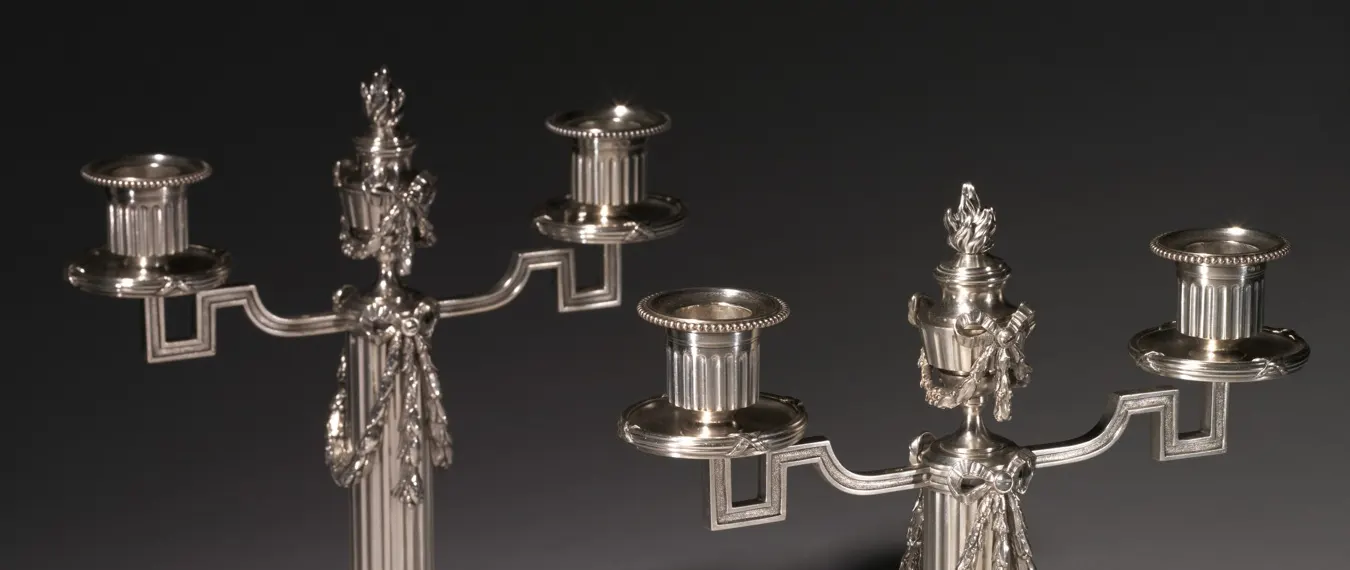
A pair of silver candelabra in the Cleveland Museum of Art demonstrates a less familiar aspect of the House of Fabergé. Dated to 1887–90, the objects are attributed to the firm and its workmaster Julius Alexandrovitch Rappoport. Each has a fluted upright, an ornamented circular base and two projecting arms carrying candle holders. Their dimensions, recorded as 28.5 by 25.1 by twelve centimetres, suggest a purpose different from that of the monumental silver associated with the ceremonial furnishing of large residences. The museum proposes that they may have been used in comparatively intimate surroundings.
The pair offers an especially interesting subject for an owner who appreciates fine silver as part of a personal collection. Its decoration has a relationship with the intended use of the objects. Their scale and the organisation of the projecting arms matter to the way they might occupy a table. Studying them can therefore provide a more considered starting point for modern hospitality than simply seeking objects bearing a celebrated maker's name.
The contribution of a specialist workmaster
The historical House of Fabergé developed a workforce incorporating specialist makers and a system of workmasters responsible for different aspects of its production. Cleveland identifies Rappoport as the master associated with the pair, rather than attributing the complete process generically to Peter Carl Fabergé. The distinction is valuable in understanding a jewellery and decorative-arts enterprise whose reputation depended on the expertise of numerous individual people.
The museum's collection record assigns the pair to St Petersburg within its culture classification, while its description associates the manufacture with Rappoport's work in Moscow. These two entries should be read with appropriate caution. The catalogue is useful for establishing the attribution to Fabergé and Rappoport, but its wording does not provide a consistent basis for claiming one precisely verified place of manufacture. Further specialist documentation would be needed to resolve that question.
When commissioning contemporary silver, a patron can establish the identities and responsibilities of the people actually making it. A design developed by one person may be executed by another. Appropriate documentation of both roles can add to a collection's history and help give proper recognition to the specialist craft represented by the finished object.
Neoclassical ornament on a relatively compact object
The pair draws on the neoclassical style, which the museum identifies as experiencing renewed interest during the late nineteenth century. Its columns, repeated fluting, symmetrical arms, ornaments and draped details establish a recognisable visual organisation. The decoration does not require the use of a large range of coloured materials, because the modelling of the silver itself provides changing relationships between light and shade.
This is particularly interesting when the objects are considered together. Repeated shapes establish continuity across two separate candelabra, while the position of each object in a room changes the way its surfaces respond to the surroundings. A reflection in one piece may not reproduce precisely the reflection in its partner. A symmetrical pair therefore need not create an entirely static impression.
A contemporary designer may develop a coordinated group of table objects according to a similar principle. The individual pieces can possess a coherent relationship without requiring every vessel to repeat exactly the same decorative motif. Differences in height, orientation and the extent of polished surface can introduce variation while retaining a common design language. This can be more appropriate to an intimate setting than attempting to fill it with numerous substantial articles of silver.
Considering the distribution of objects on a table
Candelabra introduce both a vertical and a horizontal element into the organisation of a meal. Their stems raise the sources of light above the table, while the projecting arms determine how far the arrangement extends across adjacent places. For the design to be effective, its proportions need to be considered in relation to the people sitting around it.
A table decoration may look impressive when viewed from the entrance to a room, but have a quite different effect upon the guests when seated. A tall object can interrupt the view of another person or occupy space needed during service. A comparatively low or narrow piece may create a more appropriate arrangement in certain circumstances. The suitability of the object depends partly on the dimensions of the actual table and the anticipated number of people.
The Cleveland silver should not be treated as an established model for every dining setting. Its compact proportions offer a reason to consider the role of small architectural objects during a meal, not a universally applicable dimensional prescription. A contemporary commission can begin with a study of the place settings, the routes used by the people serving the food and the manner in which the owner wishes the guests to interact.
Silver as a material for reflected light
Polished silver can produce an appearance considerably influenced by what surrounds it. The material reflects the light falling on its surfaces, while relief and changes in curvature introduce differences in the reflected pattern. Fine ornament may become visible in some lighting conditions and less apparent in others. The shape of the candelabra is therefore inseparable from the visual qualities of the metal.
A person choosing new silver for a private collection can examine the effect of different finishes and degrees of surface detail. A severely polished area may have a particularly strong relationship with the objects or sources of light nearby. A textured or matte area can respond differently, giving the designer opportunities to develop contrast within a single material. The object's position within the intended room can influence the appropriate choice.
These qualities should be distinguished from the physical condition of an antique silver piece. Old surfaces may preserve evidence of manufacture, handling and subsequent intervention. Repeated polishing can alter details. Before attempting to renew an important historic object, the owner should seek advice from an appropriately qualified metals conservator who understands the construction and significance of its particular surfaces.
Provenance and identifying a complete pair
Cleveland records the candelabra as part of the India Early Minshall Collection. The museum received them in 1966. Its published bibliography includes several studies addressing Fabergé and the collection, providing a path for readers interested in examining the objects beyond a brief identification of their maker.
The provenance of the pair before the documented period of Minshall's ownership is not fully identified in the online record. Collectors should distinguish such gaps from an established history. The fact that the museum possesses a particular example does not establish that another superficially similar pair has the same background.
A purchaser evaluating historic silver can obtain a specialist examination of the marks, construction, decorative details and condition of both pieces. A pair carries questions beyond those associated with a single object: it is important to establish the relationship between its members and whether any parts have been substituted or substantially altered. Documentation should also record any restoration known to have been undertaken.
Nothing in the museum's identification of these objects establishes a current financial value for them or a comparable pair. A contemporary buyer should seek independent advice based on the actual pieces offered and their documented histories.
The distinction between historic candlelight and modern yacht hospitality
The candelabra belong to a tradition in which candles served a practical and decorative role. Using open flames aboard a yacht introduces serious fire and operational concerns. A historical candle holder should not be brought into service merely because its scale appears appropriate to the dining area. The vessel's safety arrangements and the directions of the responsible crew take precedence over any decorative precedent.
A modern designer can explore other ways of introducing the visual quality associated with small sources of light. Appropriate flameless alternatives, or suitably designed electric fixtures, may allow a table arrangement to develop an individual character without introducing the particular risks associated with candles. The actual electrical and material requirements of any fitting must be addressed independently.
An owner who values original silver may prefer to maintain an important collection ashore and commission new objects specifically for the yacht's dining environment. The maker can examine the available space, the method of securing and storing the pieces and the way they will be incorporated into ordinary service. The relationship between decoration and practical use, rather than literal reproduction of the old lighting method, is the relevant principle to carry forward.
An example of fine craftsmanship at the scale of private life
The Cleveland collection identifies the pair in gallery 211, devoted to Fabergé, under accession 1966.494. Visitors intending to study the originals should check their current display. The museum's open-access photograph provides an opportunity to examine the individual pieces and the relationship between them.
The attraction of Rappoport's candelabra lies in their demonstration that an object created within a renowned luxury enterprise need not be conceived around the most conspicuous forms of ceremony. It can instead respond to the dimensions and character of a relatively personal activity. The restrained scale, coordinated composition and detailed silverwork make the pair an especially instructive precedent for collectors who value the experience of craftsmanship in everyday surroundings.
Sources and photograph
Source documentation: https://www.clevelandart.org/art/1966.494. Photograph: Pair of Candelabra, 1887–90 — Cleveland Museum of Art, Pair of Candelabra, 1887–90, The India Early Minshall Collection 1966.494; CC0 Open Access.. Resized for web display under CC0 1.0.