An object conceived around the act of writing
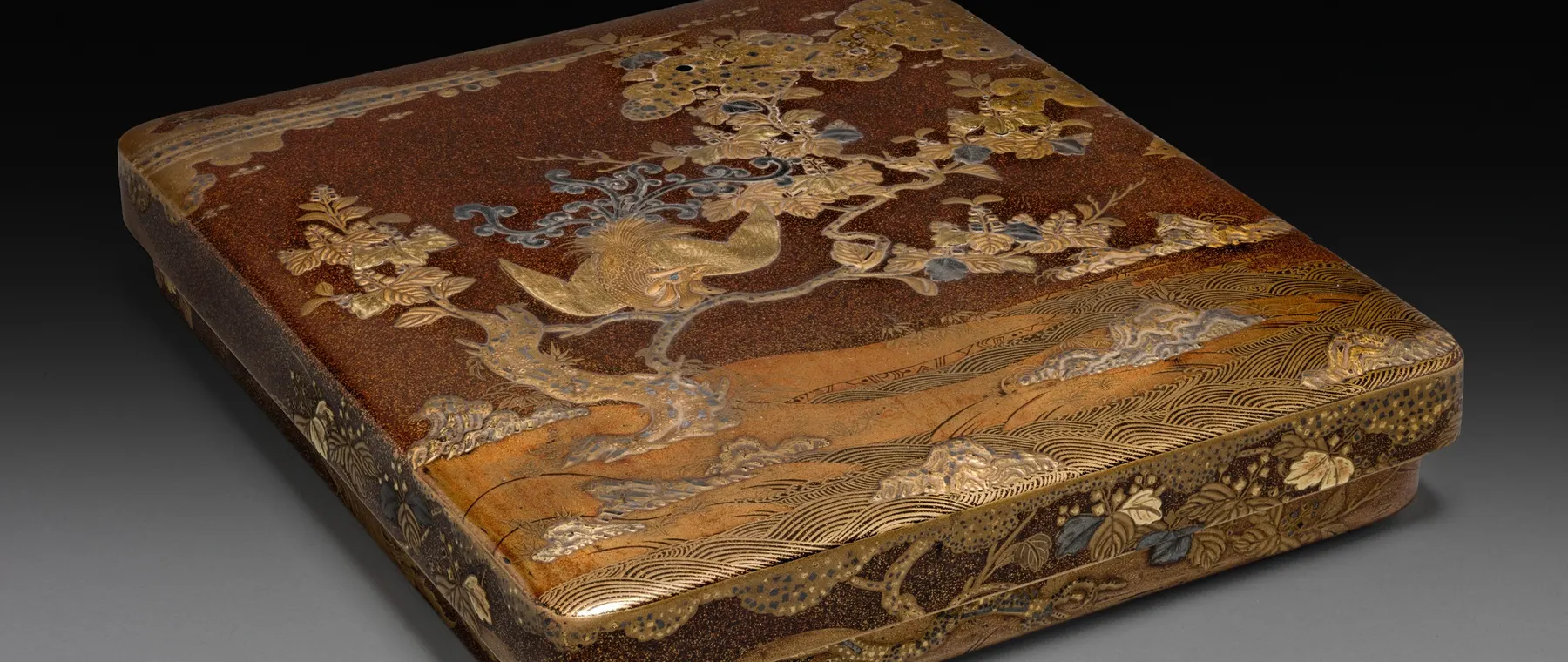
A late-sixteenth-century Japanese writing box in the Cleveland Museum of Art provides an accomplished example of the relationship between personal objects and artistic craft. The museum dates the box, accession 2016.34, to the Momoyama period and records its dimensions as four by 20.5 by 23.5 centimetres. Wood forms its underlying structure, while lacquer, gold and silver powders and metal foil create the ornament. The external design represents a phoenix in a paulownia tree. Inside, a moonlit autumn landscape with chrysanthemums introduces a markedly different atmosphere.
For owners interested in fine objects for a private study, the box is particularly interesting because its shape and decoration are directly related to an activity. A suzuribako was developed to hold equipment for calligraphy, including brushes and the materials required to prepare ink. The object was neither simply a painting nor a container whose appearance was unrelated to its contents. Its decoration made a repeated practical action into an occasion to experience the skill of the maker.
Two designs revealed in succession
The outer arrangement is associated with a mythological bird that has a long tradition of symbolic importance in East Asia. The Cleveland catalogue explains the phoenix's association with the paulownia tree and with imperial authority. The interior presents a different visual experience, one connected to contemplation of an autumnal night rather than the celebratory character of the external motif.
The distinction is meaningful because the two designs are not normally encountered at the same time. Opening the box changes the aspect of the object visible to its owner. Instead of trying to communicate the same character across every surface, the artist has organised the appearance of the piece in relation to the sequence of its use.
A contemporary maker producing a writing case or personal cabinet can explore a comparable principle through original imagery. A restrained exterior may conceal a carefully developed lining, or an expressive outer design may give way to a subtler surface on the inside. The quality of the object arises through the transition between those states as well as through its individual decorations. The actual historical meaning of the phoenix motif should remain distinct from any modern personal symbolism selected by a commissioning client.
Maki-e and the physical character of the surface
The museum records both sprinkled metallic powder decoration and the application of gold and silver foil. The Japanese term maki-e encompasses techniques in which finely prepared decorative particles are introduced into a lacquer design. The catalogue specifically identifies nashiji, associated with the speckled appearance of a pear skin, and takamaki-e, a relief form of sprinkled decoration. These techniques permit several different kinds of visual effect on a surface that might otherwise appear relatively flat.
Gold and silver can introduce contrasting qualities of light, and the depth of the decorative forms may become more noticeable when the object is examined from a different position. A viewer encountering an image online should recognise that the photograph provides only one representation of these changes. The physical object may have a much more varied response to its surroundings.
The work involved in developing such a finish is an important part of its value. Its appearance depends upon the preparation of the underlying material and the sequence in which the subsequent elements are applied. A modern commission employing lacquer should be discussed with a specialist maker who understands the actual system proposed. The choice should take into account the conditions in which the resulting object will be kept and whether it will be subject to frequent handling.
Calligraphy and the arrangement of tools
The writing box was conceived for an array of implements rather than an arbitrary assortment of small possessions. Traditional calligraphy involves brushes, ink and an inkstone, and the associated equipment must be arranged so that it can be used effectively. The dimensions and compartments of the box reflect that purpose.
The Cleveland collection includes another example, accession 1969.124, dating to the fifteenth century, with pine, bamboo and camellia imagery. The catalogue records its retained inkstone and water dropper, the latter ornamented with a design related to the winter and early-spring theme of the lid. The relationship between a tool and its container is therefore evident not only in the main object but in the coordinated appearance of the equipment within it.
For a contemporary owner who enjoys keeping a journal during a yacht journey, a specially made case can be developed around the writing instruments actually used. It need not reproduce the tools of historical Japanese calligraphy. The selection of paper, pen, notebook or other material can establish the required dimensions before the decorative design is considered. A box whose contents can be removed and returned in an uncomplicated manner may contribute more to the pleasure of writing than a larger ornamental object lacking a defined function.
Choosing an interior design that belongs to its owner
The historical box offers a useful precedent for thinking about the relationship between an individual possession and the room in which it is used. Fine objects selected for a private cabin may express interests and associations not necessarily represented throughout the principal reception areas of the yacht. The significance of the object may be known to the owner even if it is not immediately apparent to visitors.
A successful modern commission can be developed around those particular circumstances. A traveller might wish to record a family association, a coastline or the character of a destination without depicting it through a conventional landscape painting. A specialist artist could explore that idea through the subtle arrangement of colours and materials within a writing box. The owner can decide which references should be visible externally and which should emerge only during use.
There is an important distinction between drawing inspiration from the way a historical work is organised and copying its culturally significant motifs. A phoenix-and-paulownia design belongs within a particular tradition of imagery. The contemporary client can instead encourage the maker to develop an independent interpretation that reflects the actual purpose of a new commission.
The limits of displaying historic lacquer aboard
Historical lacquered wood may be sensitive to environmental conditions. Its underlying wooden structure and the applied decorative layers form a composite object, whose individual materials can respond differently to changes in the surroundings. The preservation of such a piece should be considered with a conservator who can examine its actual condition.
A yacht between twelve and twenty-four metres may experience variations in temperature, illumination and humidity during successive phases of a voyage. A valuable original should not be introduced without considering those conditions and the physical protection of the object. The practical need to secure the contents of a drawer or cabinet also has a significance distinct from the appearance of the historical object when displayed ashore.
For an owner principally interested in using the writing case during travel, a modern purpose-built version may be more appropriate than an original dating to the sixteenth century. Its dimensions and construction can be considered in relation to the available storage and the yacht's anticipated operating conditions. Specialist advice should guide the choice of materials and finishes. A recent commission can fulfil its own functional and artistic purpose without placing an old cultural object at unnecessary risk.
Commissioning storage with attention to the sequence of use
In an ordinary furniture arrangement, storage is often assessed according to its total capacity. A smaller personal object calls for a more detailed assessment. A pen or brush used most frequently may deserve a particularly accessible position, while other equipment can be kept in separate parts of the case. The interior arrangement should accommodate the dimensions and handling requirements of the intended contents.
A client can discuss the sequence of operations with the maker: opening the case, selecting the equipment, putting it to use and returning each piece. That process may reveal unnecessary complexities in an original design proposal. It can also identify opportunities to introduce subtle decorative details that become visible at particular moments.
The same consideration applies to the position where the case is used. A desk aboard a yacht should be assessed in relation to the person occupying it, the available illumination and the relevant practical requirements for keeping objects secure. A well-designed case can complement that arrangement rather than impose an entirely separate set of demands upon the room.
A documented object rather than an anonymous luxury motif
The Phoenix Writing Box entered Cleveland's collection through the Leonard C. Hanna Jr. Fund. The collection record does not currently assign it to an individual named maker or identify it as being on view. Those limitations should be respected: its existence in the museum's collection does not establish that a visitor can encounter the original on a particular day.
Its open-access image and catalogue provide a valuable opportunity to study the documented object and the relationship between its external and internal decoration. The significance of the box derives from the way its craft forms part of an ordinary human activity. Its elaborate imagery is not simply an addition to a useful container, but an integral part of the experience of opening and using it. For the contemporary traveller, the most enduring inspiration may be the possibility of making a small private routine more meaningful through an object conceived with comparable care.
Sources and photograph
Source documentation: https://www.clevelandart.org/art/2016.34. Photograph: Writing Box (Suzuribako) with Phoenix in Paulownia, late 1500s — Cleveland Museum of Art, Writing Box (Suzuribako) with Phoenix in Paulownia, late 1500s, Leonard C. Hanna Jr. Fund 2016.34; CC0 Open Access.. Resized for web display under CC0 1.0.