A different side of Tiffany’s glasswork
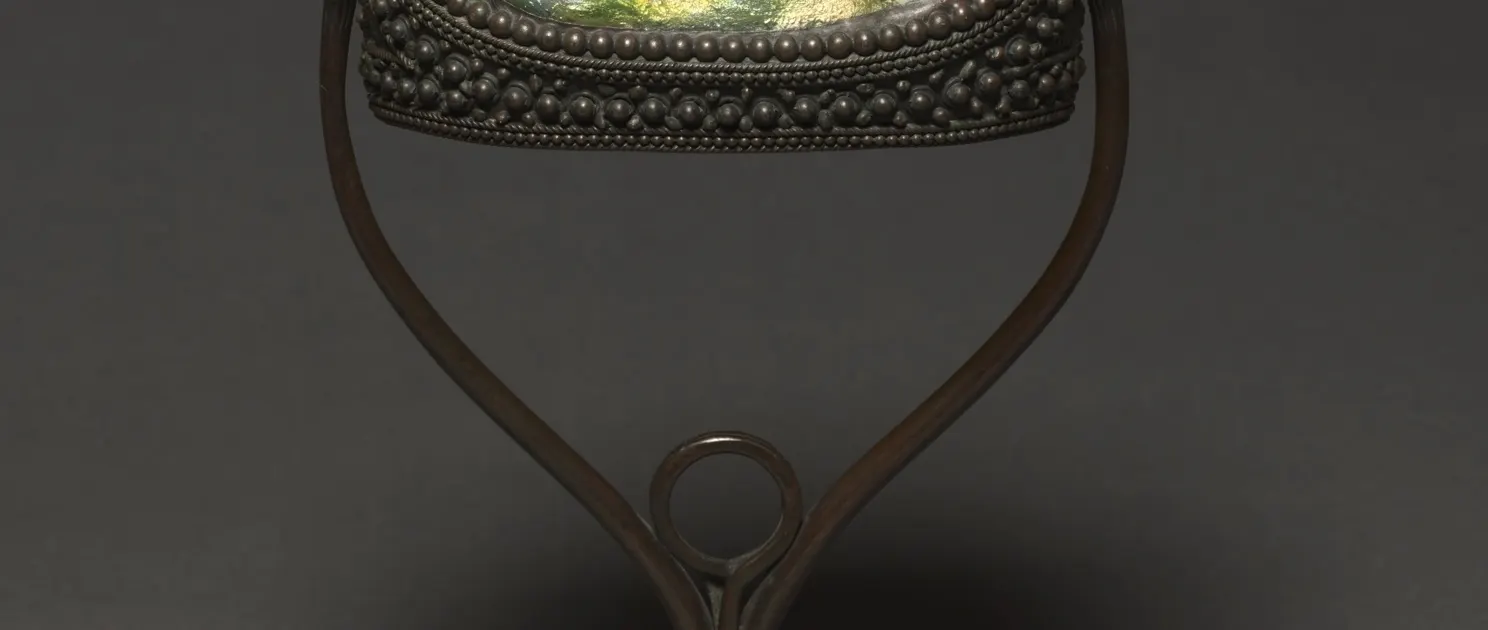
The Cleveland Museum of Art’s Turtleback Reading Lamp, made between approximately 1895 and 1902 by the Tiffany Glass & Decorating Company, belongs to a particularly interesting category of American decorative arts: small electric lamps conceived for individual use. Measuring 35.6 centimetres high, the lamp combines bronze with Favrile glass. A green and yellow iridescent shade is supported by curved bronze arms, while the base carries small dark green glass elements and raised ornament. It is currently recorded in gallery 209, dedicated to Tiffany.
The attraction of this comparatively modest object is distinct from that of the immense stained-glass commissions traditionally associated with Louis Comfort Tiffany. Its intended purpose was to illuminate a reader's immediate surroundings, making the quality and direction of the light relevant to its design. For an owner planning a private cabin or saloon, the lamp offers a historical example of how a single carefully composed source of illumination can participate in the character of a room. It does not need to dominate the entire architectural scheme.
From monumental windows to personal possessions
By the turn of the twentieth century, Tiffany’s firm had extended its activity into a variety of smaller decorative objects. The museum identifies desk accessories, clocks, boxes and candlesticks alongside lamps among the products developed for this market. The important distinction was their intended scale of use. A window might transform the light within a church or a large residence. A small lamp would instead occupy the space beside a book or writing surface.
The move towards smaller objects did not remove the need for artistic decisions. The designer had to consider how different materials would relate to each other within a restricted physical area. A relatively small change to the profile or colour of an individual element could alter the whole impression of the finished piece. Its closeness to the user also made the treatment of its surface especially important.
This emphasis on personal possessions remains relevant to a contemporary client who has limited space within a yacht. A reading lamp may be one of the objects encountered most frequently during a stay aboard. A well-developed commission can have an impact disproportionate to its size because it participates in a repeated activity rather than an occasional ceremonial display.
The turtleback analogy
Tiffany used the name turtleback for irregularly shaped pieces of cast glass whose textured appearance suggested the surface of a turtle shell. The designation describes the resemblance of the glass rather than its biological composition. In the Cleveland example, the oval upper form is framed in bronze, while rounder glass components introduce colour into the lower portion of the design.
The interest of the approach lies partly in the distinction between a recognisable visual reference and a literal representation of its subject. A designer may take inspiration from the character of a natural surface without reproducing a complete natural object. The way a form responds to light can be as significant as its outline, particularly when the object itself incorporates a source of illumination.
A contemporary glassmaker could independently investigate that principle by developing a texture whose character changes in response to the direction and intensity of light. The intention need not be to imitate a historic Tiffany product. The maker can develop an original design related to the actual location and the way the individual lamp will be experienced.
The frame as an independent decorative element
Two curved bronze supports rise to hold the shade of the Cleveland lamp. The central stem and ornamented base develop a relationship with those supports, giving the metal structure a visual identity independent of the glass. The repeated rounded and curved elements soften the appearance of what is, at its most basic level, a mechanism for placing a light source at an appropriate height above a surface.
The visible relationship between the metal and glass demonstrates an important characteristic of decorative lighting. A fitting can be considered through both its daylight appearance and the effect produced once the light is switched on. During the day, the frame and glass are experienced as an assembly of physical materials. When illuminated, the shade may become more prominent and the relative importance of particular details changes.
A designer specifying a new fitting can examine those two states separately. A feature that appears visually discreet when unlit may become a significant source of colour when illuminated. Equally, a piece intended to provide relatively neutral functional lighting may have an especially interesting character in daylight. The intended role of the lamp should determine the balance between those effects.
Another perspective on Tiffany’s reading lamps
A separate object in the same museum collection, the Nautilus Reading Lamp, accession 1997.298, dates to approximately 1899–1902. Its maker also used bronze and leaded glass, developing a shade whose form evokes a nautilus shell. The museum relates the design to Tiffany’s presentations in London in 1899 and Paris in 1900. Later versions could incorporate an actual shell and a different sculptural stand.
The comparison is valuable because each lamp addresses the relatively new technology of electric illumination through a different natural analogy. Neither is principally an attempt to conceal the existence of the lamp behind the architecture of the room. Instead, the technology is given an identifiable material and artistic character.
That approach offers a useful alternative to the assumption that contemporary lighting should always disappear into a ceiling or piece of cabinetry. Concealed lighting can be effective in some circumstances, but a visible object can introduce a distinct scale and quality to a room. The most appropriate arrangement may include both forms. A reading position can benefit from an independent light while the wider interior uses integrated illumination to establish a comfortable background.
Preserving the original object and its technology
A collector considering an early electric lamp should recognise that its artistic and technical history may not be identical. The visible bronze and glass may survive in a particular state while the electrical fittings have undergone replacement or modification. An existing cable is not evidence that the lamp can be safely connected to a modern installation. Original electrical equipment should be assessed by appropriately qualified specialists before any attempt to operate it.
Conservation decisions may involve a balance between preserving historically significant material and achieving safe operation. A museum can exhibit an object without using it in the way its original owner did. A private collector may likewise prefer to preserve an important lamp as an inactive object. A contemporary fitting developed in collaboration with an artist may offer a more appropriate solution where actual daily service is required.
Technical suitability is especially important aboard a vessel. The applicable electrical system, mounting arrangement and materials must be evaluated for the marine environment. The Cleveland lamp is presented here as a documented work of decorative art, not as a recommendation to install an antique electrical device aboard a yacht.
Designing a reading space aboard
The layout of a yacht between twelve and twenty-four metres may place a reading chair or a berth close to a window, a storage compartment or the principal circulation route. That situation can make the selection of a light more significant than its initial appearance in a decorative catalogue suggests. The light source should suit the actual position of the reader and the relationship between the book and other nearby surfaces.
In a new project, the interior designer can work with the relevant technical specialists to establish the location of a fitting and its intended controls early in the layout process. A fitting used during the evening may need to provide appropriate light without disturbing other occupants. Reflections in a window or a highly polished surface can influence the selection of its position. The effects of those reflections may change when the surrounding exterior becomes dark.
If the owner wants a more sculptural object, its construction can be developed around these practical requirements. An individual glass shade or crafted metal enclosure can provide a distinctive element without interfering with access, safe passage or the subsequent maintenance of the vessel. The relationship between artistic form and technical purpose is precisely what makes the early Tiffany lamps interesting as precedents.
Studying the lamp in Cleveland
The museum records the Turtleback lamp as the bequest of Charles Maurer. The accession number, 2018.287, provides a direct reference to its documented collection record and open-access image. Its current location is identified as gallery 209. Visitors interested in seeing this specific object should confirm its display and the museum's opening arrangements before making a journey.
The lamp rewards observation at the comparatively small scale for which it was devised. The contrast between bronze and glass, the visual relationship between the shade and the base, and the way the structure supports the light together establish the character of the design. These qualities remain meaningful independently of the original electrical technology. They help explain why the development of an individual object for an everyday activity can be as rewarding as the creation of a far more elaborate interior.
Sources and photograph
Source documentation: https://www.clevelandart.org/art/2018.287. Photograph: Turtleback Reading Lamp, c. 1895–1902 — Cleveland Museum of Art, Turtleback Reading Lamp, c. 1895–1902, Bequest of Charles Maurer 2018.287; CC0 Open Access.. Resized for web display under CC0 1.0.