A town at the head of an intricate coastal landscape
Vannes combines the architectural character of a preserved medieval town with the maritime landscape of the Gulf of Morbihan. Brittany Tourism describes a city in which the old ramparts, pedestrian streets, contemporary galleries and markets are within reach of the port. For the owner of a yacht between twelve and twenty-four metres, that concentration of attractions makes a longer stay particularly attractive. Guests who want to spend a day investigating the town's cultural life need not travel far from their accommodation, while others may choose an excursion towards the gulf. The yacht's operating arrangements require a separate assessment. The inland position of the town's marina and the configuration of the surrounding waters mean that its capacity for a particular vessel cannot be inferred from an ordinary photograph or tourism map. Contact the facility responsible for the intended berth and confirm the requirements of the individual yacht before setting a passage schedule. A shore visit from another suitable base remains an alternative if the town itself cannot accommodate the vessel.
The ramparts and the gardens of a fortified city
Brittany Tourism identifies the ramparts walkway and gardens among Vannes's principal visitor attractions. Their arrangement gives a distinctive perspective on the relationship between a defensive enclosure and the town protected by it. From outside the walls, visitors can consider the overall scale and structure of the historic fortifications; from within, the experience changes to narrower streets and the smaller spaces created by individual buildings.
A town garden beside historic stonework is a particularly interesting subject for anyone interested in landscape design. Plants and trees introduce seasonal variation to an environment dominated by permanent architecture. The two elements need not compete visually. A considered walk provides the opportunity to observe how the scale of the vegetation affects the appearance of the walls and how views open as the visitor moves between the paths. Check current access and maintenance arrangements before assuming that every section is accessible. Those who prefer a gentle excursion can select a shorter route and spend more time appreciating the details of the setting.
Place Henri IV and the half-timbered buildings
The historic centre's half-timbered houses and Place Henri IV provide another aspect of Vannes's architecture. Timber structures, rendered infill, the arrangement of openings and decorations at street level together create a streetscape quite different from the solid granite walls of the fortifications. A walk can be organized around the observation of such structural and decorative relationships rather than simply identifying individual famous houses.
Owners with an interest in the restoration of buildings or yachts may appreciate that a traditional material needs to be understood in relation to the conditions in which it is used. Timber exposed to the atmosphere of a historic street may have quite different requirements from wood fitted within a modern yacht's accommodation. Maintenance and the preservation of significant features are nevertheless meaningful concerns in both environments. A guided town walk may provide useful historical context for the different stages of construction and conservation. Many of the buildings are occupied properties, so their external character should be appreciated from suitable public areas. Do not assume that entry to interiors is available unless a specific arrangement has been confirmed.
The Danielo Rotunda and changes in architectural taste
The northern side of the cathedral of Saint-Pierre contains the Danielo Rotunda, also known as the chapel of the Holy Sacrament. Brittany Tourism identifies this circular chapel as an exceptionally early French example of Renaissance architecture. Its relationship with the larger cathedral offers an interesting illustration of the way different architectural traditions can coexist within one religious complex.
An owner who normally encounters Renaissance-inspired ornament as an element of modern design can instead observe how a historical work is organized within its own structural and cultural setting. The form of the chapel, the proportion of its elements and its position relative to the adjoining building are part of that experience. A feature added after the construction of an earlier church can communicate the interests and resources of the period in which it was created. It is more instructive to consider that relationship than to classify the whole cathedral under a single stylistic label. Current visiting arrangements must be confirmed, with respect for services and the continuing religious use of the building. Arrange a specialist guide if the family wishes to explore the architectural history in detail.
La Cohue and the paintings of Geneviève Asse
La Cohue, a medieval hall housing the Museum of Fine Arts, is particularly attractive to visitors whose interests extend beyond historical architecture. The regional tourism authority highlights its contemporary collections and the work of the painter Geneviève Asse, born in Vannes. An exhibition situated inside a historic building can provide a striking encounter between different periods of creative work. The medieval origin of the hall is one aspect of the visitor experience; the way contemporary art occupies those spaces is another.
For collectors, the significance of a painting can emerge through relationships among its colours, the scale of the work and the conditions in which it is seen. A visitor need not be considering a purchase to appreciate these considerations. The experience can also prompt reflection on the different demands of exhibiting work aboard a yacht. A moving vessel requires suitable installation and protection of objects, and may encounter considerable variation in the light and humidity of individual spaces. The museum's own exhibition programme should be consulted beforehand rather than assuming any specific Asse painting will be displayed on the chosen date.
A contemporary cultural programme in an old town
Brittany Tourism describes street art, photography exhibitions at the Kiosque, events at La Traverse and artistic activities extending towards the port. These details are worth including in the itinerary because a preserved medieval town is not necessarily defined exclusively by its past. Artists and cultural organizations working today contribute to its identity in quite different ways from the builders of the older streets.
A family could devote an afternoon to exploring public artwork, followed by an exhibition or performance if the actual programme offers something of interest. Public art is encountered in the context of the street rather than within the controlled conditions of a gallery. The appearance of a work may be influenced by the surrounding buildings, the weather and how people use the space. Check dates directly with the appropriate institution. A listing of cultural venues is not confirmation that a particular performance is taking place during the visit. Guests with different interests can choose separate activities and return to the yacht or another agreed meeting point later.
Market ingredients and the Gulf of Morbihan
The regional visitor guide highlights the markets around Place des Lices and Place du Poids Public. Its account emphasizes the local combination of agricultural produce and seafood, including oysters from the gulf. This is a useful setting for an owner interested in the culinary heritage of Brittany rather than simply seeking formal dining.
A market visit can introduce the family to the seasonality of local ingredients and the businesses supplying them. Actual origin and availability should be discussed with the seller rather than inferred from a regional description. Oysters and other seafood require appropriate handling and storage, and guests with medical or dietary restrictions should select suitable alternatives. If the yacht's chef intends to use market produce, organize the purchasing trip around the vessel's practical arrangements and the time needed to prepare it. Otherwise, an independent lunch ashore gives guests an opportunity to sample regional dishes without undertaking additional provisioning. The Saint-Patern neighbourhood, identified by Brittany Tourism for its cafes, restaurants and shops, may provide a further setting for an evening in the town.
Exploring the gulf independently of the yacht
The gulf's islands and peninsulas are a major reason to allocate additional time to Vannes. The tourism guide identifies passenger ferries and cycling options towards areas including Séné and Saint-Armel, and describes access to island services from the ferry terminal. These arrangements offer owners the ability to plan shore excursions without expecting a substantial private yacht to use every small landing.
The captain must establish the actual navigational conditions, appropriate tidal information and applicable restrictions for any proposed movement in the gulf. A ferry route is not automatically suitable for a yacht of different dimensions and handling characteristics. Guests who intend to travel by public boat should confirm the departure point, timetable, carriage of bicycles and return arrangements. The Conleau peninsula's seawater pool and waterfront offer another local excursion, subject to actual conditions and access. A future visit during Gulf Week, the biennial gathering described by the tourist board, requires confirmation of dates and specific event arrangements rather than reliance on a previous edition's programme.
An itinerary with room for individual interests
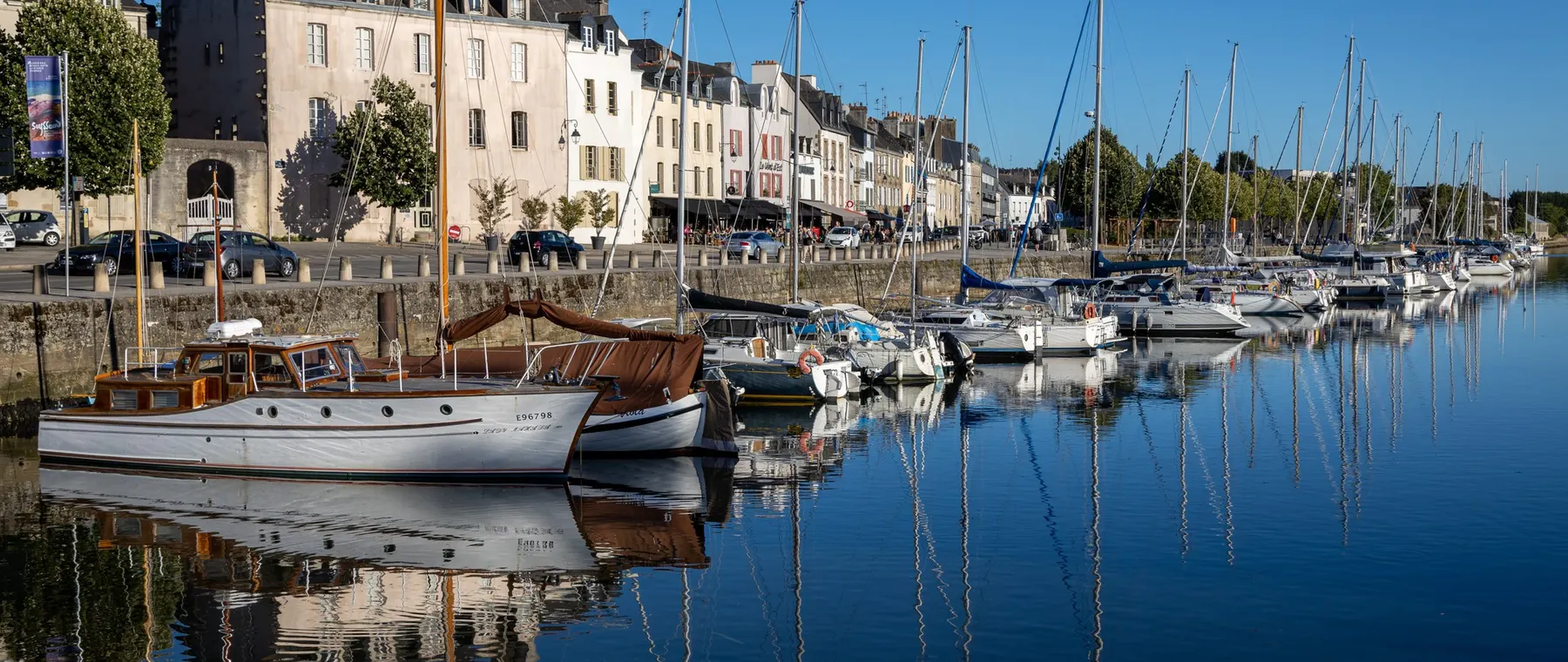
Vannes can be experienced through several separate days: the medieval centre and cathedral, the art museum and contemporary exhibitions, a market visit, and then a chosen excursion into the gulf. High-speed rail connections with Paris give guests another option for joining or leaving the group independently of the vessel. Confirm the current transport arrangements and the yacht's actual berth location before booking transfers. The accompanying licensed photograph by Superbass shows the port of Vannes in August 2022; it is not evidence of current access or capacity. The pleasure of the destination is that the town's architecture and the gulf each deserve time of their own. Rather than make every activity dependent on a nautical itinerary, allow the captain to determine safe vessel movements and give the guests the freedom to discover Vannes at a comfortable pace.
Sources and photograph
Source documentation: https://www.brittanytourism.com/destinations/the-10-destinations/southern-brittany-morbihan-gulf/vannes/. Photograph: Port of Vannes, August 2022 — Superbass / Wikimedia Commons, CC BY-SA 4.0. Resized for web display under CC BY-SA 4.0.