Cornouaille's harbour of contrasts
A visit to Concarneau can unite three different encounters with Brittany: an intensely historic fortified settlement, an active fishing port and a coastline associated with summer sailing. The regional tourist board describes a town of art and history with a compact walled centre, a substantial fishing industry and an important connection with the Glénan islands. For an owner of a privately operated luxury yacht between twelve and twenty-four metres, the question is how to combine those attractions into a stay that has a character of its own rather than treating the town as another marina on a list. Confirm a suitable berth and the practical arrangements for the actual vessel before establishing an arrival date. The presence of many fishing craft does not indicate the availability of a recreational berth of suitable dimensions. Once those needs are addressed, visitors can explore the old town, maritime collections and culinary culture without asking the captain to move the yacht for each activity.
An island enclosed by stone
The Ville Close occupies an island approximately 350 metres long and 100 metres wide, according to Brittany Tourism. Its bridges and entrances provide a striking transition between the contemporary town and the compact streets within the walls. The defensive architecture developed over several centuries. The belfry, sundial and the approaches to the walls are prominent features of the visitor experience. Rather than follow a predetermined route at maximum speed, allow time to understand the relationship between the island and the waterfront beyond it.
The narrowness of the available space is essential to the architecture. Streets, houses, public entrances and the fortified enclosure exist within a much smaller area than would normally be available to a modern development. A family interested in architectural conservation may appreciate the way individual features contribute to a collective appearance. The visitor guide suggests arriving early in the morning during summer to avoid some of the busiest periods. Check current opening arrangements and access to the ramparts, especially for guests who prefer to avoid steep steps. A gentle walk at street level can be equally worthwhile.
Rue Vauban and the inhabited town
Rue Vauban is the principal street through the walled town. Brittany Tourism identifies the narrow side streets, distinctive shop signs and the fountain at Place Saint-Guénolé as features of a walk. The interest lies in moving between the different scales of space. An entrance from the bridge leads into a comparatively confined street, while smaller routes offer glimpses of the water beyond. Half-timbered and gabled buildings recall earlier approaches to urban construction.
The town is not a film set. Businesses operating within its walls need access for staff, deliveries and the people who live nearby. Respect private entrances and do not assume the interior of every historic building is open to visitors. Guests who appreciate independent makers can spend time examining objects, textiles or decorative work rather than simply acquiring souvenirs. Pieces intended for the yacht should be selected with their proper use and storage in mind. A seemingly small fragile object may require careful securing aboard a moving vessel. Conversations with makers about their materials can be as valuable as a purchase.
The fishing industry beyond the walls
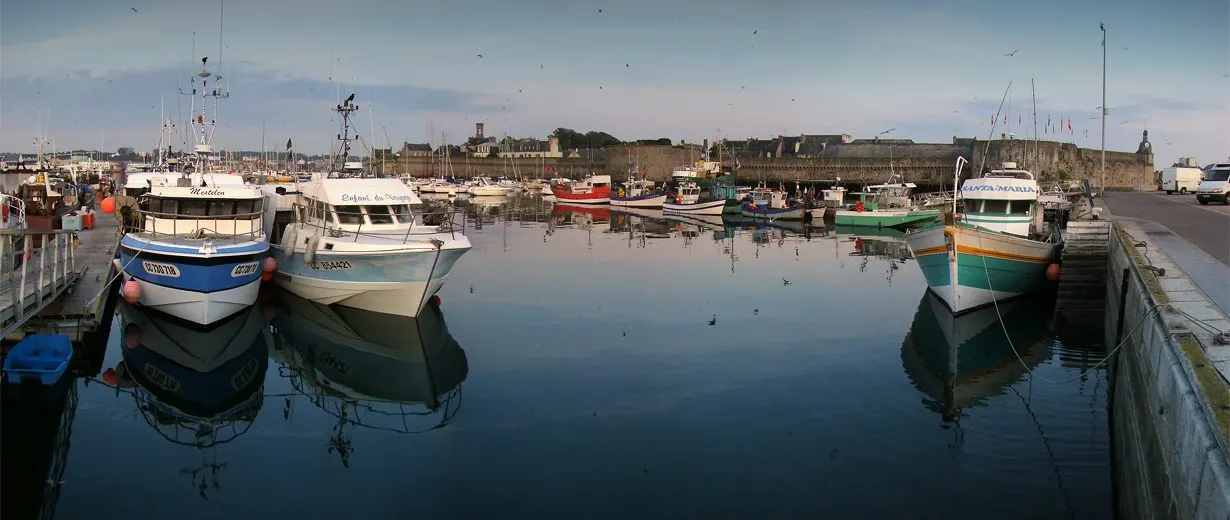
The regional authority describes the extensive fishing activity of Concarneau, including deep-sea and coastal fishing and the fish market. It identifies the town as an important European tuna port. Those statements explain why the docks have a working character quite distinct from the marina. The actual number and types of boats occupying a particular quay will naturally change. Visitors should not treat the tourism organization's descriptions of landing activity or auction schedules as permission to enter working areas.
The fishing fleet is a meaningful part of a maritime visit because each boat's configuration has been shaped by the tasks undertaken aboard it. The arrangement of deck space, equipment, storage and machinery differs from the priorities of a private cruising yacht. A guest who appreciates the engineering of their own vessel may find those differences interesting to observe from appropriate public places. The wider industry also includes people responsible for handling, transport, preservation and sale of fish. Their work is part of the town's heritage, not simply incidental activity taking place behind the visitor attractions.
The Fishing Museum and a vessel's purpose
Brittany Tourism identifies the Fishing Museum within the visitor programme. A dedicated collection gives families the chance to investigate the ways boats and equipment have developed alongside different fishing methods. Consider the connection between an intended task and the object designed to undertake it. On a contemporary yacht, a design decision may concern accommodation, sailing performance or endurance. On a vessel serving a fishery, the working requirements may take precedence over characteristics that private owners take for granted.
A museum offers context that cannot necessarily be obtained by looking at modern boats from the quayside. Objects may illustrate technologies no longer used, and interpretation can explain the social circumstances of the people involved. Confirm the museum's current opening conditions, exhibitions and accessibility. A family whose children have spent several days afloat can make the museum visit an occasion to discuss the different ways that people earn a living from the sea. It need not become a formal lesson; the connections can emerge naturally from observations made during the visit.
Les Filets Bleus and the identity of the community
One of Concarneau's most distinctive traditions is Les Filets Bleus, the festival that originated in 1905 during a period of difficulty for the local sardine fishery. Brittany Tourism explains the original connection with solidarity among fishermen and identifies the annual summer celebration as part of the modern cultural programme. That background gives the event meaning beyond entertainment. It developed from a community responding to circumstances affecting its livelihood.
An owner planning to attend a future edition should obtain dates and programme details directly from the organizers. Large public occasions can affect transport arrangements, restaurant bookings and demand for marine facilities. A shore-based plan can offer flexibility when the yacht's desired arrival is not feasible. The family can participate in public celebrations while respecting the event's local character. Arrange appropriate transfers and avoid putting pressure on the captain to make a passage merely because an event ticket has been purchased. Alternatively, a visit outside festival season offers time to discover the history on which the celebration is based.
Kériolet and a different architectural tradition
Kériolet castle, identified by the tourism authority for its fifteenth- and nineteenth-century heritage and Neo-Gothic architecture, provides a separate excursion beyond the Ville Close. The contrast with the fortified island is instructive. A large residence has a different relationship with landscape, ownership and the movement of visitors from that of a densely enclosed maritime settlement. Architectural details can be considered in the setting for which they were created rather than as isolated decorative motifs.
Owners interested in residential design can look at how materials and spaces communicate a particular identity, while recognizing that an historic building has its own history of alteration. A guided visit may illuminate the decisions behind the building's later appearance. Obtain current visitor information directly and organize suitable land transport. A separate afternoon at the castle can be more rewarding than attempting to fit it into a short interval between arrival and departure from the marina.
The Glénan islands and the coastal itinerary
Concarneau is a departure point for excursions towards the Glénan archipelago. The prospect of clear water and island scenery is attractive to private yacht owners, but the route must be evaluated according to the actual boat and prevailing conditions. A tourism description is not authoritative guidance concerning depths, anchoring or environmental restrictions. Consult current nautical publications and the responsible local authorities before contemplating a passage. An organized passenger excursion can be an excellent alternative for guests if the yacht itself cannot safely use the intended waters.
Walks along the coast towards Sables Blancs provide another means of appreciating the bay. Choose a route according to actual weather, accessibility and the interests of the party. The shore programme can include a meal based on local fish or preserved seafood from one of the canneries mentioned by Brittany Tourism, subject to actual availability and dietary requirements. The strength of a visit to Concarneau is the combination of historic architecture and maritime work rather than the achievement of a certain number of nautical miles. Give the family time to investigate those connections, and keep the movements of the yacht dependent on safe, confirmed operating arrangements.
Sources and photograph
Source documentation: https://www.brittanytourism.com/destinations/the-10-destinations/quimper-cornouaille/concarneau/. Photograph: Concarneau, Finistère — Tango7174 / Wikimedia Commons, CC BY-SA 4.0. Resized for web display under CC BY-SA 4.0.